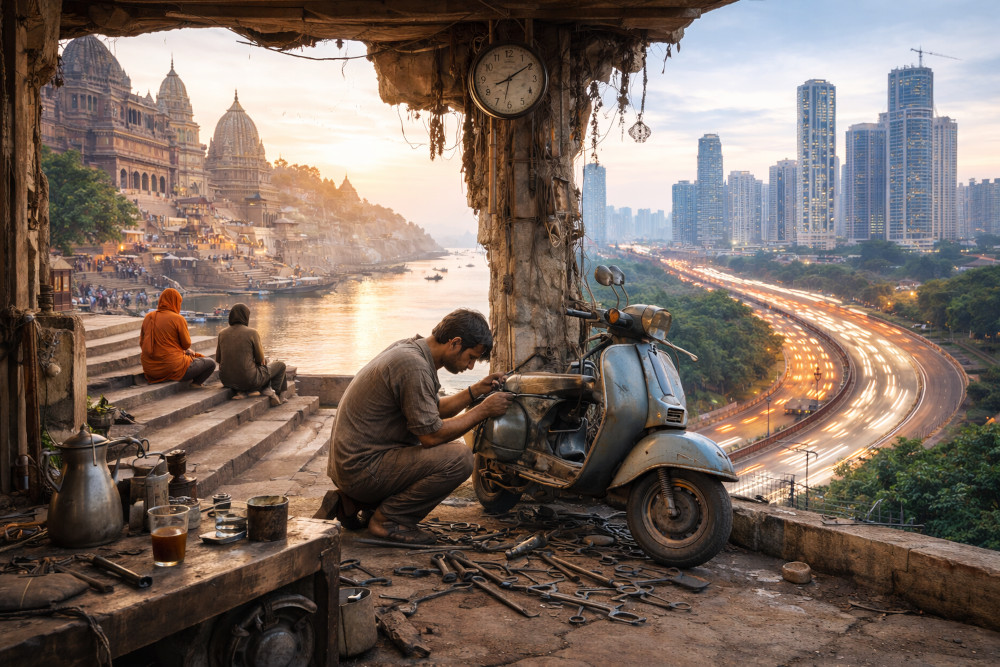
[Between improvisation and eternity lies India’s missing horizon: the medium term.]
Benaras—Varanasi, Kashi—is an instructive place to observe how India really works.
Here is a city that promises liberation from the cycle of birth and rebirth, a place where people come seeking karmic redemption accumulated over many lifetimes. And yet everyone—pilgrims and priests alike—also understands, quite intuitively, the practical mechanics of getting ahead. Paying a panda a little extra for faster darshan at the Kashi Vishwanath temple is not an aberration; it is routine. (Full disclosure: I did it too.)
In Benaras, the sacred and the expedient coexist without discomfort. So do beauty and disorder, devotion and improvisation, eternity and urgency. The city does not experience these as contradictions. It simply absorbs them.
And that, perhaps, is precisely why it offers such a useful lens on the Indian condition.
Because beneath its outward paradox lies a deeper one—one that may help explain why we struggle to plan effectively even for the next decade, let alone the next generation.
The Missing Middle
Instant gratification is often associated with underdeveloped economies, or societies without a deep sense of history or belonging. India, however, is neither. Ours is a civilization steeped in time—mythological, historical, cosmic. We think comfortably in epochs and yugas, in karma accumulated across lifetimes.
And yet, when it comes to civic behaviour, governance, enterprise-building, or infrastructure, we often behave with startling short-termism. We cut corners for immediate personal benefit while simultaneously holding deeply fatalistic beliefs about destiny and cosmic order.
What’s missing is not patience per se—but respect for the medium term.
We oscillate between two extremes:
-
Immediate payoff (Abhi ka kaam nikaalo)
-
Infinite patience (Uparwala dekh lega… agle janam mein sudhar jaayega)
The ten-to-twenty-year horizon—the space where institutions are built, cities planned, and cultures sustained—barely exists in our collective imagination.
Infrastructure as Cultural Behaviour
Mumbai illustrates this vividly.
Much of South Mumbai’s infrastructure—the coastal road, metro alignments, traffic rationalization—draws from studies and planning exercises dating back decades. The irony is that by the time some of this infrastructure came online, a large share of the population had already moved northward, stretching deep into the western and central suburbs.
Those regions remain dramatically under-served: inadequate transport capacity, poor civic amenities, reactive planning. The mismatch is obvious in hindsight, but it was equally visible long ago.
Why were we unable to act sooner, or sequence development in a way that anticipated population movement?
This pattern repeats across sectors—urban planning, water management, education capacity, public health. We are rarely surprised by problems. We are simply late to act on what we already know.
One of the clearest institutional expressions of this missing middle is India’s system of city governance itself. Our cities generate the bulk of economic activity, yet municipal governments remain financially weak, politically constrained, and structurally incapable of long-term planning. Mayors have limited authority, city budgets are thin, and infrastructure is built through fragmented agencies rather than accountable urban institutions. The result is predictable: we respond to growth after it has already overwhelmed capacity, instead of shaping it in advance.
The medium term requires institutions that can hold a plan steady across decades. Our cities rarely have that.
Mythology, Fatalism, and Deferral
Part of the answer may lie in our cultural wiring.
Indian philosophical traditions offer profound comfort. The idea that moral balance will be restored over lifetimes can be deeply stabilizing for individuals.
But when applied—often subconsciously—to collective life, it can encourage deferral of responsibility.
Compare this with Confucian-influenced societies, where moral duty is anchored in discipline, order, and continuity within a single lifetime. The future is not metaphysical; it is administrative.
Indian culture, by contrast, often reconciles chaos in the present with faith in eventual cosmic justice. The result is a tolerance for disorder combined with extraordinary ingenuity in navigating it.
This is not a moral failure. It is a cultural pattern.
But it has consequences.
Why Campaigns Aren’t Enough
India has not lacked for exhortations. From cleanliness drives to financial inclusion to digitization, governments have repeatedly attempted to change behaviour through campaigns.
Yet cultural change does not happen through slogans alone. It requires a deeper reorientation of what a society chooses to respect.
Clean streets, functional footpaths, enforceable rules, boring-but-reliable systems—these require citizens to value outcomes that are neither instant nor transcendent.
They require respect for the middle horizon: not the immediate fix, not the cosmic consolation, but the slow accumulation of trust in institutions.
The Case for Cultural Leadership
Large national ambitions—whether framed as development targets or civilizational resurgence—will only succeed if accompanied by a narrative that revalues the medium term.
Building research capability, world-class infrastructure, or resilient institutions requires a willingness to invest today for benefits that may not be visible immediately, but will become visible within our own lifetimes.
The future cannot remain either an emergency or a metaphysical abstraction. It has to become something we take
responsibility for, step by step, year by year.
Reclaiming the Middle
Perhaps the real Indian dilemma is not that we think too short-term or too long-term.
It is that we skip the space in between.
Until we learn to inhabit that middle—to plan, execute, and take collective responsibility for outcomes that mature within a decade or two—we will continue to oscillate between jugaad and destiny.
Benaras will remain what it is: spiritually magnificent, materially compromised, and entirely comfortable with both.
And yet Benaras has always lived in many times at once. It teaches people to look beyond the immediate, and it teaches them how to survive the immediate.
Perhaps the task of modern India is to add one more horizon: the disciplined middle ground where cities are planned, institutions are strengthened, and collective life becomes more reliable—not instantly, not in some distant metaphysical future, but within a generation.
Benaras is comfortable with paradox. The hope is that India can become comfortable with progress of the slow, steady kind.