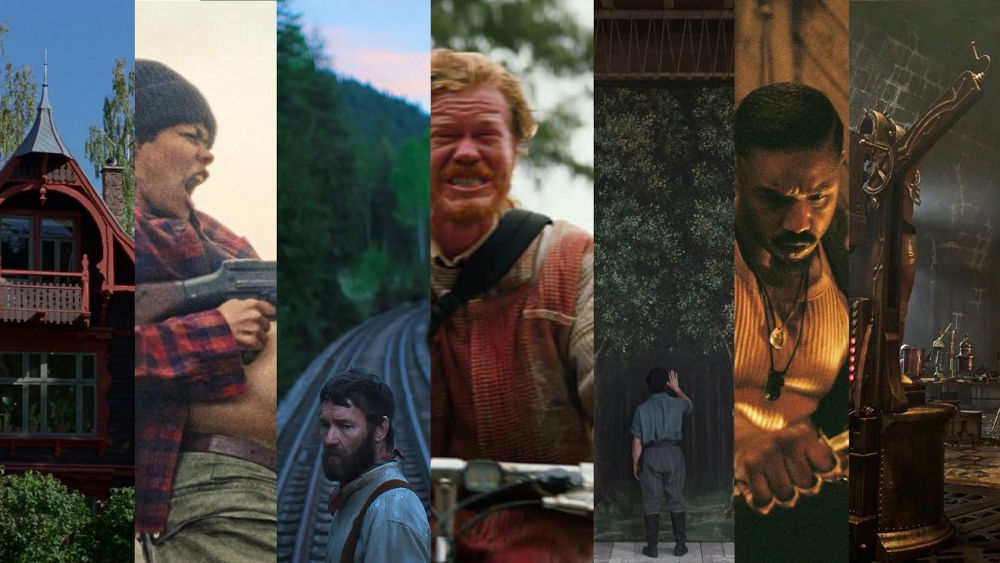
Cultural movements are messy things, and a handful of Oscar nominees hardly make a statistical sample. But this year’s films suggest an industry moving in extremes—of pacing, budgets, and creative control.
Four patterns stand out this year: streaming studios learning the awards game; films operating at two radically different speeds; big budgets backing strange ideas; and several nominees built almost entirely around performances.
Rise of the Streaming Gods
Despite earlier resistance from the Academy, the big streamers now know exactly how to play the awards game. Keep the film in theatres just long enough to qualify—and let the prestige rub off on the platform.
Frankenstein and Train Dreams are children of Netflix, who just kept them in theatres long enough to qualify for awards. More carefree with their pursestrings was Apple, as they still seek legitimacy. Giving F1: The Movie a generous theatrical release with a full six months, they not only recouped much of their costs, they also used it as marketing for their platform.
The Two Speeds of Cinema
More insidious and perhaps more important than this is how the velocity of films is responding to the rise of streaming.
If the average audience member has a steady binge appetite of fast-cut TV shows where cliffhangers adorn the ending of every scene, movies must respond in kind. This leads to two distinctly different camps that our nominated films operate in. Pacing is the most obvious pattern among the nominees. This year’s films seem to exist at two radically different speeds.
The films this year are either tightly paced, glued to the screen, or operate at a meditative crawl.
Let us first inspect the films that practically hum with kinetic energy.
Ryan Coogler’s Sinners might be the most audacious pitch Hollywood has greenlit in years. Imagine telling a studio something like: ‘I want to make Cowboys vs Aliens in a musical with black people.’ Somehow Coogler pulls it off. This genre-bending film is a period drama for most of its run time.
[Sinners: Ryan Coogler’s film moves effortlessly between intimate character moments and explosive spectacle]
Coogler moves effortlessly between intimate character moments and explosive spectacle, occasionally bringing the entire film to a halt for musical numbers that feel like cinematic sorcery.
Then there’s Yorgos Lanthimos’s delightfully unhinged Bugonia. Two conspiracy theorists kidnap a tech CEO believing she’s an alien destroying the Earth’s bees. The film swings wildly between genres, while its score barrels forward like a runaway orchestra.
And at the peak of this hyperactive energy sits One Battle After Another, Paul Thomas Anderson’s maximalist masterpiece and the overwhelming favourite to win Best Picture. The film feels like a relentless ninety-minute thrill ride despite running more than twice that long. Johnny Greenwood’s avant-garde score drives the film forward with manic energy while Anderson lets his more experienced actors roam gloriously off-leash.
At the opposite end of the spectrum are films that take their time—sometimes a lot of it. They seem to take the view that short attention spans must be combatted with slow, resplendent, sun-speckled shots to savour the emotion of the film.
Train Dreams may be the most meditative film in the lineup. Joel Edgerton plays a quiet labourer building railways in 19th-century America. The film moves slowly, but its cinematography is so lush that even chopping trees becomes hypnotic. The film is about tragedy, and more importantly acceptance.
Hamnet, directed by Chloé Zhao, tells the story of Shakespeare’s family tragedy through the eyes of Agnes Hathaway, William Shakespeare’s wife. The dialogue occasionally grates—it wanders into phrases that feel suspiciously modern for the 16th century. (I winced at ‘Hello’ for greeting, and the egregious use of ‘okay’.) But this has to do with Zhao’s improvisational approach. She uses body work and dream work to get actors into a moment that allows them to explore emotions deeply. And it really works, especially in the second half of the film. The film (though ponderous) is heartbreaking.
And then there’s the Norwegian film Sentimental Value, one of the most quietly devastating films of the year. Rather than building a plot and filling it with characters, the film simply lets us spend time with a fractured family whose emotional inheritance stretches across generations. The result feels less like a scripted drama and more like watching real lives unfold. It’s a beautiful film, with subtle craft and insight into the human soul.
Big Budgets, Strange Ideas
Another striking trend this year is how many large-scale films are unapologetically weird.
Studios want to win Oscars. And the film directors seem to have realised this. This means that directors like Guillermo Del Toro (Frankenstein - $120 mn), Paul Thomas Anderson (One Battle After Another - $175mn) and Ryan Coogler (Sinners - $100 mn), can have access to healthy budgets.
In previous years, superhero blockbuster movies absorbed the big budgets (Avengers Endgame - $400 mn), leaving tiny independent budgets directors with a distinctive vision. In the same year of Avengers Endgame, Roma directed by Alfonso Cuaron got $19 mn and the Spike Lee-directed BlacKKKlansman got $15 mn. Today the comic blockbusters aren’t recouping and so their budgets (Superman - $225mn, Thunderbolts - $180mn) have been put to good use elsewhere. Even more impressive is that while Marvel directors are bogged down with notes and committee members, it seems like all our auteur directors got a free hand. Not all auteurs are equally bankable, but there’s no doubt in my mind the three mentioned got lucky with timing.
Guillermo del Toro’s long-dreamed-of Frankenstein is the clearest example. It is a meditation on humanity, loneliness and what it means to be a monster.
[Frankenstein: A meditation on loneliness and what it means to be a monster]
Unconstrained by film length and budgets, Del Toro might well have chased every reference that AI and the internet could have thrown. He adapts the structure from Mary Shelley’s original story, taking us to the Arctic and then shifts to Victor’s perspective and then the monster’s perspective. He also takes us back into Victor’s childhood, and gives the monster more elegance and depth.
Oscar Isaac’s Victor Frankenstein is brilliant and obsessive, but the emotional core of the film comes from Jacob Elordi’s creature, beautifully told in Elordi’s sensitive balletic movements. The physical performance conveys a surprising tenderness.
Next comes the slick yet tempestuous filmmaking of Yorgos Lanthamos with the bazonkers genre-swinging Bugonia. The film is just plain weird, and we love it.
Two mangy conspiracy theorists kidnap an uber rich company executive and are convinced she’s an alien screwing up the bees on Earth. Oddly enough they are more human and relatable than her (like all good CEOs, she borders on sociopathic). If the film is bonkers, the score is absolutely off the rails (in the best way).
One Battle After Another went into production without the ending being written. I can’t understand how the film might have been pitched. Several scenes, just written on paper, shouldn’t work. And yet the whole thing wraps us up in and takes us on an electrifying ride that feels like a tight 90 minutes, when in reality the run time is more than double that.
These are actually experimental films. But audiences are flocking to the theatre and producers are getting more and more comfortable with them.
Even F1: The Movie, which sits near the bottom of the Best Picture race and the most conventional nominee, is technically dazzling. In addition it sits at a whopping budget of between $200-300 mn, far outscaling everything but Avatar.
It’s got true star power, with Brad Pitt carrying the movie, not with acting, but his charisma.
The plot is predictable, but the filmmaking is extraordinary. It gets into the grind of F1 strategy and makes it accessible. If the story occasionally feels like wish-fulfilment for Formula One strategists, the filmmaking more than compensates. But the true stars of the film are the editors, who had to go through realms of real race footage, and craft stories that made each race unique and interesting.
Films Built Around Performances
Several nominees also function primarily as acting showcases.
Marty Supreme stars Timothée Chalamet as a fictional ping-pong prodigy. The script has no sub-plot really to cut away to, so we follow his journey of ups and downs. It’s not Chalamet’s best performance (That would be Call Me by Your Name), but Chalamet’s portrayal of an irascible self-centred brat while simultaneously having audiences root for him, will lead to a Best Actor statue for him.
It may be the most divisive film of the year. Its frenetic pacing and erratic storytelling will either exhilarate you or exhaust you. I personally found it closer to the latter.
Meanwhile Hamnet clearly offers Jesse Buckley the kind of emotionally explosive scenes that Oscar campaigns are built around. She is extraordinary, particularly in the second half of the film.
But the most remarkable performance of the year might belong to Rose Byrne in If I Had Legs I Would Kick You. Byrne spends the entire film quietly unraveling under the pressure of everyday life, delivering a masterclass in suppressed despair.
The Film to Beat
Much of this ultimately converges in One Battle After Another.
[One Battle After Another: A film brimming with hyperactive energy]
Paul Thomas Anderson has made a film that feels experimental, political, technically dazzling, and wildly entertaining all at once. Scenes that look absurd on paper somehow become electrifying on screen.
Leonardo DiCaprio and Benicio del Toro chew the scenery with enthusiasm, but it’s Sean Penn—playing a grotesque white supremacist villain—who steals the show. Somehow Penn manages to wring an unsettling amount of audience empathy from a character who should be utterly despicable. And in a short but pivotal part, Teyana Taylor steals scenes from actors with twice her experience.
Add Radiohead guitarist Johnny Greenwood’s ferocious score and Anderson’s fearless direction, and you have a film that feels like a controlled explosion.
If this year’s Oscars are a study in extremes—speed and stillness, spectacle and strangeness—One Battle After Another somehow manages to contain all of them at once.
Unless the Academy does something deeply strange, this controlled explosion is taking home Best Picture, Best Director and then some.
In Conclusion
The takeaway from this year’s Oscars may simply be that cinema is now operating at the edges—faster, stranger, and more director-driven than it has been in years. Whether that balance holds is another question. But for now, the industry seems comfortable letting filmmakers push in opposite directions at once.
In case you want spoiler-free reviews of all the movies at the Oscars, and decide what to watch next, click here. I will warn you of the length of the article. In case you want a quick overview of who will win what, click here.