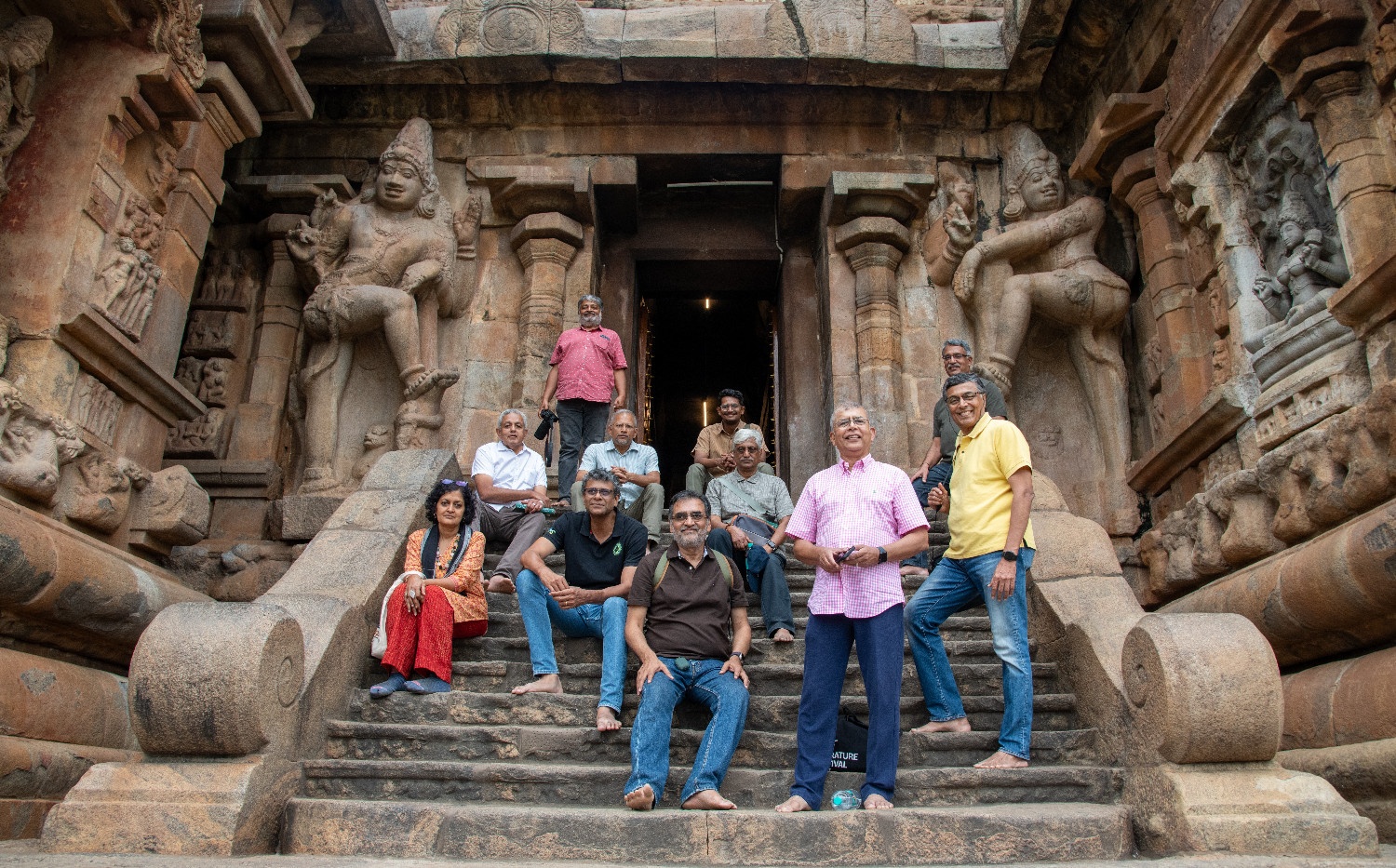
[On the steps of Rajaraja Chola’s dream in stone: Brihadishwara temple (the Big Temple), Thanjavur.]
Before this odyssey, my knowledge of the Cholas was embarrassingly thin. I knew they were important Tamil kings. And, thanks to my fondness for street food, I knew they paired well with bhatura.
What I did not expect was how companionable this journey would be. Old friends from a previous odyssey and new ones, all eager for an enriching experience. Diverse opinions. Cool weather. Beautiful landscapes. Smooth roads. Too much food. Too much filter coffee.
I was surprised by how quickly this trip stopped being about monuments and became one about systems.
We were privileged to have Anirudh Kanisetti and Meera Iyer as our co-travellers and intellectual anchors. Anirudh is an engineer-turned-historian and the author of Lords of Earth & Sea. Meera is a historian and co-founder of Carnelian Heritage Tours. They set the tone early. No reverence without examination. No romance without context. What followed was a journey of shared inquiry, fuelled by arguments, laughter, and prodigious banana-leaf meals.
Four days in the Kaveri delta cured my ignorance not through dates or dynasties, but through four elements: water, stone, metal, and trade.
[Scroll / swipe above to walk the full journey. For a full-screen experience, click here. ]
Empires Begin with Water, Not Weapons
The Chola story does not begin with armies. It begins with a river being coaxed to behave.
Our first halt was at the Anaicut dam near Tiruchirappalli, built nearly two thousand years ago by Karikala Chola. One of the world’s oldest functioning masonry dams, it looks disarmingly plain. In reality, it is a feat of hydraulic design and engineering. Its impact was revolutionary.
Earlier, the delta was hostage to floods and uncertainty. Now trace the logic forward: a diverted river, managed flow, predictable harvests, surplus grain, taxable land. Geography offered leverage, and the Cholas learned how to use it.
Art as Statecraft
We reached the Brihadishwara temple (or the Big Temple, as it's commonly known) at Thanjavur as twilight softened the granite. The great Vimana rose like a frozen flame. Rajaraja’s dream in stone, standing proud and utterly indifferent to our mortal awe.
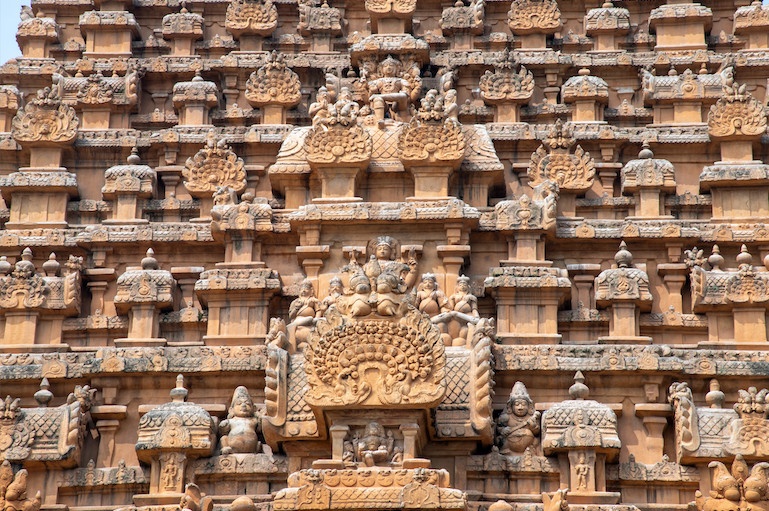
[Sculptures on the great Vimana of Brihadishwara temple]
Beyond its scale (66 metres high, nearly 49,000 tonnes of granite), what mattered was organisation. This was not merely Shiva’s house; it was a declaration: We are here. We are legitimate. We are eternal.
Inscriptions reveal a thriving ecosystem: priests, dancers, accountants, guards, musicians, artisans. Grain flowed in. Grants flowed out. Ritual and revenue were inseparable. Aesthetic splendour served administrative purpose.
The following morning, we were granted rare access to the Vimana’s interior. Steep spiral stairs. Narrow, dark passages. An inner pyramid of perfectly stacked, corbelled chambers above the sanctum. Chants reverberated endlessly. Ancient murals lingered in half-light. Strictly no photographs allowed. Naturally, we took a few.
Outside, Anirudh dismantled another popular myth. The idea of a standing “Chola navy” and heroic overseas conquest, he argued, is overstated. Maritime expeditions were driven largely by trade, by merchant guilds rather than imperial armadas.
Five Temples, Five Ideas
Anirudh and Meera had curated not just temples, but a sequence.
Brihadishwara, Thanjavur
A proclamation in stone. Clean geometry. Sparse ornamentation. No mortar, no glue, only precisely stacked granite. Completed around 1010 CE, its walls carry the 108 karanas of Bharatanatyam. Majestic and masculine, designed to be seen from afar. Shiva here is the cosmic pillar, the axis of the universe.
Nageshwaraswamy, Kumbakonam
Quieter. Older. Ninth-century masonry. On a precise day each year, during Chithirai (April–May), sunlight enters the sanctum. These architects were engineers, astronomers, and aesthetes at once. Shiva here embodies cycles: life, death, renewal.
Airavateshwara, Darasuram
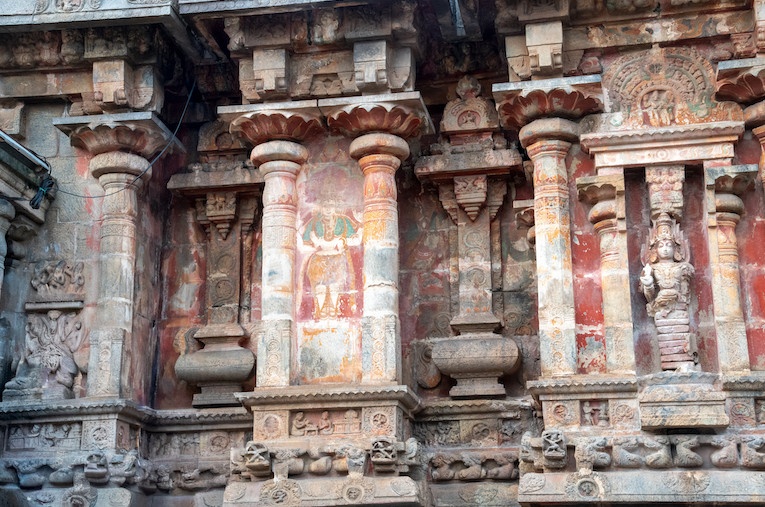
[Gods, dancers, demons on the pillars of Airavateshwara temple]
Mischief and delight in stone. Built in the twelfth century, its chariot-like mandapam predates Konark. Wheels roll in granite. Pillars teem with gods, dancers, demons. Less vertical ambition, more sculptural joy. Shiva here grants grace and animates the world.
Nataraja, Chidambaram
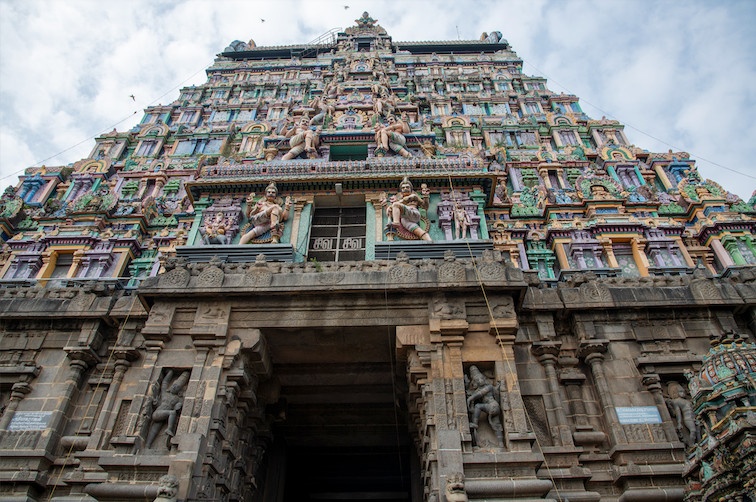
[The Nataraja temple gopuram]
The frame expands dramatically. Vast courtyards, processional pathways, pools, gardens. Enlarged five-fold under Kulothunga I, the complex doubled as a cultural hub, even receiving a jewel from the Khmer king of Angkor. Shiva dances inside the Chid-Ambaram, the Sky of Consciousness, form rising and dissolving in infinite space.
Gangaikonda Cholapuram
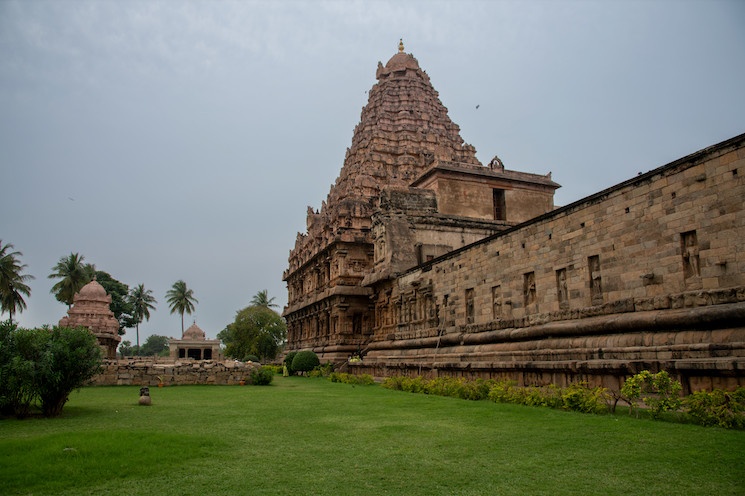
[The Shiva temple at Gangaikonda Cholapuram]
Commissioned by Rajendra I, ambition reborn in a new capital. Softer lines, broader curves, a more “feminine” expression of power. The Ganga brought south. Here, Shiva bestows prosperity and guardianship. The city remained the seat of Chola power for nearly two centuries.
Together, these temples articulate a single cosmology: Shiva as axis and rhythm; the king as earthly partner; architecture as a microcosm of the cosmos. Each temple emphasises a different facet of divinity: power, time, grace, consciousness, benevolence.
Queens, Not Just Kings
Long bus rides encourage argument and unsettle tidy narratives. Empire histories celebrate warrior-kings. Chola history resists that simplification.
Queens mattered.
Sembiyan Mahadevi came up often. Widowed young, she did not retreat into obscurity. Through temple patronage, she emerged as a power centre, shaping aesthetics and exercising authority without banners or battle cries. She is often credited with fixing the Nataraja form of Shiva at the heart of Chola devotion, a form that has since been refined, replicated, and carried across the world. Other royal women were similarly active in endowments and cultural policy.
Men Creating Gods
If temples project authority, bronzes humanise it.
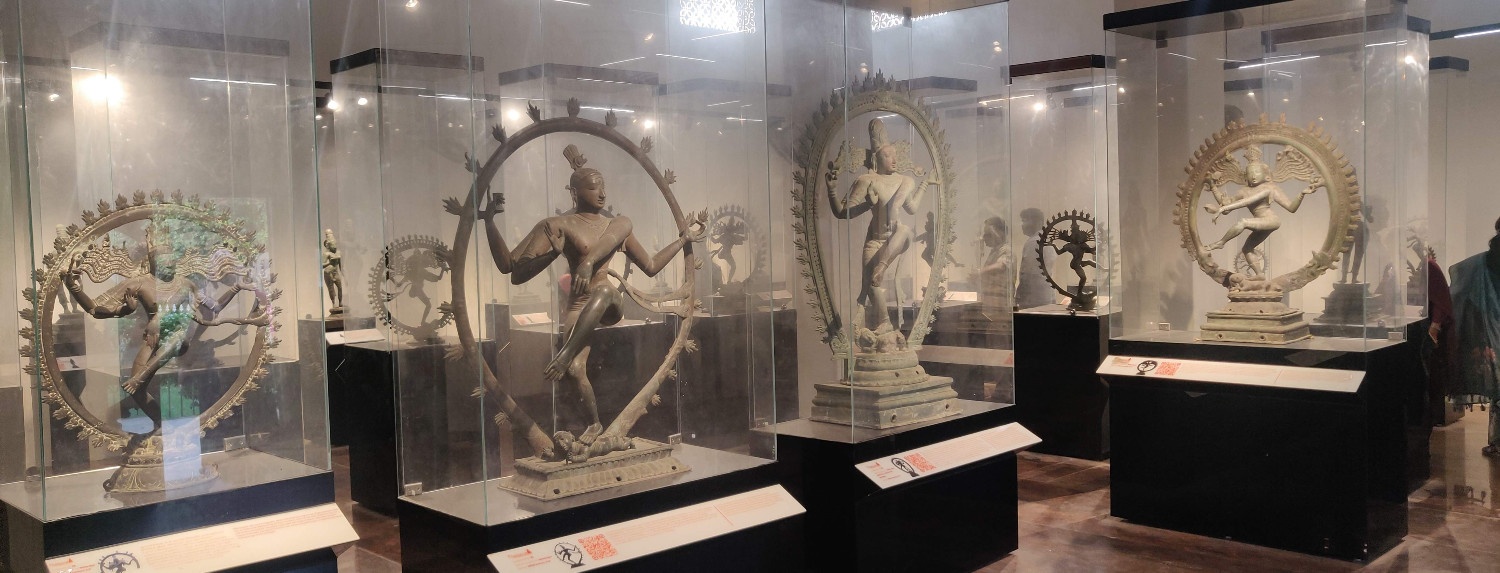
[Chola bronzes at the Thanjavur Palace museum]
At the Thanjavur Palace museum, the Chola bronzes stopped us cold. Metal breathes and glows. Serene faces. Impossibly graceful bodies. We lingered far longer than planned.
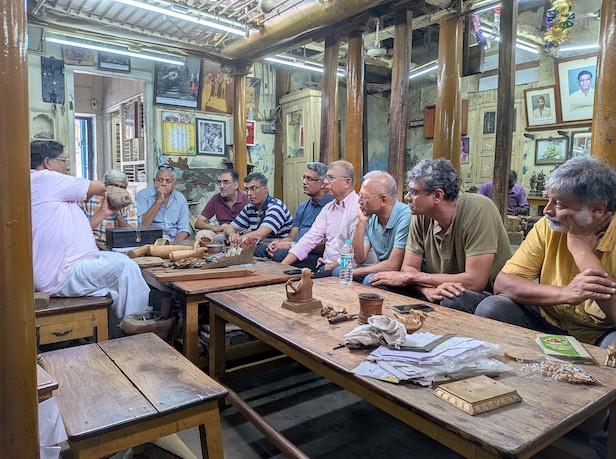
[At a bronze workshop]
Near Kumbakonam, we watched bronzes being born. Wax, fire, patience, devotion. Artisans from a lineage stretching back over thirty generations still follow traditional methods. No shortcuts. No manuals. Shiva dancing. Shiva meditating. Vishnu reclining. Lakshmi smiling.
Anirudh spoke of processions: bronze deities leaving the sanctum, carried through streets and fields, blessing people where they lived. Power, made portable.
The Joys and Frictions of Journeying Together
Between temples, the bus became a debating chamber. History’s purpose. Aesthetics versus utility. Legacy versus vanity. Were Mayawati’s parks or Trump’s ballrooms so different from Rajaraja’s ambitions? Opinions collided. Laughter followed. Someone, inevitably, demanded coffee.
At one highway stop, we finally solved the “Degree Coffee” mystery. Degree refers to milk quality, temperature, and thickness. Of course.
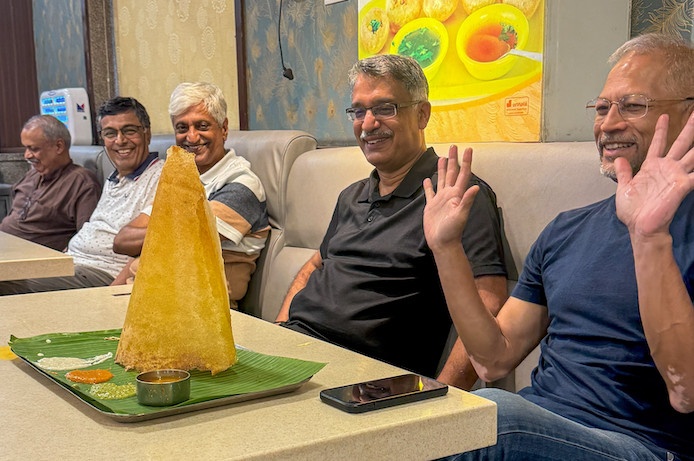
[Food haven!]
Food was a highlight too: Murugan Idli in Krishnagiri (twice), Chellammal’s Manpaanai Samayal with its wood-fired abundance, banana leaves sagging under generosity. In Kumbakonam, a stern warning greeted us: “Puuuure veg saar. No eggs.” We survived. Some of us flirted with sambhar fatigue.
We made small but meaningful detours. Briefly ducking into the tiny home of the mathematical genius S. Ramanujan, a reminder that brilliance needs no granite grandeur. Exploring the palace excavations at Ariyur, where amid trenches and pottery shards, history felt immediate, with dirt under its nails.
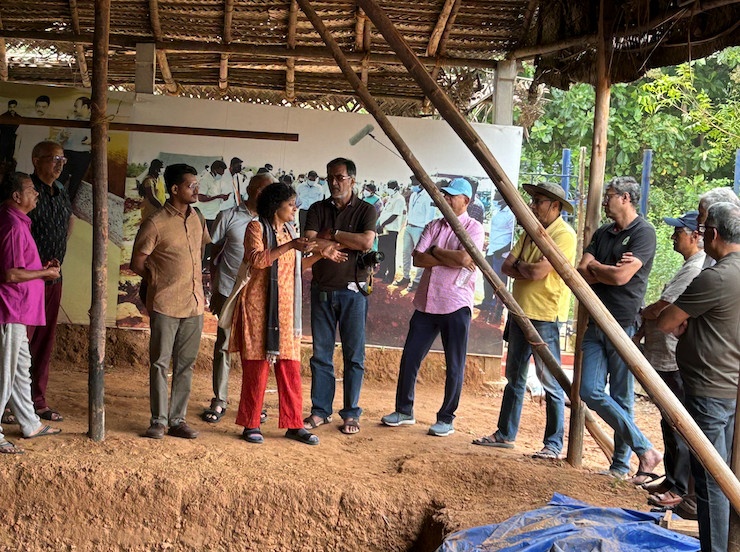
[Exploring the palace excavations at Ariyur]
Evenings slowed. Drinks by the Vennar river. One night, a hotel conference room doubled as a makeshift tavern. We struggled for beer, and struggled more for a corkscrew. Travel, like history, rewards persistence.
The Work of Reflection and Remembrance
The shadow of Ponniyin Selvan followed us like a friendly ghost. Magnificent cinema. In reality, Anirudh reminded us, the Cholas were darker and more complicated. Their inscriptions record burning cities, captured women, and plundered rivals. None of this fits neatly into a popular narrative.
Our final evening conversation ranged widely. History, politics, preservation. Whose history is worth keeping? Who decides? What do we question? What do we let go? Good questions. No easy answers.
Rise in Stone, Decline in Ledgers
Empires rise on rivers, expand with trade, immortalise themselves in stone, and fade when economics erodes ambition.
Chola success carried costs. Temple grants shrank taxable land. Campaigns drained treasuries. Rivals rose. Administrative flexibility vanished.
There was no sudden collapse. Only steady erosion.
What Remains
Residue.
Temples still breathe. Rituals persist. Cuisine, language, and craft carry memory forward.
Walking barefoot through Chola temples, gazing at their bronzes, history felt both past and present. Ancient India engineered rivers, choreographed sunlight, aligned stone to the cosmos. We struggle with Wi-Fi, traffic, and crumbling flyovers.
This odyssey was not about sightseeing. It was about seeing.
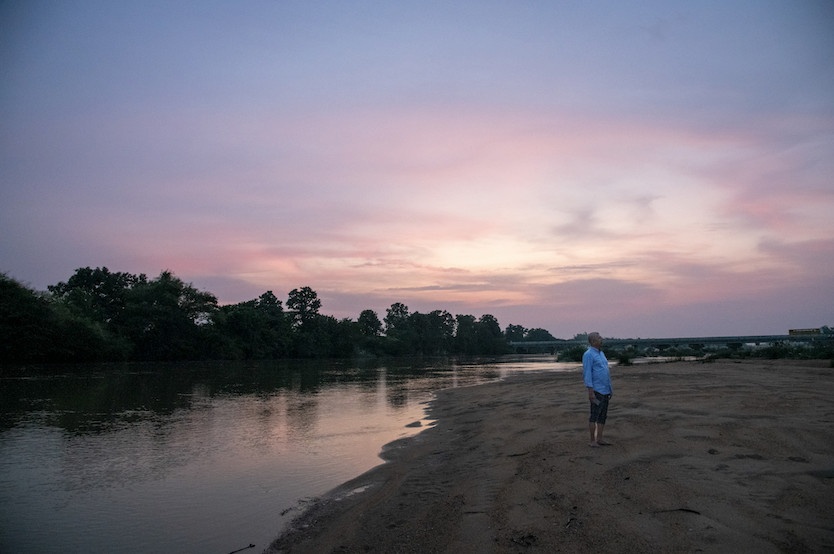
[Sunset on the Vennar River, a tributary of the Kaveri]
Civilisations do not vanish; they disperse into stone, soil, ritual, and metal. And sometimes into a stranger at a highway cafe, telling you to slow down your coffee.
The Kaveri moves on to the sea.
The Kaveri is always there.
A Quick Guide to the Chola Empire (9th–13th century CE)
The Cholas: A Tamil dynasty that rose from minor chieftains to become one of South Asia’s most influential powers.Heartland: The fertile Kaveri delta, covering today’s Thanjavur, Kumbakonam, and surrounding regions.
Strengths: Irrigation and agrarian administration; monumental temple architecture; masterful bronze casting; long-distance trade across the Bay of Bengal; sophisticated merchant-guild networks.
Notable rulers: Rajaraja I (Brihadishwara temple) and Rajendra I (maritime expeditions to Southeast Asia).
Sources of power: Control over land and water, temple-centred institutions, a strong tax base, and maritime trade.
Decline (13th century CE): Erosion of state revenues due to extensive temple grants and costly campaigns; rise of rival powers and regional warlords; shifting trade routes.
If You Go: Helpful Tips
Best time: November to March. Summers can be punishing.Slow the pace: Two major temples a day is plenty. These sites reward unhurried attention.
Get a good guide: To understand the bigger picture, not just see the structures.
Footwear matters: Expect to walk barefoot on stone and gravel. Slip-on sandals and a small cloth bag help.
Mind temple rhythms: Early mornings and late afternoons are cooler, calmer, and more contemplative.