·FF Life
The Happiness We Keep Postponing
A reflection on joy, and why the ordinary day may be enough
HC

Haresh Chawla
Investor | Entrepreneur
What the return of the Piprahwa relics asks of us—about restraint, remembrance, and how we practice attention today
"The Light and the Lotus" delivers a compelling call for business leaders to cultivate attention, restraint, and deep cultural insight. Exploring an exhibition of ancient Buddhist relics, the article underscores the profound value of focused presence amidst modern distractions. It vividly illustrates how historical traditions manifest as vibrant, lived practices across diverse cultures, offering crucial lessons in global cultural intelligence. For leaders navigating international landscapes, understanding these deep-seated cultural nuances beyond transactional exchanges fosters stronger relationships and reveals innovative pathways. The piece implicitly encourages reflecting on an organization's core values and how their clarity and continuity, like ancient wisdom enduring, forge resilient leadership.

By Jay Vikram Bakshi, Deven Pabaru and Vanashree Ghate
The directions are clear, but the path winding.
Adjacent to the Qutab Golf Course in Saket is the Rai Pithora Cultural Complex. A statue of Prithviraj Chauhan astride a horse, strung bow held aloft, marks the steps beyond a lit fountain. Turn right, follow the black cobblestone path past the metal detector, the X-ray scanner, the familiar pat-down by security—and you enter a different kind of space.
The replica of the Sanchi stupa gateway beckons. At its centre sits a dark stone Buddha in lotus pose, hands held in quiet balance. A second-century sculpture from the Kushan period, on loan from the Indian Museum in Kolkata, it feels less like an object on display than a presence establishing the rhythm of the place.
Inside, arrows on the floor guide movement. A volunteer hands over a brochure. Visitors lean in to examine a small seal referencing the monastic community of Kapilavastu—now Piprahwa. And then, almost without noticing it, they begin to circle.
As one moves around the stupa at the centre, the instinct to circumambulate takes over. It feels like remembering something half-known. The galleries open into a world that existed two millennia ago, when the Buddha walked through Bodh Gaya, Sravasti, and Vaishali—and when his followers carried his ideas far beyond. Sculptures, paintings, and ritual objects trace that journey, from Gandhara through Central Asia and onward to East Asia.
You are not alone. A low chant—Buddham saranam gacchami—plays softly through the space. Around you are diplomats, scholars, students, monks in simple robes, and visitors in business suits taking quick photographs to send home. No one seems in a hurry.
What stays with you is not the centrepiece display or the archaeological model of Piprahwa, but a relief sculpture from fourth-century Gandhara. It shows monks gathered around the Buddha’s coffin, mourning his passing—the Mahaparinirvana. The figures are carved in grief, not reverence.
There is splendour here too—the craftsmanship of gold leaf and pigment. But what lingers are the hushed tones, the absorption on the faces of those who have travelled far to be here. For them, these relics are not history alone. They are reminders that someone once walked this path—and left behind a way of navigating the world.
A Return. A Reminder. by NS Ramnath, Founding Fuel
[Note: The deck has a documentary titled Bones of the Buddha. Watch the 2-minute video here if you had trouble accessing it inside the deck. Watch the full documentary here.]
For some visitors, the Saket exhibition opens a wider, more uncomfortable realisation. The story of Buddhism does not only travel outward from India; it also returns to us refracted through other cultures.
For one Indian business professional, that realisation arrived unexpectedly on recent work trips to Japan and Taiwan. In meetings with officials and business leaders, conversations moved beyond commerce into culture. Questions surfaced early: had he been to Bodh Gaya? Did he understand Buddhism—not as philosophy, but as lived practice?
In Japan, Buddhism appeared not as inherited identity but as everyday presence. Temples were woven into the fabric of cities. Ordinary people paused briefly—to bow, light incense, seek a blessing. These were not acts staged for visitors, but habits folded quietly into daily life.
What struck him most was not difference, but familiarity. Practices recognisable from India had survived abroad with clarity and continuity, even as they thinned or vanished at home. Across East and Southeast Asia, Bodh Gaya remains a destination of singular importance—a point of origin and pilgrimage.
The unease this produced was not religious, but civilisational. India, it seemed, had grown distant from one of its most influential inheritances.
It was on returning home that the Saket exhibition came into focus. The Piprahwa relics marked the closing of a long loop—from Kapilavastu to Bodh Gaya, outward across Asia, and now back again. Not as triumph, but as reminder.
What has returned to public view at Saket is often described, correctly, as the Piprahwa relics. But that description is too narrow. What is on display is not a single object or a coherent set of artefacts, but the residue of a long, interrupted journey—one that began in the late nineteenth century and has unfolded unevenly across institutions, borders, and belief systems.
The relics were unearthed in 1898 during excavations at Piprahwa, near what many scholars identify as the ancient Kapilavastu region, close to the Buddha’s birthplace. The discovery—bone fragments, reliquaries, inscriptions, and an extraordinary cache of gems—was immediately recognised as exceptional. Yet almost from that moment, the collection began to fragment. Some relics entered colonial museums. Others were distributed to Buddhist kingdoms and monastic centres across Asia. Still others remained in private hands, largely unseen.
For more than a century, the relics existed in this dispersed state—studied, venerated, debated, present everywhere and nowhere at once. They travelled quietly, shaped as much by imperial systems of custody as by religious traditions of circulation and sharing. What they did not do, for most people, was appear together.
The exhibition at Saket marks a rare moment of reunion. Not a permanent one, and not a complete one—but enough to register as a pause in a long dispersal. The emphasis here is not on recovery or reclamation, but on temporary gathering. The relics are presented without triumph, meant to be encountered, not possessed.
That distinction matters. These are not props in a civilisational victory lap. They are reminders of a teaching that resisted enclosure—ideas that spread not through conquest, but through translation; not through assertion, but through practice.
The return of the Piprahwa relics was not inevitable. For a brief but consequential moment, it appeared that part of this long-dispersed inheritance was about to slip further away—this time into the routines of the global art market.
In early 2025, it emerged that a substantial collection of the Piprahwa gems—nearly 1,800 pearls, rubies, sapphires, topaz, and patterned gold sheets—was scheduled to be auctioned by Sotheby’s in Hong Kong. The move prompted objections from Buddhist leaders and the Indian government and was eventually halted, as reported by BBC News.
Scholars and monastics questioned whether objects so closely associated with human remains—meant for veneration rather than exchange—could ever be treated as commodities. The seller was described as a custodian, not an owner. But if these relics form a shared inheritance for a global community of practitioners, who has the authority to decide their fate?
As objections mounted, the Indian government stepped in, exploring legal options and issuing careful communications. What followed was a layered negotiation, understated in tone but firm in intent: these were not artworks to be traded.
Return also required more than argument. It required someone willing to step in without claiming ownership, to absorb the financial cost, and to keep the relics outside the logic of the marketplace. It was here that philanthropy entered—not as patronage, but as facilitation.
The Godrej Industries Group, led in this effort by Pirojsha Godrej, executive vice chairman, agreed to acquire the relics and enable their return to India. The framing mattered: not corporate acquisition, but stewardship—an attempt to return them to a public, non-commercial context.
The significance of this episode lies less in its resolution than in the paradox it reveals: how does one safeguard, in the contemporary world, objects that belong to a tradition built on non-attachment? For a moment, diplomacy and philanthropy acted with restraint, even when the market offers no such instinct.
What followed the halting of the auction was not celebration, but something closer to relief. No one involved appeared eager to turn the episode into a story of victory. That restraint was telling.
The language around the return was careful. These were not artefacts being “recovered” or “reclaimed.” Nor was the episode framed as a correction of history, even though colonial excavation, custodianship, and long dispersal hovered in the background. Instead, the emphasis was on stewardship: enabling the relics to return to public view, briefly and provisionally, without asserting ownership or finality.
This distinction matters because it resists a familiar temptation. Repatriation is often cast as a moral endpoint—a restoration of rightful possession. The return of the Piprahwa relics points to a more complicated reality. These are objects associated with a tradition that resisted enclosure. The Buddha’s teachings emphasised impermanence and non-attachment; his remains, centuries later, have been handled by systems that rely on custody and control.
What unfolded instead was a quieter choreography. The Indian state acted through procedure rather than proclamation. Philanthropy intervened without demanding centre stage. The relics were returned not to vaults or private collections, but to a temporary exhibition space—accessible, open, explicitly time-bound. Nothing here pretended to permanence.
In that sense, the return functions less as a claim than as a gesture of restraint in a world that rewards accumulation. A gesture that acknowledges historical complexity without attempting to resolve it neatly, and leaves the meaning of the relics deliberately unfinished.
Seen this way, the repatriation does not close a chapter. Not ownership, but access. Not certainty, but care.
The gesture is modest. And precisely for that reason, it carries weight.
Inside the exhibition, no one explains what to do. There are no instructions, no curatorial voice telling the visitor how to approach what lies ahead. And yet, behaviour changes almost immediately.
People slow down. They stop cutting straight across the space and begin to move in arcs. Some circle once, then again, before realising what they are doing. Others pause longer than they intended. Phones remain in hands but are consulted less frequently. Attention settles.
The space itself does some of the teaching. The torana marks an entry not simply into a gallery, but into a different rhythm. The stupa form at the centre draws the body into circumambulation. The exhibition does not ask visitors to contemplate these forms intellectually. It lets them inhabit them.
This reflects a deeper logic of the Buddhist tradition itself. The Buddha did not teach through proclamation or authority. He taught through experience—inviting observation, repetition, and testing. Insight, in this view, emerges through practice.
Long before visitors encounter concepts such as impermanence or non-attachment, they have already participated in something akin to method. Movement replaces instruction. Attention does the work that explanation often cannot.
What is striking is how unforced this feels. There is no attempt to persuade or dramatise. The exhibition trusts the form to shape experience quietly, without insisting on interpretation.
For some visitors, the effect is disarming. The relics are not encountered as objects on display, but as a medium—one that collapses distance rather than invites contemplation from afar. The recognition that the Buddha, too, was once flesh and bone does not diminish the teaching; it sharpens it. Liberation feels less like abstraction and more like human possibility—approached through practice rather than reverence alone.
Only later does one recognise what has taken place. The exhibition does not explain Buddhism. It enacts it. And in doing so, it prepares the ground for an engagement that does not begin with belief, but with attention.
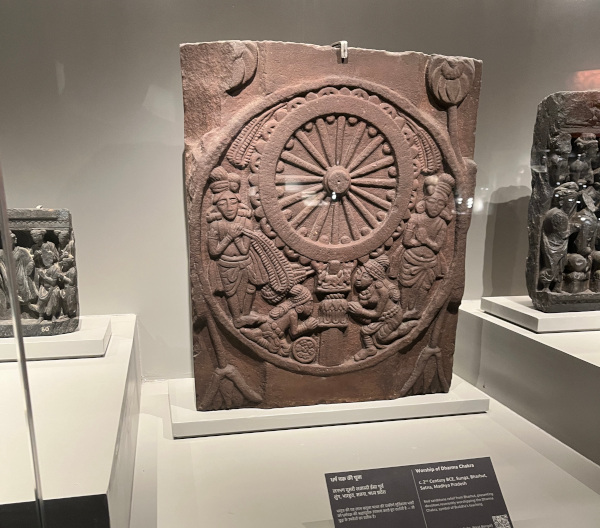
[Worship of Dharma Chakra, symbol of Buddha's teaching. Red sandstone relief from Bharhut, Madhya Pradesh. Image credit: Jay Vikram Bakshi]
From the beginning, the Buddha resisted being turned into an object of belief. When asked who he was—god, saint, celestial being—he declined each label. He described himself simply as awakened. Buddha was not a name, but a condition: one who had learned to see reality as it is.
That distinction mattered. The Buddha urged his followers not to accept his words out of reverence, but to test them through experience—“as a goldsmith tests gold.” He positioned himself not as a prophet or authority, but as a guide who had walked a path that others could walk too. His teaching, he insisted, was not doctrine, but method.
Seen in this light, the relics gathered at Saket do not function as proofs of divinity. They serve a quieter purpose. They remind us that awakening was realised by a human being—one made of flesh and bone—through sustained attention and ethical discipline. What they commemorate is not transcendence, but attainability.
This is why relics have carried such weight within Buddhist traditions across cultures. As Kaveri Gill, Senior Fellow at the Shiv Nadar Institute of Eminence, notes, the presence of relics could stand in for the Buddha’s physical presence—not as artefacts to be revered, but as living embodiments of a way of training the mind. Their relevance lies not in history alone, but in what they continue to demand: responsibility for one’s inner life, and the possibility of reducing suffering through practice.
What they leave us with is not belief, but obligation: if awakening was possible once, it must remain possible now.
If relics are reminders, they also pose a quieter, more demanding question: now what? What are we meant to do with them, beyond acknowledging their return or standing briefly in their presence? It is easy to speak of Buddhist wisdom—impermanence, interdependence, compassion—as ideas to admire. Much harder is the question of method: how these insights are practiced, with what intention, and how they shape the way we live.
In several Buddhist traditions, wisdom is never meant to function in isolation. Insight is incomplete unless it is embodied and lived. Compassion, in this understanding, is not a sentiment or a moral posture; it is a discipline—cultivated deliberately through attention and restraint, and expressed in how one responds to suffering in the world.
This shifts the emphasis away from belief and toward responsibility. The return of the relics is not an endpoint but an entry point. They can be museumised as heritage, or revered as sacred objects—but they can also serve as prompts for deeper reflection: about historical wrongs and repair, about personal and social predicaments, about the challenges that demand pause rather than reaction. They ask whether inner discipline can translate into outward responsibility, and whether wisdom can find expression in the relationships we build and the structures we inhabit.
This insistence on method over belief has remained remarkably consistent. In modern times, Tenzin Gyatso, His Holiness the 14th Dalai Lama, has often made the point plainly: if careful inquiry or scientific understanding were to disprove a Buddhist claim, Buddhism should accept that and revise its understanding. The emphasis, he suggests, is not on defending doctrine, but on reducing suffering through better knowledge of the mind.
Seen this way, the relics do not offer comfort or closure. They hold open a space of inquiry. In an age marked by polarisation and the flattening of the “other,” they quietly insist that insight must take the form of practice—that rehumanising those we are trained to dismiss begins not with grand moral claims, but with sustained attention. The question they leave us with is not what they mean, but what kinds of lives they ask us to practice, again and again.
It is tempting to explain the pull of the exhibition in terms of heritage or belief. But neither quite accounts for the atmosphere inside the space—the quiet attentiveness, the absence of urgency, the willingness to linger without being instructed. Something else seems to be at work.
The moment we inhabit is marked by acceleration. Attention is constantly fractured, pulled outward by alerts and feeds that reward reaction over reflection. Public life, too, feels increasingly polarised, compressed into positions that leave little room for ambiguity or patience. Even moral language can feel performative.
Against this backdrop, the exhibition offers a counter-experience. It does not argue or persuade. It creates conditions in which attention can settle—if only briefly. The visitor is not told what to think or feel. They are simply given the space to notice what happens when they slow down.
This restraint is central to why the exhibition resonates now. In a culture that equates visibility with value and assertion with conviction, the refusal to demand anything feels almost radical. Its power lies in what it withholds: spectacle, instruction, urgency. It trusts the visitor to arrive at meaning through experience rather than persuasion.
That trust mirrors a deeper feature of the Buddhist tradition itself. The Buddha did not promise resolution or comfort. He offered an invitation to observe and test insight against lived reality.
This may explain why visitors from vastly different backgrounds—diplomats, students, monks, professionals—find themselves sharing the same quiet. The exhibition does not flatten difference, but it suspends hierarchy. Everyone enters on equal terms, subject to the same slowing of pace.
In this sense, the exhibition functions less as a cultural event and more as a civic one. It quietly restores capacities that feel under strain today: the ability to pause before reacting, to sit with discomfort without immediately resolving it, to recognise interdependence without turning it into slogan.
These are not spiritual luxuries. They are practical skills for living together in a crowded, contested world. The exhibition does not claim to repair their absence. It simply makes it visible.
[By NS Ramnath]
The exhibition will close. The relics will move again, returning to their separate custodial lives in museums and repositories. The temporary reunion at Saket was never meant to last, and nothing in the space pretends otherwise. Impermanence here is part of the design.
That, too, is faithful to the tradition the relics point toward. Buddhism has never promised permanence—of objects, of insight, or of understanding. What it offers instead is a way of paying attention to what passes, without clinging to it or turning it into possession.
Seen in that light, the question the exhibition leaves behind is not whether the relics should remain together, or even where they belong. It is quieter, and more unsettling: what does one do after the encounter ends? What carries forward once the space empties and ordinary life resumes?
The relics do not ask to be admired indefinitely. They do not offer answers to be memorised or beliefs to be affirmed. They function as reminders—brief, fragile prompts that point back toward practice: toward the discipline of noticing how one responds to the world, and to others, when no one is watching.
If there is a residue that lingers, it is not reverence but recognition. A recognition that wisdom does not arrive fully formed, and compassion does not sustain itself without effort. That restraint, patience, and care are not inherited traits but cultivated ones—relearned, again and again, in the ordinary conditions of life.
In this sense, the exhibition does not conclude anything. It offers a recalibration in a culture that rarely slows long enough to ask what it is accumulating, and why. What remains, then, is not the relics themselves, but the question they quietly insist upon: how will we live, once the reminder has passed?
The answer, as the Buddha himself suggested, is not to be found in the object, but in the way one walks away from it.
(Additional reporting by Akashleena Chakrabarti and Aayush Soni)
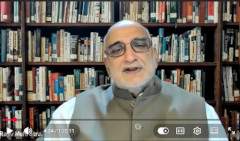
Rajiv Mehrotra, Secretary & Trustee of the Foundation for Universal Responsibility of HH The Dalai Lama, established with the proceeds of the Nobel Peace Prize, reflects on Buddhism as a lived path—less a belief system than a method of attention, inquiry, and practice—in The Way of the Buddha. The talk complements this essay’s focus on experience over doctrine.
Board Adviser and Entrepreneurial Mentor
Jay Vikram Bakshi works at the intersection of evolving technologies and social development. Jay is a proponent of federated AI architecture for India’s frugal development. With a background in media, telecom, digital marketing and CSR, Jay is an advisor with CII Foundation, mentor at AIC-NMIMS, and Founder at Digiqom. He is a former journalist who also works with the community by helping build libraries in rural India.
FF Insights: Sharpen your edge, Monday–Friday.
FF Life: Culture, ideas and perspectives you won't find elsewhere — Saturday.

Founding Fuel is sustained by readers who value depth, context, and independent thinking.
If this essay helped you think more clearly, you may choose to support our work.

Founding Fuel is sustained by readers who value depth, context, and independent thinking.
If this essay helped you think more clearly, you may choose to support our work.
A reflection on joy, and why the ordinary day may be enough
Haresh Chawla
Investor | Entrepreneur
A reflection on joy, and why the ordinary day may be enough
Investor | Entrepreneur

An exploration on the art of Kolkata during Durga Puja

Ronaan Roy
Former Deputy General Manager | Mahindra
An exploration on the art of Kolkata during Durga Puja
Former Deputy General Manager | Mahindra

11 stories that asked us to slow down, look closer, and feel more deeply

Founding Fuel
11 stories that asked us to slow down, look closer, and feel more deeply
Dive into other themes from our network.