
Attraversiamo: Crossing Over in Italy
A journey through Pompeii, Tuscany, Florence and Rome becomes a meditation on art, memory, and the fragile permanence of human endeavour
27 March 2026· 15 min read
TL;DR
This evocative Italian journey transcends a mere holiday, becoming a profound meditation on art, memory, and the delicate permanence of human endeavour. The author embarks on a spontaneous adventure. In Pompeii, the narrative poignantly captures life abruptly frozen, highlighting existence's fragility against Mount Vesuvius. The journey then shifts to the lighter, gravity-defying beauty of the Amalfi Coast, celebrating simple, perfect moments. It then moves to Florence, the cradle of Renaissance, and to Rome. This escapade beautifully intertwines historical reverence with unbridled enthusiasm, transforming preconceived notions into a richly lived experience that underscores humanity's enduring spirit.
A City Imagined
My generation—and I suspect many that followed—first encountered Rome through Roman Holiday: the spontaneous escapade of a free-spirited princess, Audrey Hepburn, discovering the city with a sense of wonder that felt both innocent and contagious. Long after the Vespa rides and the Trevi Fountain faded into memory, that feeling endured. Somewhere along the way, I must have, in my mind, tossed a coin into the fountain, promising myself a return.
Years later, another Rome took shape—the Rome of Michelangelo, Leonardo da Vinci, and Sandro Botticelli—where art was not merely aesthetic, but a way of understanding and shaping the world.
Visiting Rome, then, felt less like travel and more like a calling. I wanted to borrow Hepburn’s unbridled enthusiasm to wander through piazzas and vicoli, and also to absorb the landscape that had once nurtured these artistic minds. I did not yet know that the journey would collapse these imagined Romes into one lived experience.
Setting Out
October, the shoulder season, turned out to be kind—on fares, on visas, on the general temperament of travel. We chose not to over-plan. A car rented at the airport, a loose route, and a willingness to stop and stare at whatever took our fancy—even the wine at a trattoria.
The only decisions we made: drive towards Naples before night, see the ruins of Pompeii in the morning, drive around the scenic slopes of the Amalfi coast, and head to Florence. We wanted to experience Florence before Rome to get the perspective right.
Attraversiamo—let’s cross over.
Not just streets, but states of mind. From a scripted holiday to an instinctive surrender to the moment.
We drove out at sunset, the road opening into a stretch of quiet anticipation. On Route A1, close to the sea, a continuous cluster of lights twinkled on the horizon—like a terrestrial Milky Way stretching towards Naples. That night, we found an Airbnb perched on a hillside between Naples and Pompeii. I lingered on a terrace with a glass of local wine, suspended between stars above and lights below.
Fearing the sun would be unbearable in the day, we decided to postpone touring Naples and headed to the archaeological ruins of Pompeii early in the morning.
Pompeii: Time Interrupted
We reached Pompeii early, with Mount Vesuvius rising quietly in the distance.
Here, time does not pass—it stops.
A prosperous port city, caught mid-breath on an August morning in AD 79. Bakers at work, rituals underway, gladiators preparing for spectacle. And then the eruption. Burning pumice, ash, silence.
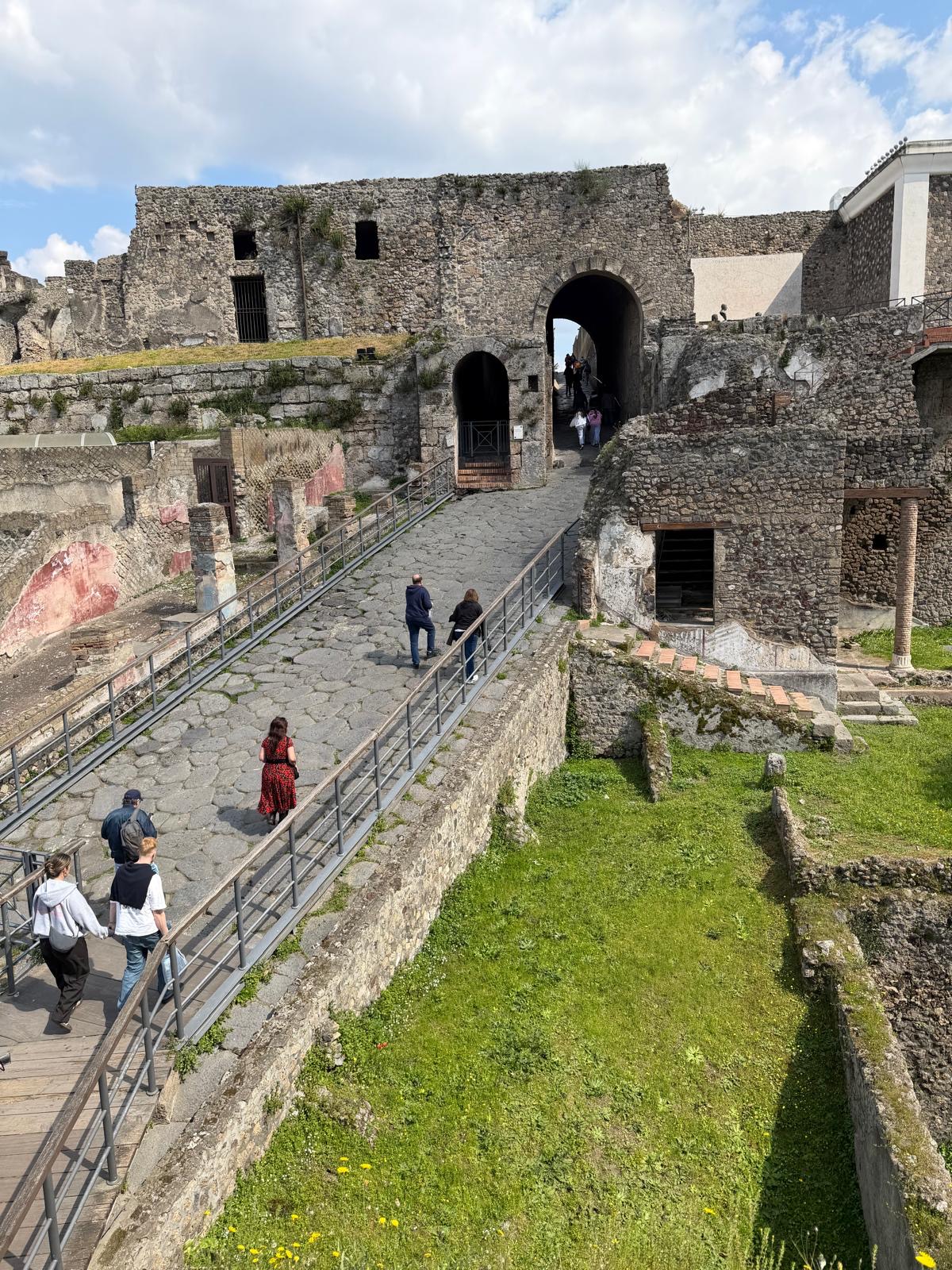
Walking through the ruins, it became difficult to admire the sophistication of urban planning—the amphitheatre, the baths, the frescoes, even an area where immigrants are still imprisoned—without confronting the fragility of existence. We followed the guide mechanically. The guide’s narration filled in detail, but what lingered was the stillness. Life, interrupted without warning.
I am told that Icarus, who flew too close to the Sun, plunged to his death into the sea somewhere nearby.
Amalfi Coast: A Sudden Lightness
From Pompeii’s stillness to the lift of Positano on the Amalfi Coast was almost disorienting.
The cliffside town—houses in soft hues of cream, pink, blue, and terracotta—seemed to defy gravity. Roads seemed like staircases. We wandered around the vertically stacked shops. The air carried a different energy, lighter, almost playful.
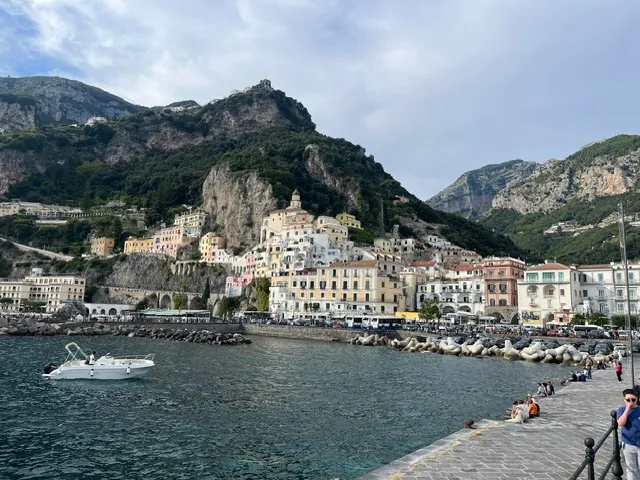
We paused for a panini—cream cheese, olives, greens. Simple, precise, unexpectedly perfect. Travel often distils itself into such moments. The fresh orange juice, the sharp sweetness of lemon ice cream (from local harvests)—small indulgences that stay longer than planned itineraries.
Fuelled up, we headed north towards Florence. The plan was to reach the vineyards of Tuscany before nightfall and stay somewhere in the wilderness.
Tuscany: The Art of Abundance
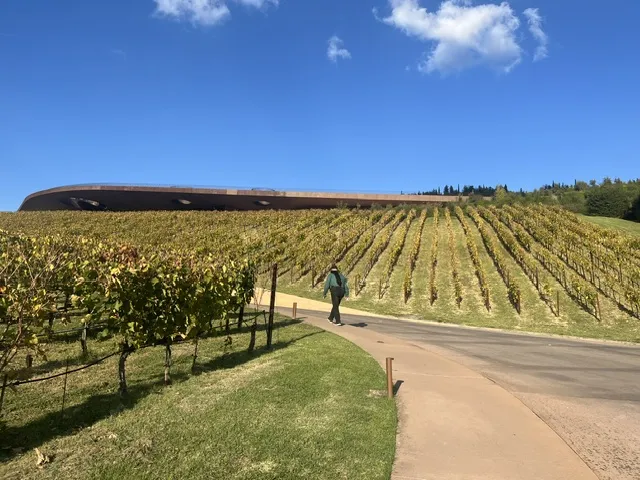
We drove north into Tuscany, arriving at the vineyards of Antinori nel Chianti Classico by dusk.
Even as I marvelled at the state-of-the-art glass lounge and the winding staircase to the rooftop ristorante, what struck me first was not opulence, but restraint—the architecture folding into the hillside, the quiet choreography of wine-making, the sense of time stretching rather than rushing. Steel chambers, aging barrels, and the slow transformation of grapes into something enduring.
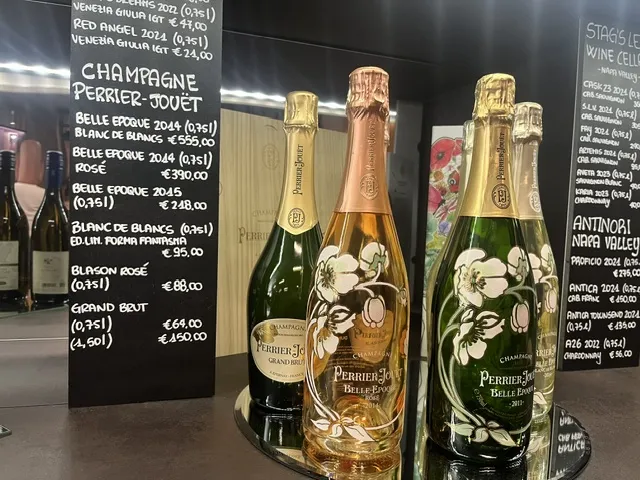
We took a guided tour of the vineyard and a paid wine-tasting experience.
That evening, with a glass of Tignanello and an early dinner, carpe diem felt less like a phrase and more like a lived truth.
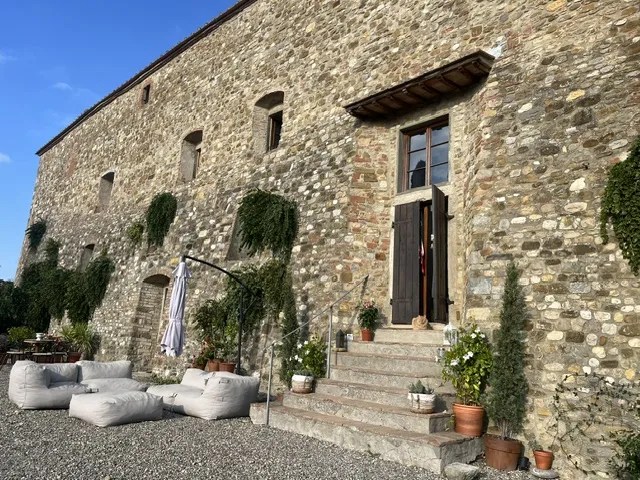
Nearby, at the Fonte De Medici village in the Chianti Classico region, we found an Airbnb—a country home that felt almost cinematic: stone walls, iron gates, a distant church spire. We drove through miles of olive orchards to reach this secluded place. Awe gave way to serenity. It had been a day of striking contrasts: the fragility of Pompeii, the beauty of Amalfi, the abundance of Tuscany. Unplanned, and yet perfectly composed.
Next morning, after a hearty country breakfast, we set off for Florence.
Florence: Where Art Thinks
Florence—the city of artists and thinkers like Michelangelo, Leonardo Da Vinci, Botticelli, and Machiavelli—demands slowness.
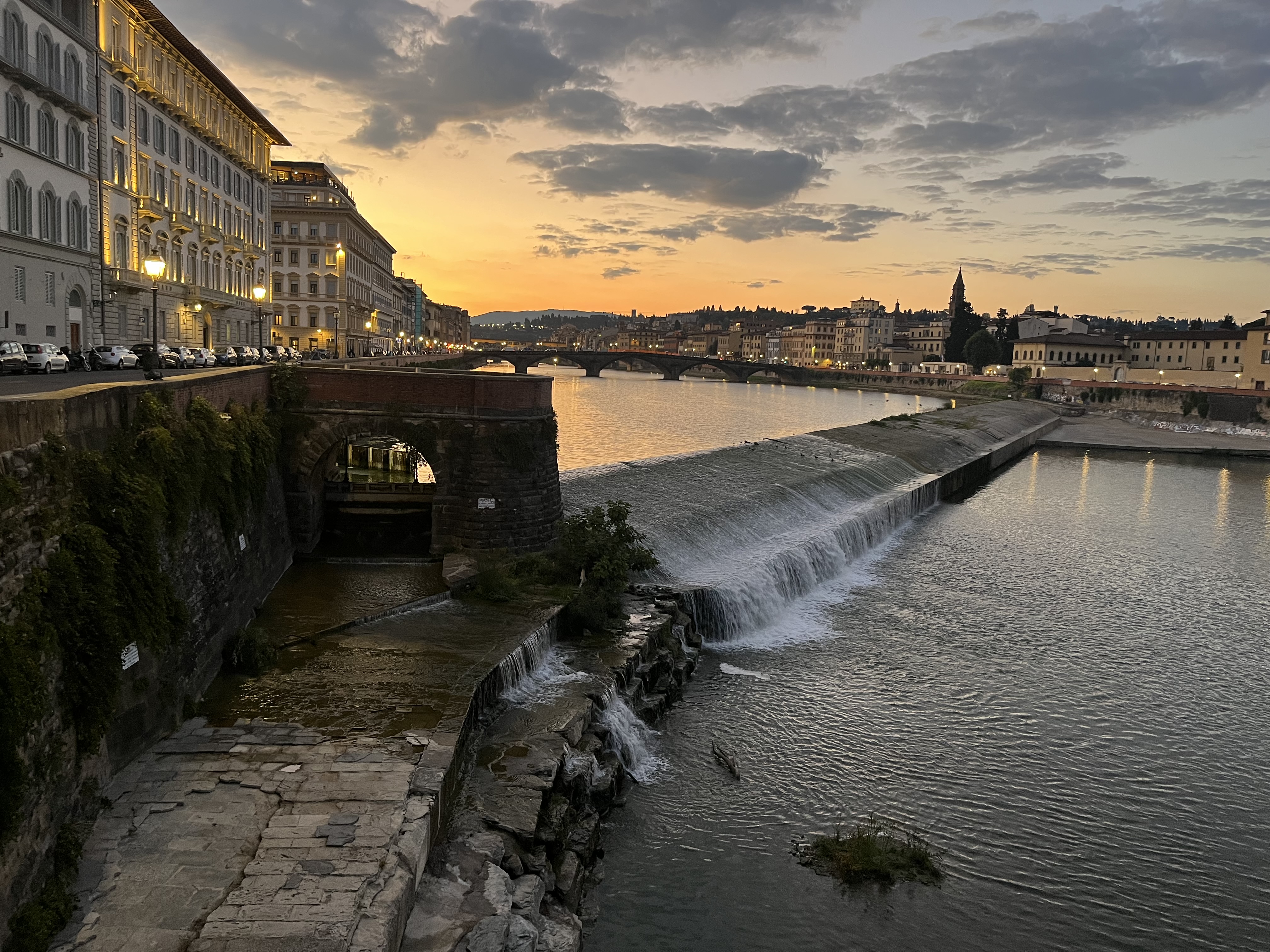
From Piazzale Michelangelo, the city reveals itself in quiet symmetry—the river Arno, terracotta roofs, the Duomo rising with quiet authority. It felt less like a city and more like a carefully held idea.
That very evening, we joined a walking tour on Renaissance and the Medici Tales to understand the town.
Walking through Florence is an education. The Renaissance was not just an artistic movement but a shift in how humans saw themselves—through inquiry, humanism, and the rediscovery of classical forms. Patronage, particularly from the Medici, allowed artists to think, experiment, and create without compromise. Here, the artist was not a craftsman, but an intellectual, at par with poets and philosophers.
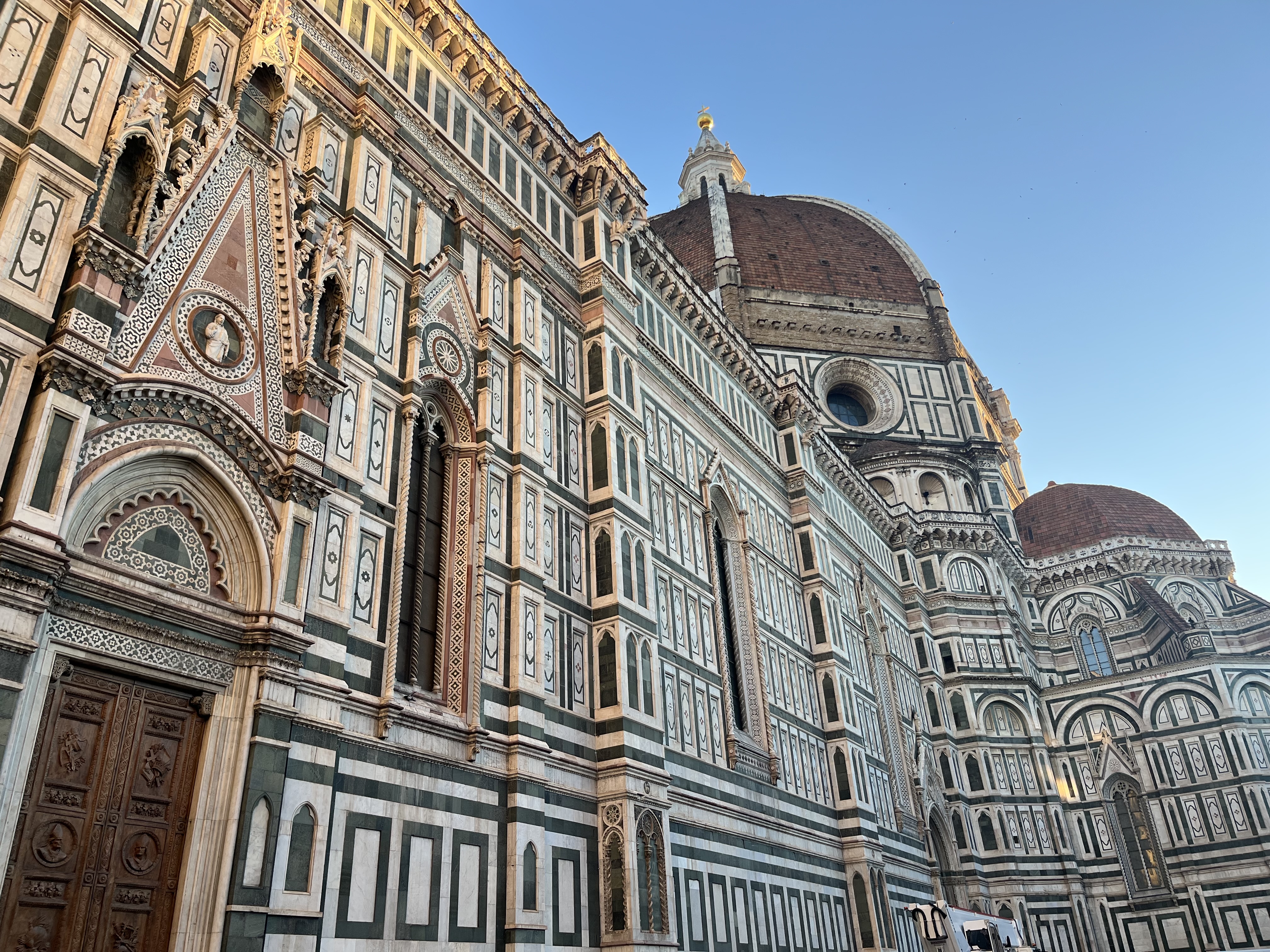
As we walked around town, we spotted the Duomo di Firenze (the Cathedral of Saint Mary of the Flower). It is the main landmark of Florence, recognisable by the brick double-dome designed by Brunelleschi.
I returned to the Cathedral early the next morning to catch the sunlight on the monument. The morning light makes the pink and jade green glow. I also caught an undisturbed view of the main door with Madonna and child on the arch. I tilted my head back to see the statues above, and was surprised to see the row of artists at the top of the archway. This town knows how to respect its artists.
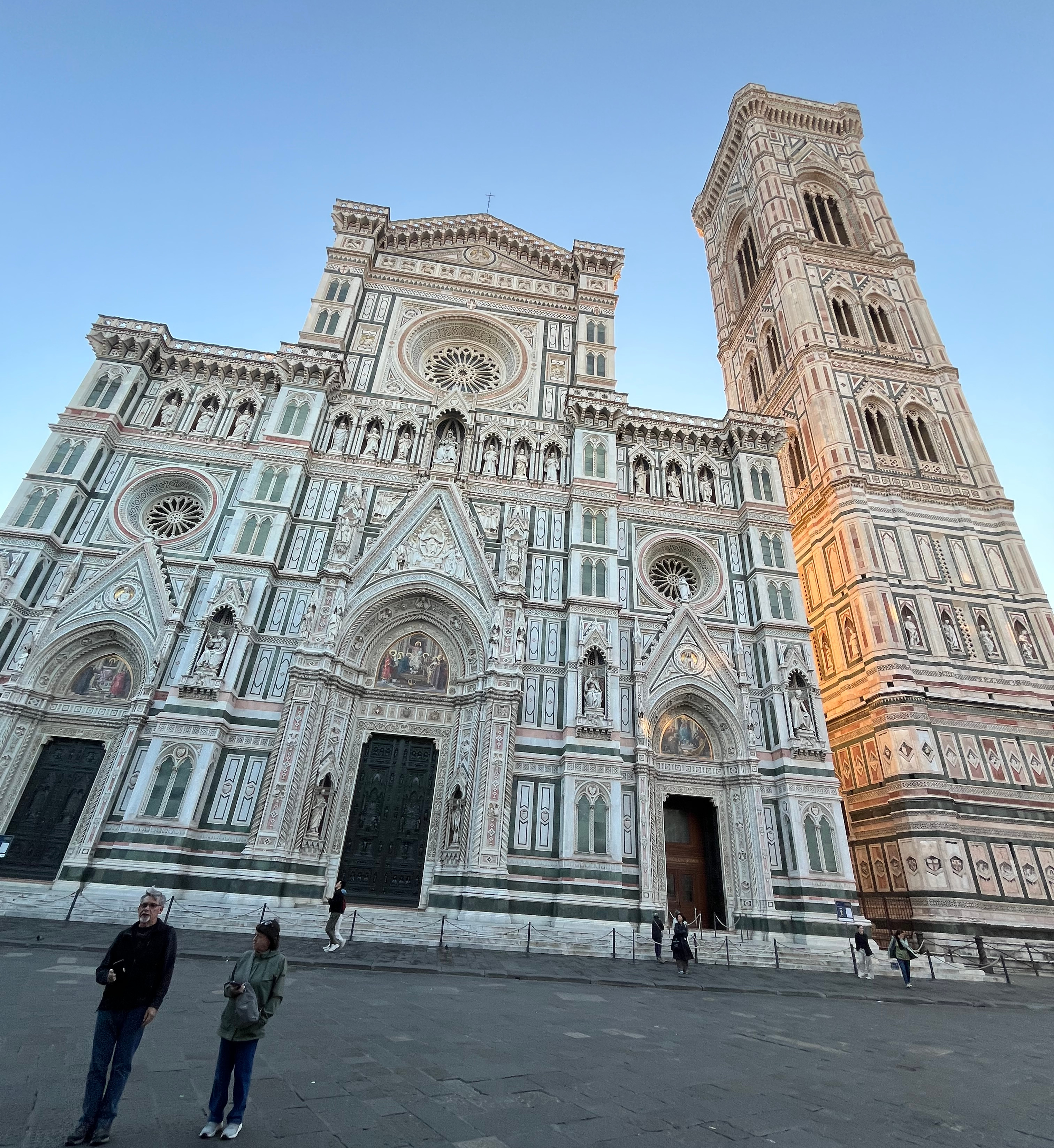
We decided to take different walking tours on each of the three days we were in Florence. Because it needs to be seen at a slow pace. And because cars are not allowed on most streets.
Encountering David
Despite an advanced booking, we encountered long queues at the Galleria dell'Accademia. But the wait dissolves the moment you enter.
Michelangelo’s David stands—14 feet of marble, and yet startlingly alive.
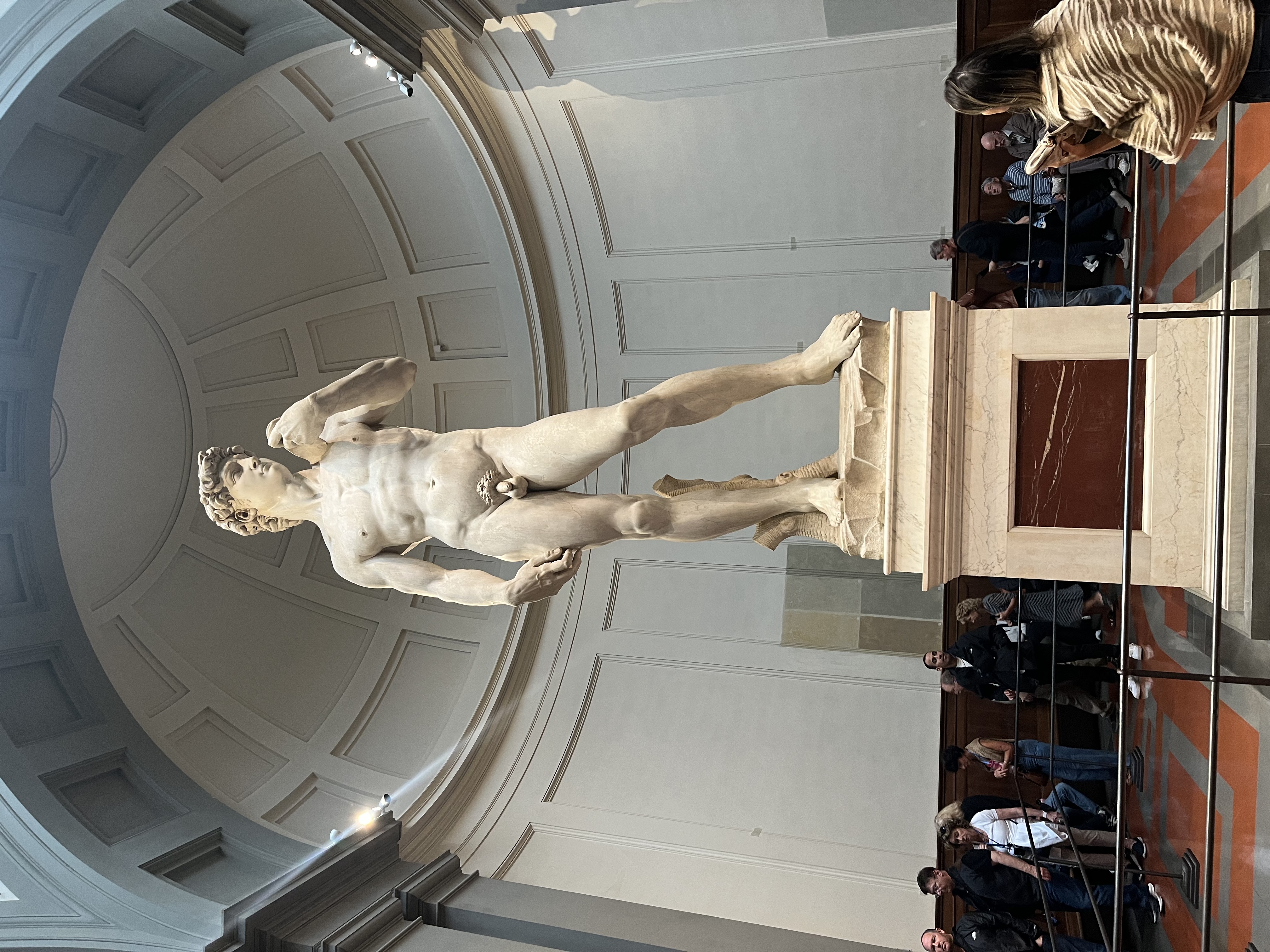
Michelangelo captures not the victory over Goliath, but the moment before it. The tension in the neck, the quiet readiness in the stance, the weight balanced in contrapposto—everything suggests imminent action. It is a study not just of anatomy, but of resolve. In the taut body of the teenage shepherd boy, I could see confidence, strength, sexuality, power, all at once.
I learnt that Michelangelo searched hard for a single piece of marble and that the sculpture emerged from a discarded, imperfect block of marble. He believed the form already existed within the stone—his task was merely to reveal it. It is difficult not to see this as a metaphor, extending far beyond art.
The Uffizi: Learning to See
The Uffizi Gallery overwhelms by design.
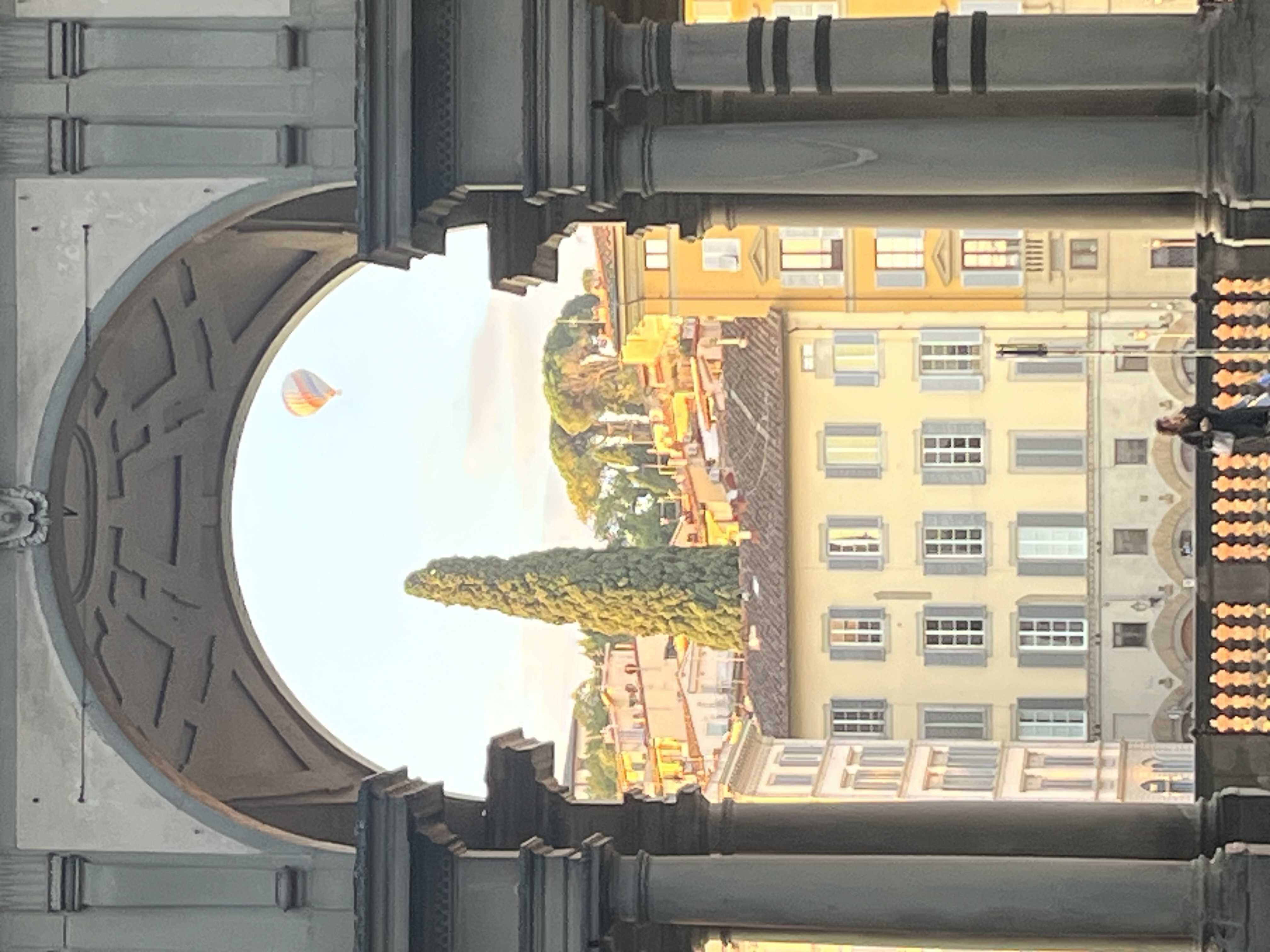
To reach it, we walked through the concentric arches of the long Vasari Corridor, itself an architectural delight.
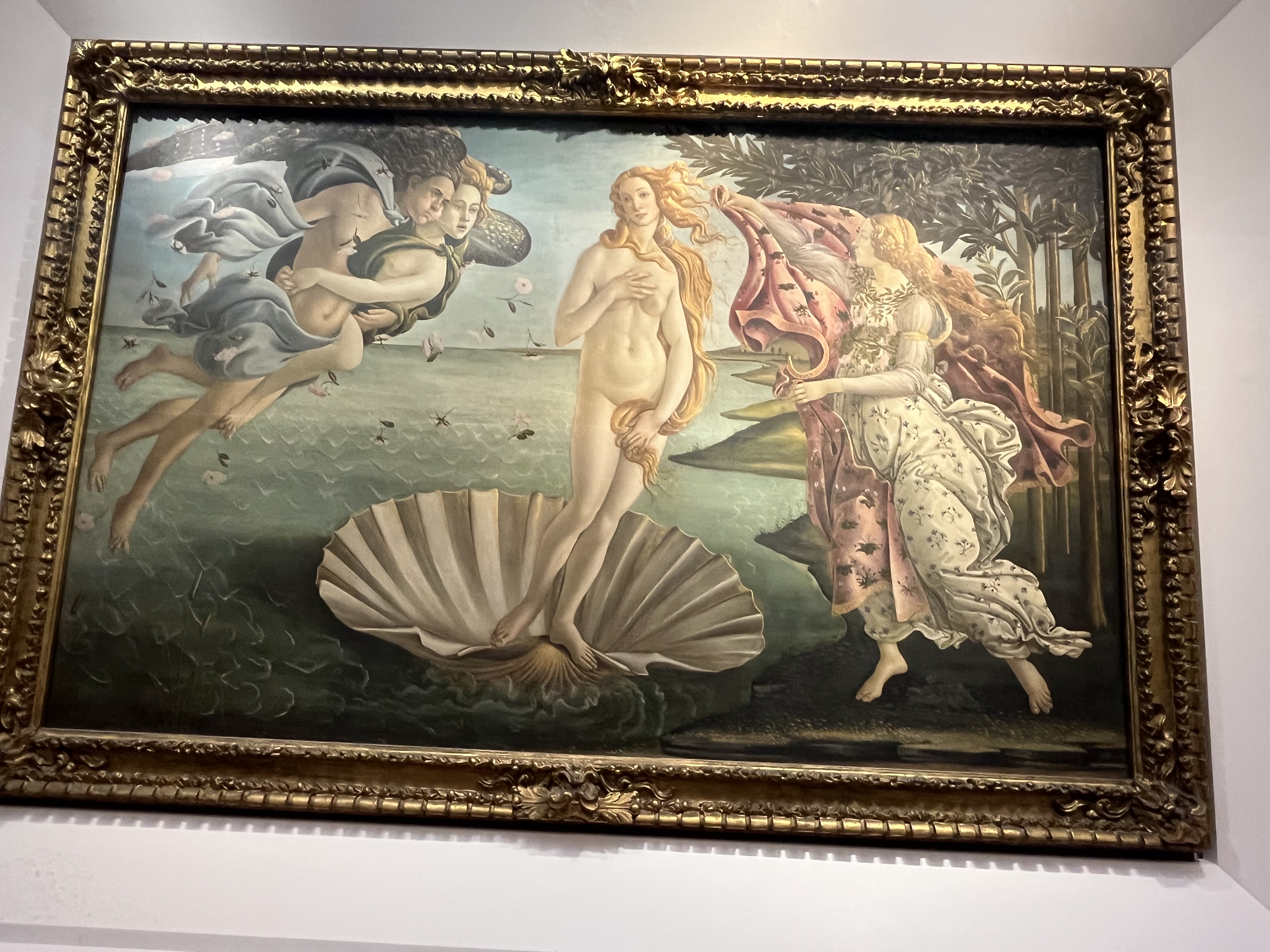
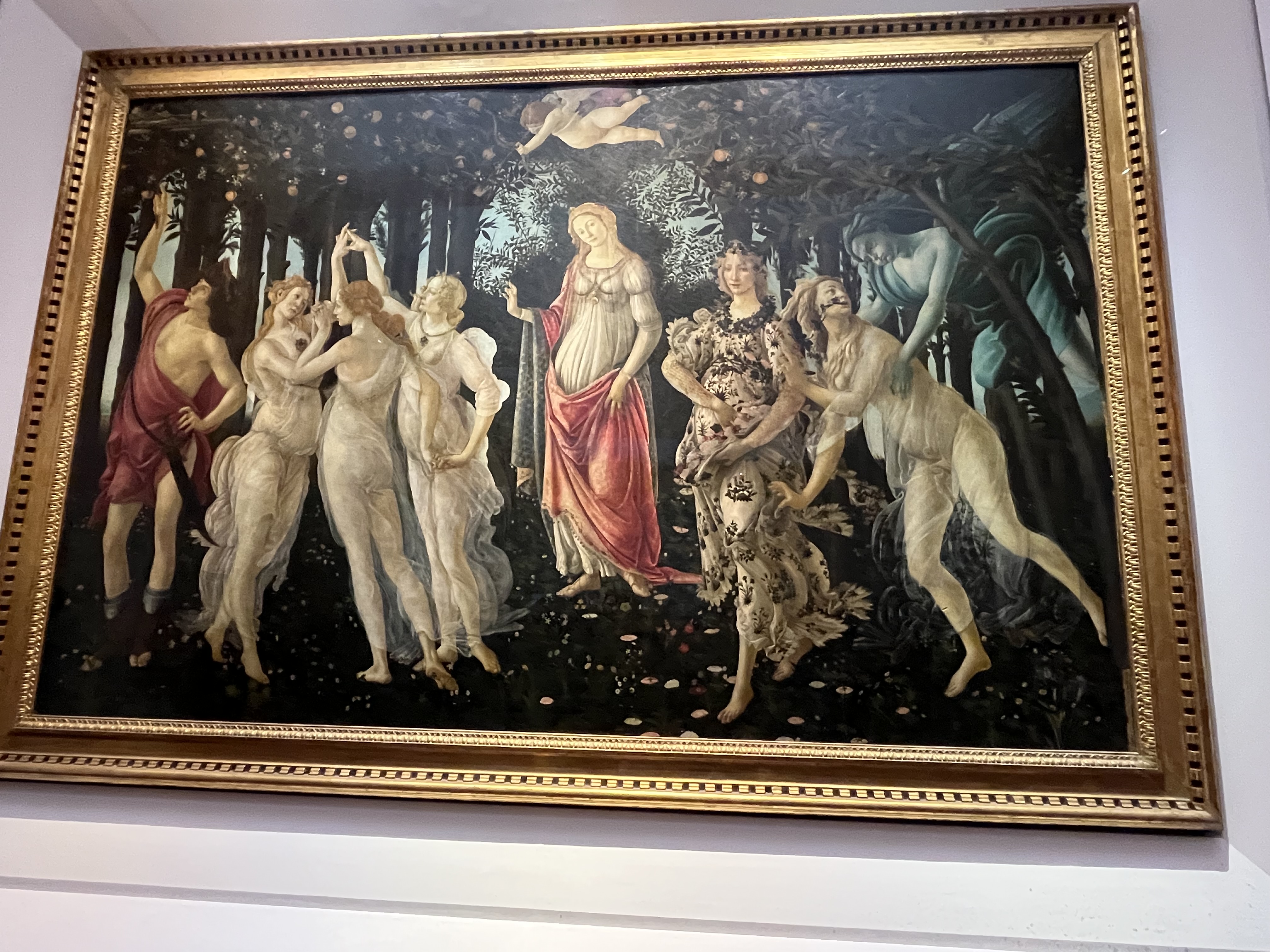
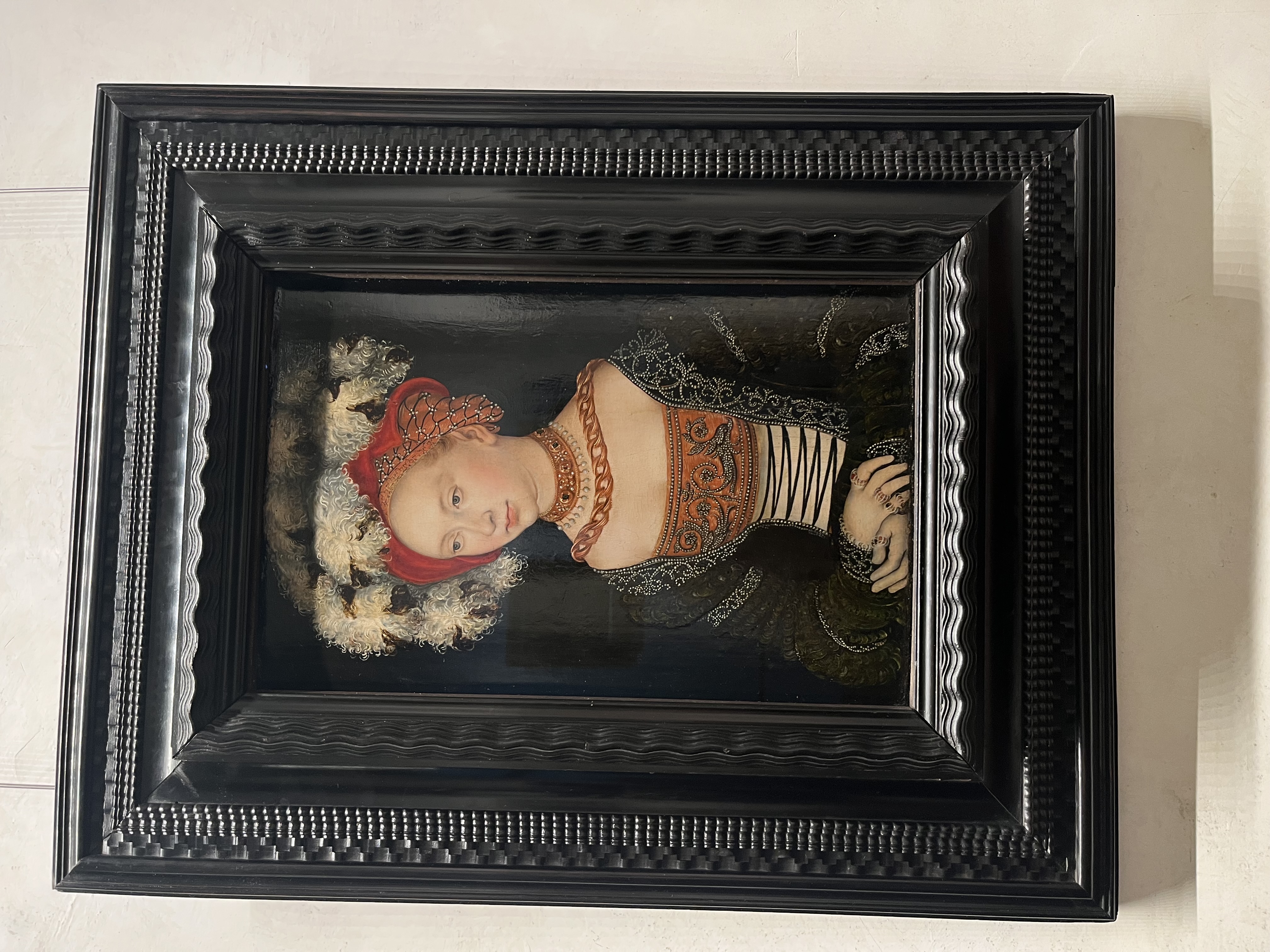
We’d intended to spend three hours, but it felt insufficient. Botticelli’s Birth of Venus—ethereal, poised—lingers. Primavera (Spring) unfolds like a layered poem. Lucas Cranach’s Female Portrait captures sensuality and intellectual elegance of the Renaissance woman. The works demand not just attention, but engagement.
Even the pause at the rooftop café becomes part of the experience—wine, artisanal pasta, conversation, the city unfolding in the background. Florence teaches you that seeing is an act that requires time.
Rome: A City in Layers
Rome resists neatness.
It does not present itself as a sequence of monuments to be checked off a list. It reveals itself in layers—ancient, medieval, modern—coexisting in ways that quietly unsettle the sense of order. You walk through it, sit beside it, sometimes live within it.
Our three days there took shape around small anchors—bus routes, advance bookings, long walks. The rest was left to chance.
We’d found an Airbnb close to the station. Someone mentioned Bus #51 and that became our life line. Our first booking, the Colosseum, materialised and the bus took us right outside.
The Colosseum: Scale and Spectacle
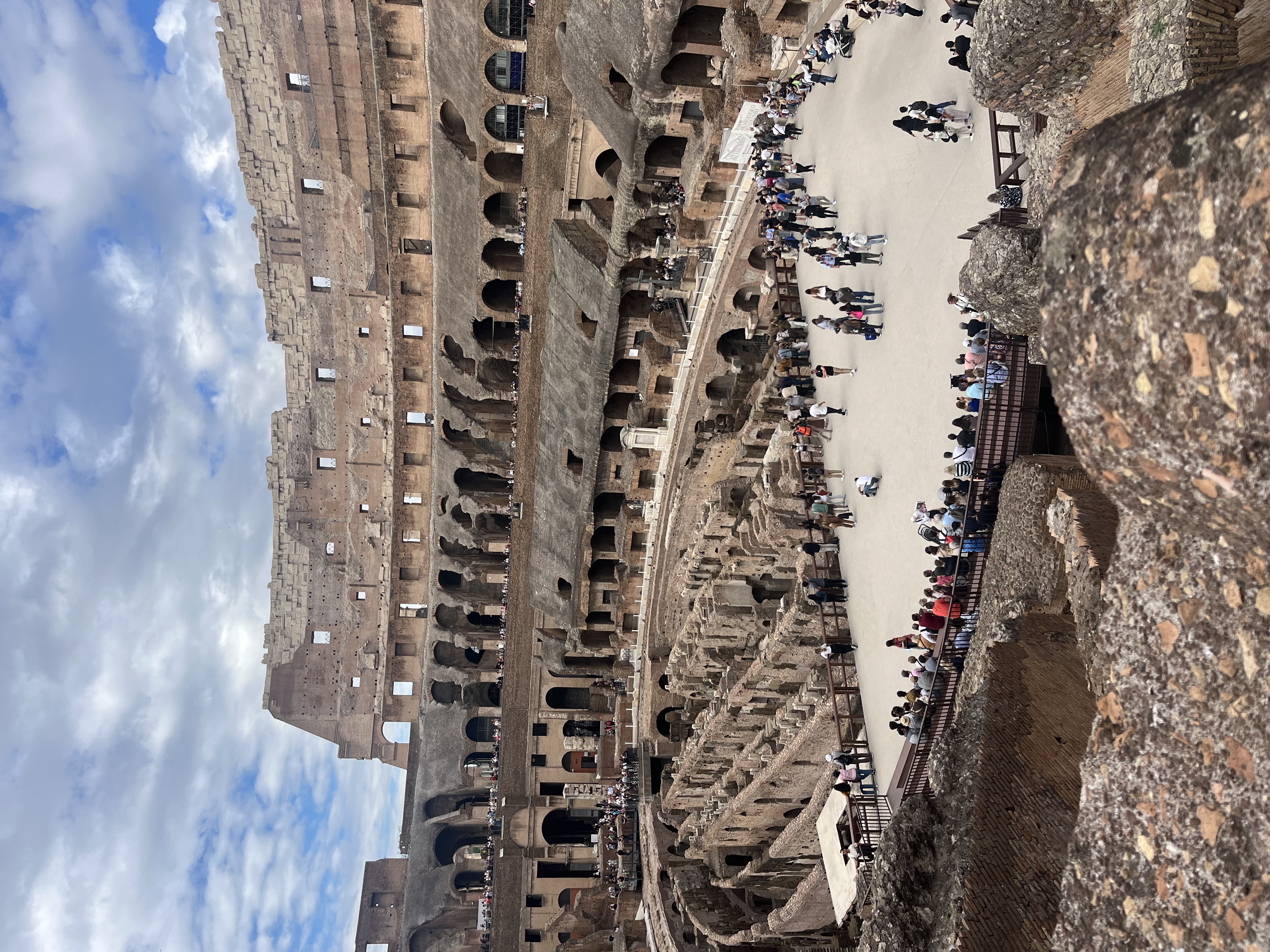
What once seated over 50,000 spectators now absorbs an equally dense crowd of visitors.
The long queue, the heavy security checks and limited entry points cause delay at a monument that has 80 gates that handled quick entry and exit for spectators in ancient times.
I securely clutched my bag as we were pushed in with the crowd.
The intimacy of Florence gives way to spectacle. Yet, once inside, the enormity asserts itself—the arena, the underground passages, the precision of design.
Standing there, it is not difficult to imagine the roar of the crowd, the clash of bodies, the theatre of survival. I am told the sand I see on the ground would soak in the blood of injured gladiators.
Crossing Over: The Forum
“Attraversiamo.”
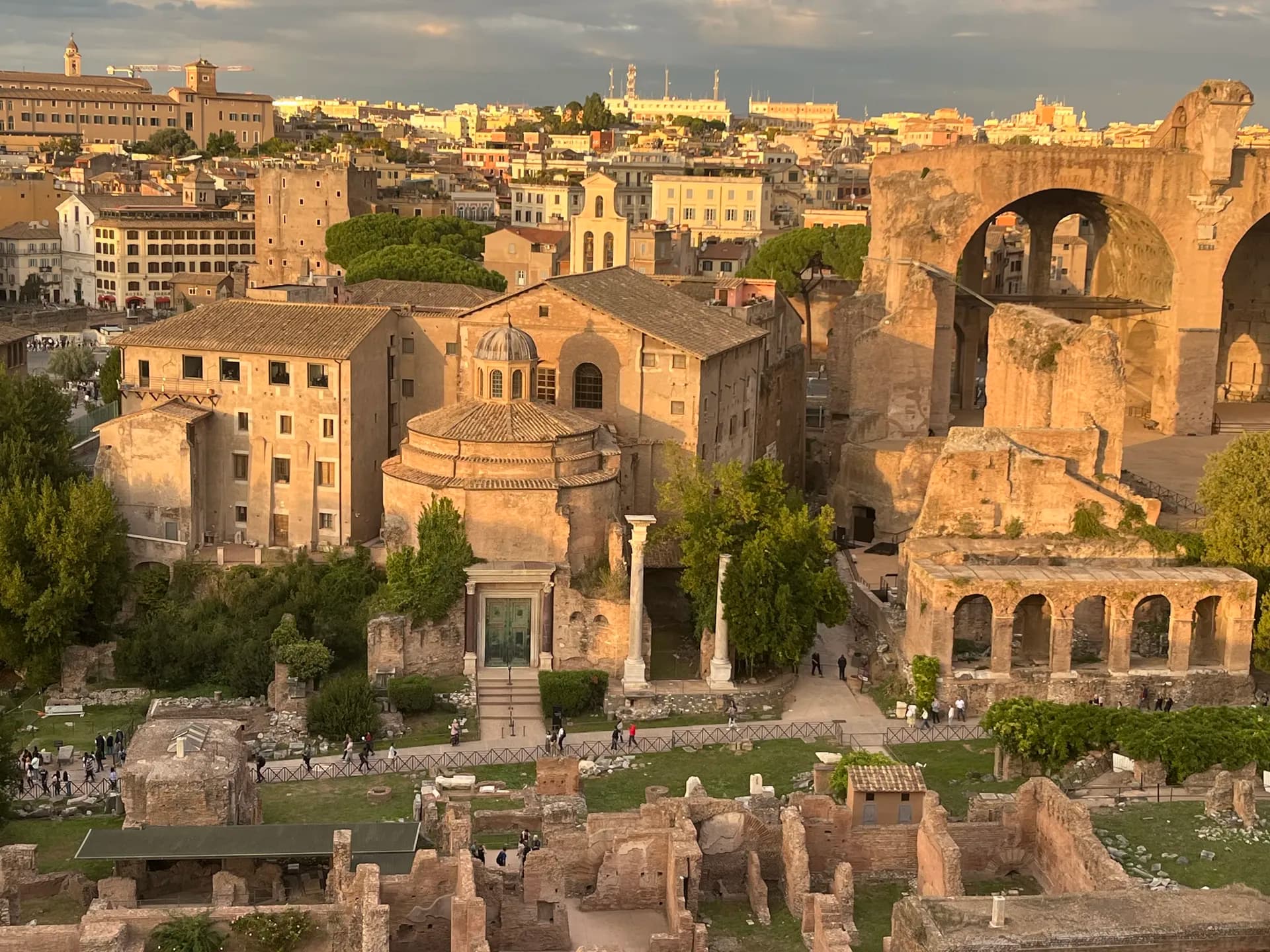
We cross over, quite literally, into the Roman Forum—once the seat of power.
It’s a long slow trudge over a hill. As the sun begins to set, the ruins soften into something almost painterly. Pillars, arches, remnants of structures that once defined public life. Time here does not erase; it settles.
We descended through a path in the ruin to reach the main road and find the bus stop for #51.
A hectic day deserves a good dinner. We booked a table at the Il Margutta restaurant in the fashionable Campo Marzio area in the city’s heart.
The Vatican: Art as Devotion
The journey culminated at the Vatican Museums and the Sistine Chapel.
We booked an early morning guided tour of the Vatican Museum in the old city. We saw a modern art installation in the front courtyard. The rotating installation, the ‘Globe within the Globe’, was a four meter bronze orb with cracked polished surface through which gaped a complicated interior globe. It struck me as a metaphor for creation and destruction. The fact that it is placed close to the Basilica hinted at the cyclic nature of human folly—a sobering thought.
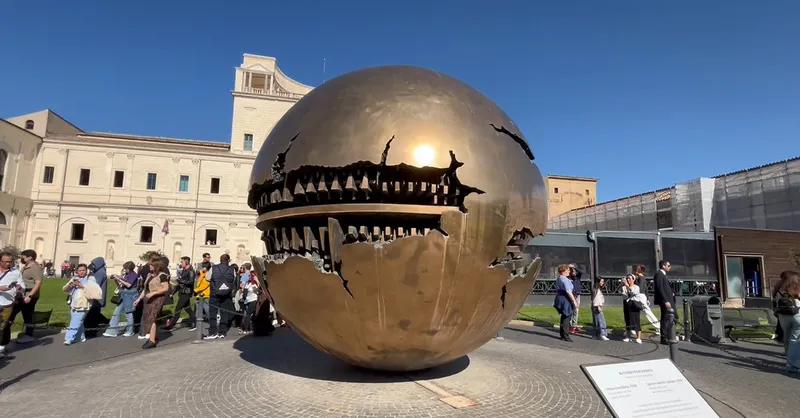
As we moved through 7km of halls and corridors, the tapestries, frescoes, and sculptures felt almost ceremonial. Founded by Pope Julius II in the 16th century during the Enlightenment, it is a treasure house of precious art.
And then, the Sistine Chapel.
Silence.
The ceiling unfolds—creation, fall, redemption. The moment where God reaches out to Adam holds the gaze. The outstretched hand of God seems more urgent, more intent, than Adam’s response.
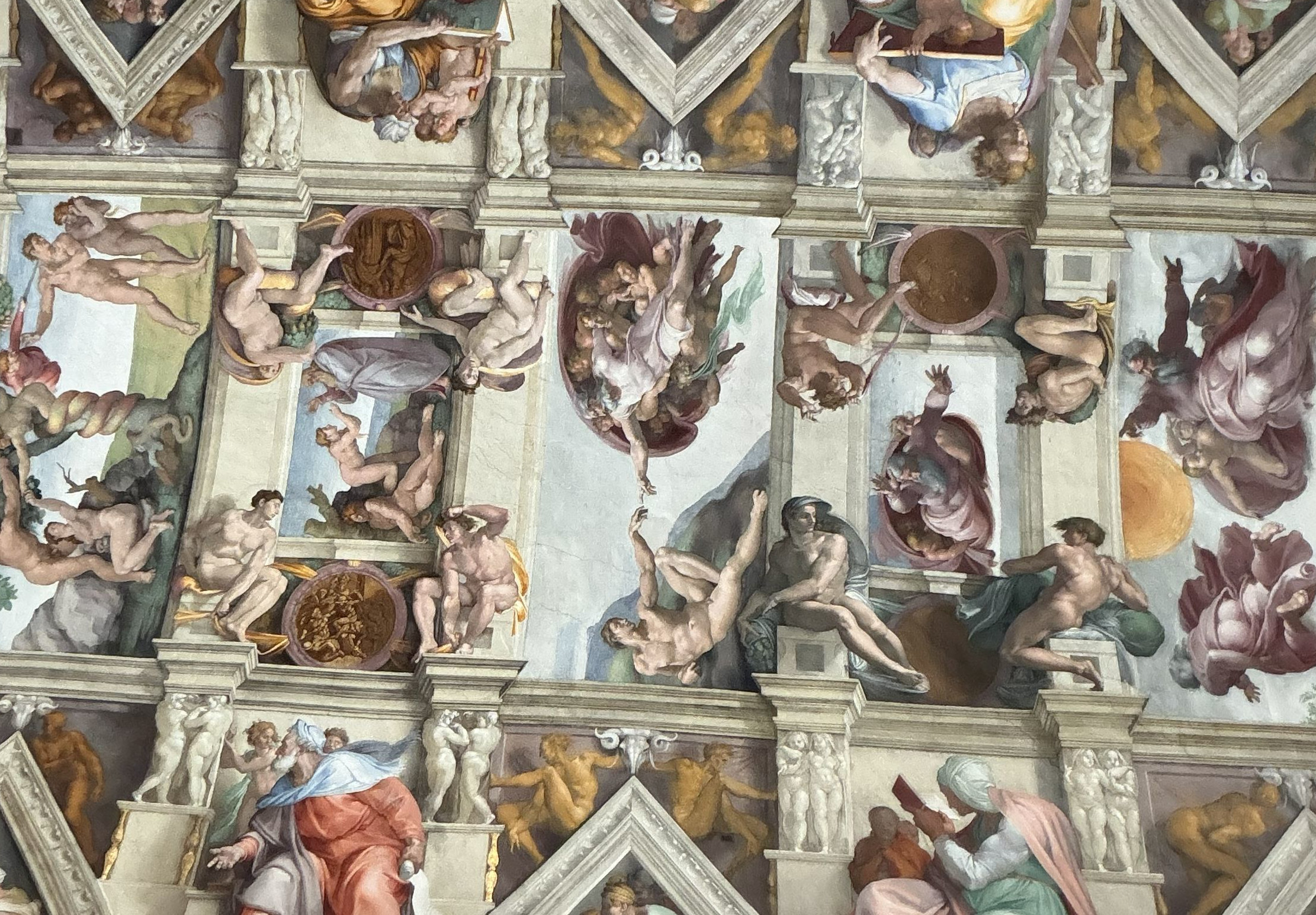
It takes a while for my gaze to move to the nine panels depicting scenes from The Book of Genesis.
Art, here, does not depict—it reveals.
At Florence the guide told us that Michelangelo was commissioned to paint the Sistine Chapel by Pope Julius II after the fame of the statue of David. But Michelangelo hadn’t painted a fresco before and was reluctant to take the commission. He is said to have taken six months to device the technique to paint on wet cement to avoid the surface getting mould; and took four years to design and paint the Sistine Chapel. I tried imagining how Michelangelo could paint the ceiling at an awkward angle for four years to create this masterpiece that generations will remember.
Pietà: The Weight of Grief
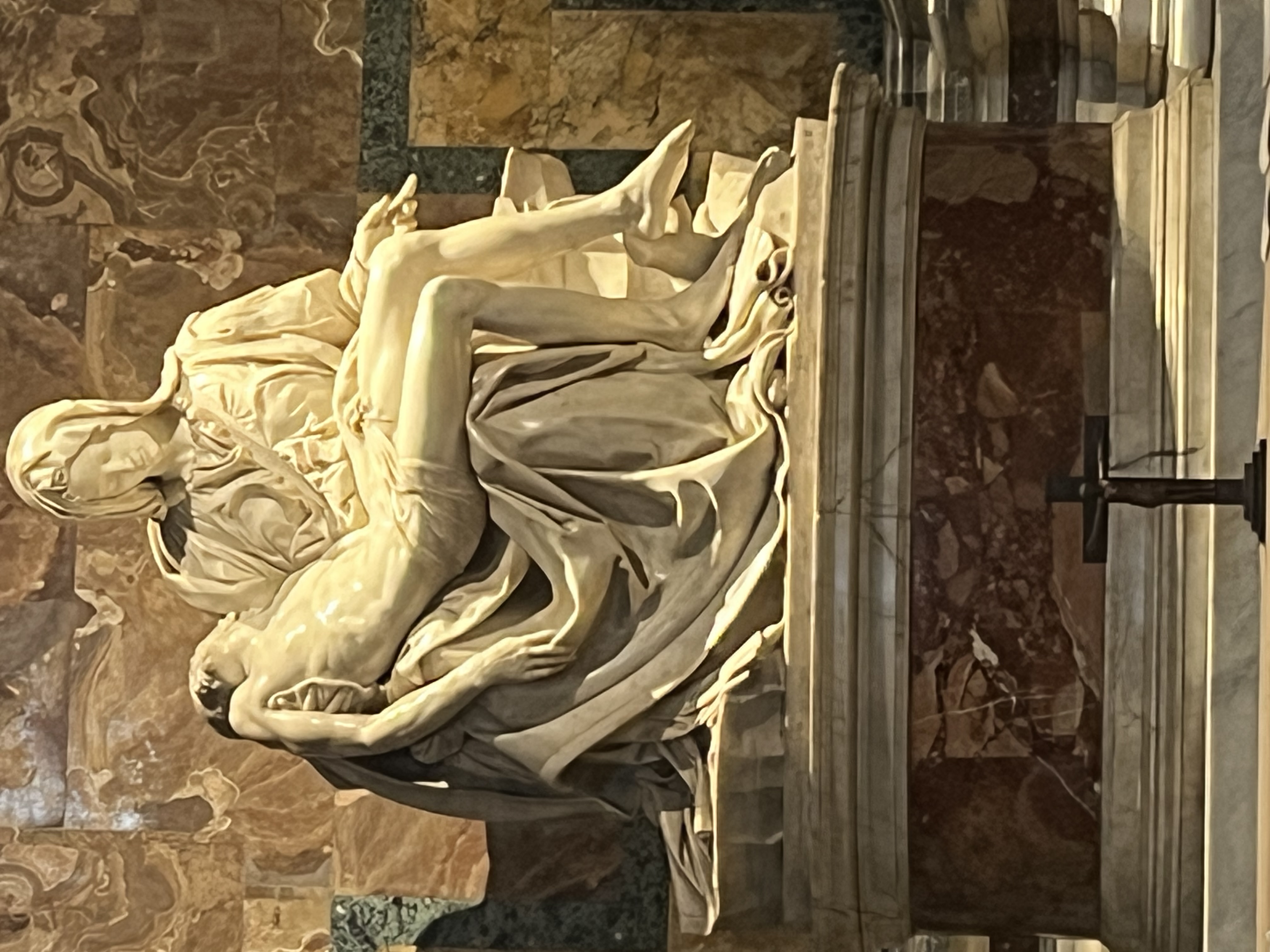
At St. Peter's Basilica, before the Pietà, something shifts.
Mary holds the lifeless body of Christ—not in despair, but in a quiet, dignified grief. The marble feels impossibly soft, almost human.
It takes time to step away.
Return: The Crossing Continues
On the final day, Rome surprises us again—a marathon, closed streets, a city in motion. We walk, we wait, we watch.
And then, the Trevi Fountain.
The coin is tossed—not as ritual, but as acknowledgment. One visit is not enough.
I return with small things—a colourful Roman Holiday calendar, a replica of David, the lingering taste of gelato. But also with something less tangible.
This journey, which began as nostalgia, ends as a meditation on time—time that accumulates, flows, fractures, and endures.

Founding Fuel is sustained by readers who value depth, context, and independent thinking.
If this essay helped you think more clearly, you may choose to support our work.

Founding Fuel is sustained by readers who value depth, context, and independent thinking.
If this essay helped you think more clearly, you may choose to support our work.
Join the conversation
Uma Narain
Former Founding Dean | School of Liberal Arts, NMIMS University
Uma Narain is a Fulbright fellow, former Founding Dean, School of Liberal Arts, NMIMS University and former Professor, General Management at S.P. Jain Institute of Management & Research.
Currently, she is an independent Consultant, advising universities and schools on New Education policy and Liberal Arts Education.
Uma is an avid reader, a movie buff, a theatre enthusiast, and an enterprising traveller interested in different cultures and people.
Beyond the noise is the signal.
FF Insights: Sharpen your edge, Monday–Friday.
FF Life: Culture, ideas and perspectives you won't find elsewhere — Saturday.
Loading comments...
Readers also liked
·Economy, Policy & Society
The Economy We Have, Not the One We Imagined
Why the Gulf crisis may be India’s moment for the next phase of reform
HC
Haresh Chawla
Investor | Entrepreneur
The Economy We Have, Not the One We Imagined
Why the Gulf crisis may be India’s moment for the next phase of reform
Investor | Entrepreneur
·Artificial Intelligence
The Knowledge Divide: How AI Will Reorganise Work, Margins, and Power
As AI agents embed intelligence into systems, the real shift is not automation—but how knowledge is owned, shared, and scaled across organisations
AB
Arjo Basu
Systems thinker & technologist | Entrepreneur
The Knowledge Divide: How AI Will Reorganise Work, Margins, and Power
As AI agents embed intelligence into systems, the real shift is not automation—but how knowledge is owned, shared, and scaled across organisations
Systems thinker & technologist | Entrepreneur
Designing for Signal
A conversation between Charles Assisi and Shrinath V on rebuilding Founding Fuel
CA
Charles Assisi
Co-founder and Director | Founding Fuel
Designing for Signal
A conversation between Charles Assisi and Shrinath V on rebuilding Founding Fuel
Co-founder and Director | Founding Fuel
Explore more
Dive into other themes from our network.