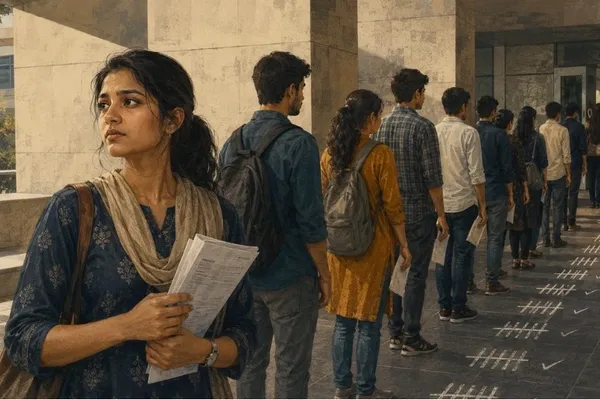
One state, several images
The Indian state does not feel the same to everyone. Those everyday encounters shape trust—and reveal what national averages can hide.
26 September 2026· 6 min read
TL;DR
This insightful essay posits that the "state" is experienced not monolithically, but through diverse, everyday encounters that profoundly shape individual trust. It highlights how citizens, particularly in India, perceive vastly different versions of institutions based on their location, needs, and service reliability. From a Vidarbha farmer to a Bengaluru entrepreneur, governmental fairness and capability are seen through disparate lenses. These countless small interactions, rather than mere constitutional promises, truly form a citizen's image of the state. The article prompts reflection on how such varied experiences impact civic trust and national stability, urging a deeper understanding beyond surface-level political discourse.

Editor’s Note
We are publishing Arjo Basu’s essay as a Sunday read because it asks us to step back from the immediate political debate and consider a larger question: how do our everyday encounters with the state shape our trust in it?
The essay does not offer a verdict on India or predict institutional decline. It asks whether a country can remain stable even when citizens experience its institutions very differently—and what those differences might mean over time.
Our community brings many different experiences of India to this question. We hope the essay prompts reflection, disagreement and conversation. For readers who would like to explore the ideas further, we have also included a Dig Deeper section.
Ask a farmer in Vidarbha what the government is, and ask a startup founder in Bengaluru the same question. They may not describe the same institution because they have not experienced the same institution.
Both are describing the same government, and neither is wrong. They are reporting on two different states that happen to share a flag and a Parliament.
India has one Constitution and one Union government. But its citizens experience many versions of the state. Each is shaped by where they live, the services they need and how reliably those services work. Over time, these encounters determine whether people see the state as fair, capable and worthy of trust.
In an earlier essay for Founding Fuel, I argued that trust in India's institutions may be becoming more conditional. Citizens continue to vote, pay taxes and follow the law, but some appear less willing to treat every institutional failure as an exception. They are beginning to keep score.
That raises a further question: what, exactly, are they scoring? There is no single answer because citizens are not all dealing with the same version of the state.
How citizens meet the state
A constitution is not a promise kept. It is a promise made. The distance between the two is where much of a nation's history is written. A constitution sets out rights, limits on power and the relationship between citizens and the state. But it cannot deliver any of these on its own. Its promises reach people through institutions: courts, police stations, schools, hospitals, municipal offices and welfare systems.
Strong institutions are, paradoxically, easy to overlook. Citizens know roughly what to expect. A complaint is acknowledged. A form follows a clear process. A benefit arrives when promised. The outcome may not always be favourable, but the process is understandable and broadly predictable. Institutions become most visible when they stop working.
When institutions work unevenly, the same complaint may be resolved in a week or ignored for years, with no way to know which outcome to expect. A rule may be enforced strictly for one person and ignored for someone with better connections. Citizens are left wondering whether the problem is delay, incompetence, bias or corruption.
This is how an image of the state forms. It is built in ten thousand small moments: whether an official looks up when someone enters the room, whether a form makes sense, whether a hospital has the promised medicine and whether an appeal receives an answer. Few of these moments are dramatic. Together, they determine what the state means to a citizen.
A constitution is not a promise kept. It is a promise made. The distance between the two is where much of a nation’s history is written.
When stories carry more weight
People do not interpret these encounters in isolation. Politicians, journalists, community leaders and social media all offer explanations for why the state works as it does. These stories matter in every democracy. They matter even more when citizens cannot rely on a consistent process or outcome.
If an institution works predictably, citizens have evidence from their own experience. Political claims may influence them, but those claims must compete with what they have seen. If the institution works erratically, that direct evidence is weaker. A persuasive story about who is responsible, who benefits and who is being ignored can then become the main way people make sense of the system.
The gap is easier to see in programmes built around visible targets. A sanitation drive may report how many toilets were built; a citizen judges it by whether water and waste systems make the toilet usable. A financial inclusion programme may report how many bank accounts were opened; the account holder judges it by whether the account gives her meaningful access to financial services. Both accounts may be true. But when experience repeatedly falls short of the announcement, the official story has to work harder.
This can create a damaging loop. Weak institutions produce uneven experiences. Uneven experiences give political narratives more power. Governments under pressure may then find it quicker to manage the story than to repair the institution. The more they rely on persuasion in place of performance, the more the underlying weakness persists.
Narrative cannot replace capacity indefinitely. It may buy time, explain a failure or preserve support. But citizens continue to encounter the state in their daily lives, and those encounters keep adding to the account.
How the gap widened
India began with an ambitious constitutional promise and institutions that had to serve an exceptionally large and diverse population. Their reach expanded, but their capacity and quality did not grow evenly. The result was never one common experience of the Republic.
The Emergency showed that constitutional institutions could be bent towards political control. The expansion of welfare brought the state closer to millions of citizens, but access often depended on local capacity and discretion. Liberalisation widened economic opportunity and raised expectations, while many courts, police forces and municipal services struggled to keep pace. More recently, digital systems have made some transactions faster and more transparent, even as older forms of delay and exclusion continue elsewhere.
These changes did not produce a simple story of progress or decline. They produced a patchwork. Some citizens gained a state that was easier to reach and more responsive. Others continued to face long delays, weak services or arbitrary decisions. Many experienced both, depending on the institution involved.
Governments have also learned that visible programmes and symbolic achievements can be delivered faster than institutional reform. Such programmes may produce real gains. But an output that can be counted is not always the same as a service that works reliably. When the gap between announcement and experience persists, citizens notice.
One country and many experiences
The same citizen may therefore hold several views of the state at once. She may use a smooth digital payment system, wait years for a court hearing and struggle with a municipal office. She may trust one institution, avoid another and depend heavily on a third.
This is why broad statements about trust can mislead. There is no single reservoir of legitimacy shared evenly across the country. Trust varies across regions, institutions and social groups. It may also change quickly when a familiar failure touches a grievance that has been building for years.
National indicators often hide this variation. GDP growth, approval ratings and election results are useful, but each compresses very different experiences into one number. A country can grow rapidly while basic services remain unreliable in particular places. A government can win a clear mandate while sections of the electorate become more willing to challenge specific decisions. Stability and fragmentation can exist at the same time.
A country can grow rapidly while basic services remain unreliable in particular places. A government can win a clear mandate while sections of the electorate become more willing to challenge specific decisions. Stability and fragmentation can exist at the same time.
The first essay described citizens moving from inherited trust to a running assessment of institutional performance. This essay adds a further complication: those assessments do not begin from the same place. People are keeping different accounts because they are dealing with different versions of the state.
Watching civic friction
How might policymakers or investors recognise this fragmentation before it becomes a national political event? No single measure will capture it. But a set of modest signals may show where pressure is building.
The right analogy may be seismic monitoring. No one waits for one dramatic signal. The more useful clues are smaller tremors and whether they are spreading across faults. India's civic equivalent is the frequency and spread of small disputes between citizens and the state. Protest data, strikes, court petitions against government orders and internet shutdowns each capture a different form of friction. Government decisions that are stayed, withdrawn or renegotiated after public pressure may reveal whether the state must keep earning compliance, decision by decision.
The spread of these disputes may matter more than any single event. A cluster of protests around one issue in one state is part of ordinary politics. But when disputes surface at the same time across unrelated issues—examinations, electoral administration and land clearances—they may point to a wider shift in how citizens respond to authority. The signal is stronger when no single organisation is coordinating them.
Existing sources offer pieces of this picture. One is Armed Conflict Location & Event Data (ACLED), an independent global monitor that records reported protests and political violence by date and location. Its data can help show whether protests are becoming more frequent or spreading across regions. Labour data record strikes and days lost. Court filings show how often citizens challenge state action. Internet shutdown trackers provide another indication of where governments expect tensions to rise. None of these sources was designed to measure trust, and each has limits. Read together over time, however, they may reveal changes that a national approval rating cannot.
Any such assessment should remain local. A single national score would recreate the very problem it is meant to solve. The point is to see where civic friction is rising, which institutions are involved and whether disputes are spreading across groups and geographies.
There is also a data problem. Places with weak institutions often have weaker reporting and thinner media coverage. The signal may be hardest to measure where it matters most. That should make analysts more cautious, not less interested. The signal is still there. It simply sits beneath the noise.
The question beneath stability
India can remain politically stable, economically important and institutionally fragmented at the same time. None of this implies collapse. It does suggest that national averages offer an incomplete picture of how citizens experience the state and how much failure they are prepared to absorb.
How much institutional failure will people tolerate before they stop giving the system the benefit of the doubt? No national mood or single protest can tell us. The answer builds through millions of encounters with institutions—and through the different accounts citizens keep.
For policymakers, the task is to make those encounters more consistent and fair. For investors making long-term bets on India, the question is equally practical. It is not only whether the Indian state works, but where it works, for whom and how reliably.
Dig Deeper
The Government Works—Just Not How You Think
The government is not as a machine to fix, but a living system to serve: a conversation with Subroto Bagchi, entrepreneur, author, and public servant
A podcast with Jaideep Prabhu, professor at Cambridge Judge Business School and author of ‘How Should A Government Be? The New Levers of State Power’
Will India muddle along, fall apart or will the flotilla advance?
How can one be sure of India's future trajectory? This extract from chapter 7 in Arun Maira's book, 'An Upstart in Government', explains three scenarios that sketch out what the condition of the country will be if the forces that affect it play out.
Join the conversation
Arjo Basu
Systems thinker & technologist | Entrepreneur
Arjo Basu is a systems thinker, technologist, and entrepreneur working at the intersection of narrative, data, and AI. He believes the future of work, and leadership, depends on how well we humanize technology while building structures that can scale trust, clarity, and opportunity.
With over 25 years of experience across data strategy, enterprise architecture, and AI-led product innovation, Arjo has spent his career designing systems that bridge people, platforms, and purpose. His work is guided by a simple belief: systems thinking, when paired with the right technology and a clear narrative, leads to sustained impact.
He founded Moksho, an AI-powered interview intelligence platform reimagining how we hire and how we prepare to be hired through simulated scenarios, sharp feedback, and credibility-building certifications.
He is the co-founder and CTO of stotio, an AI-powered Narrative OS built to help businesses distil strategy into connected and clear growth narratives across moments that shape outcomes be it fundraising, sales, brand evolution, and leadership reviews. stotio blends structured storytelling frameworks with a context-driven intelligence layer, so organizations build narrative consistency across stakeholders and decisions.
Previously, Arjo served as a Principal Data Architect and Strategist for global financial services firms in the United States, where he led high-performance teams across geographies, built enterprise-grade data platforms on Snowflake and Databricks, and created the Data Maturity Framework, now used by multiple organizations to guide scalable, insight-led transformation.
Alongside his technology work, Arjo writes fiction, poetry, and essays that explore identity, memory, and belonging, often mirroring the same questions he engages with in systems and strategy: how structure shapes behaviour, how silence carries meaning, and how humans navigate complexity.
Across technology, narrative, and design, his work reflects a commitment to building systems with structure, clarity and momentum.
Beyond the noise is the signal.
FF Insights: Sharpen your edge, Monday–Friday.
FF Life: Culture, ideas and perspectives you won't find elsewhere — Saturday.

Founding Fuel is sustained by readers who value depth, context, and independent thinking.
If this essay helped you think more clearly, you may choose to support our work.

Founding Fuel is sustained by readers who value depth, context, and independent thinking.
If this essay helped you think more clearly, you may choose to support our work.
Loading comments...


Readers also liked

·Economy, Policy & Society
The Economy We Have, Not the One We Imagined
Why the Gulf crisis may be India’s moment for the next phase of reform
HC

Haresh Chawla
Investor | Entrepreneur
The Economy We Have, Not the One We Imagined
Why the Gulf crisis may be India’s moment for the next phase of reform
Investor | Entrepreneur

·Economy, Policy & Society
How Iran Is Turning the Global Economy Into a Battlefield
As the conflict with the United States and Israel intensifies, Iran’s new leadership is signalling a prolonged confrontation—one that combines conventional warfare with pressure on global energy flows and supply chains.
VK

Vivek Y. Kelkar
Researcher, Analyst & Columnist on Geo-economics, Geopolitics and Sustainability
How Iran Is Turning the Global Economy Into a Battlefield
As the conflict with the United States and Israel intensifies, Iran’s new leadership is signalling a prolonged confrontation—one that combines conventional warfare with pressure on global energy flows and supply chains.
Researcher, Analyst & Columnist on Geo-economics, Geopolitics and Sustainability

·Leadership & Organisation
The One Leadership Skill We Forgot to Teach
In an age of noise, overload and drifting meetings, facilitation is no longer a “tool”, it’s a core leadership discipline
KA

Kavi Arasu
Leadership and Talent Development Professional
The One Leadership Skill We Forgot to Teach
In an age of noise, overload and drifting meetings, facilitation is no longer a “tool”, it’s a core leadership discipline
Leadership and Talent Development Professional
Explore more
Dive into other themes from our network.