Raghu Rai, Who Taught Us How to See India
A tribute to the veteran photojournalist whose work revealed the country’s beauty, contradictions, and defining moments
26 April 2026· 4 min read· 1 comments
TL;DR
Raghu Rai, the photojournalist who profoundly taught us how to perceive India, has passed away at 83. His journey, unexpectedly launched by a single image of a baby donkey, blossomed into a career that forged the definitive visual history of modern India. For Rai, photography was his "dharma"—a meditative quest for "darshan," an immersive truth captured not through pre-conceived notions, but from the heart with instinct and patience. His unparalleled genius immortalised India's bustling streets, its cultural titans like Satyajit Ray, and its powerful leaders, earning him a place in Magnum Photos. Through his extensive archive, Rai bequeathed a nation's beauty, contradictions, and profound moments, truly shaping our understanding of India.

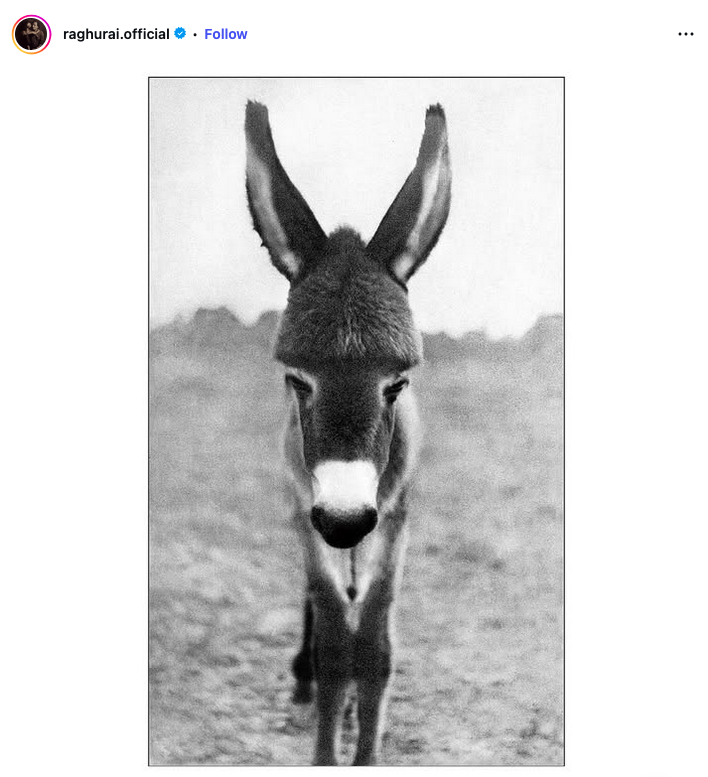
He was a reluctant engineer who found his calling chasing a frightened baby donkey around a village in the mid-1960s. Borrowing a camera from his elder brother, the photographer S. Paul, the young Raghu Rai snapped a picture of the animal that soon found its way to a half-page spread in The Times of London. The money he earned from that single image was enough to last a month. It also launched a career that would produce the definitive visual history of modern India.
Raghu Rai died on Sunday at a private hospital in Delhi at the age of 83. He had been battling prostate cancer for two years, which had subsequently spread to his stomach and brain, compounding age-related issues. He leaves behind an unparalleled archive of a nation’s beauty, its political turbulence, and its most profound tragedies.
The Dharma of the Viewfinder
For Raghu Rai, photography was never merely a profession; he called it his religion and his dharma. He refused to enter a temple, mosque, or church without a camera in his hand. He said, without his lens, no God existed for him. Instead, he sought what he described as darshan—a complete, immersive experience of a situation in its entirety.
He believed that the human mind was like a computer, pre-programmed with clichés and stored images. To take a truly great photograph, he argued, one had to switch off this mental computer and shoot directly from the heart, relying entirely on instinct. Sometimes, one has to wait for the subtle tickle or nudge of reality. He was not impressed with photographers who sought quick gratification over meaningful, meditative connection.
“Through concentration there comes a meditative moment when nature, when life reveals its own mysteries”, Raghu Rai told Rajiv Mehrotra during a conversation.
The Street and the Studio
Nowhere was this patience more visible than in his street photography.
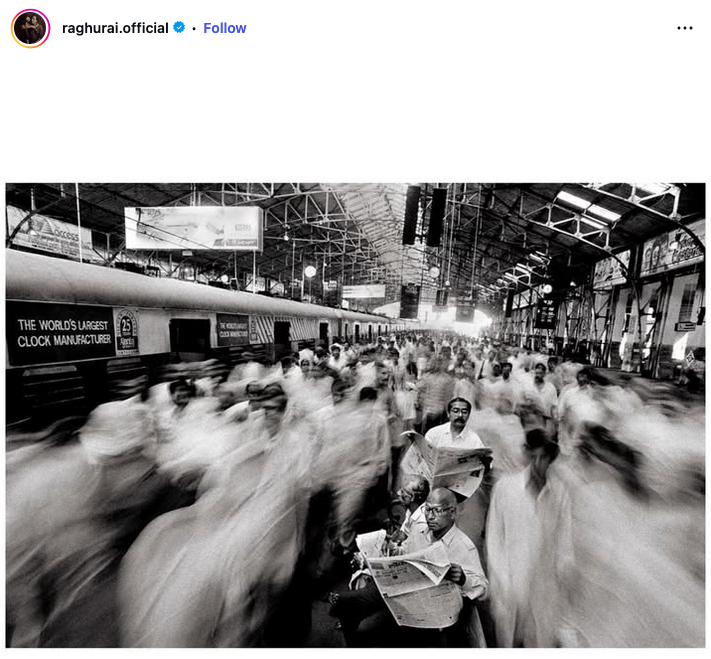
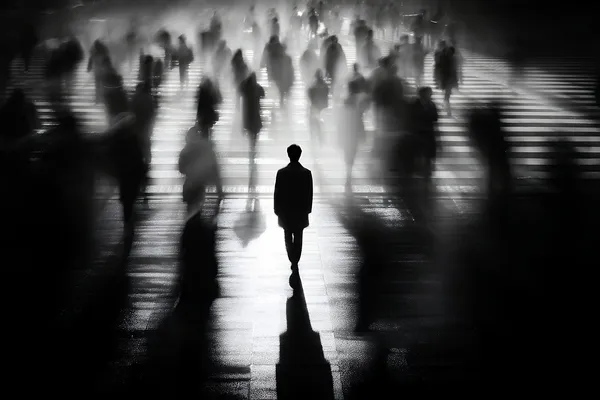
Raghu Rai's genius lay in his patience and his ability to let nature perform for him. He captured the human deluge at Mumbai's Churchgate Station during the morning rush hour by placing his camera on a box and using a long exposure; the commuters dissolved into a rushing blur, while the few men sitting on benches reading newspapers remained perfectly sharp.
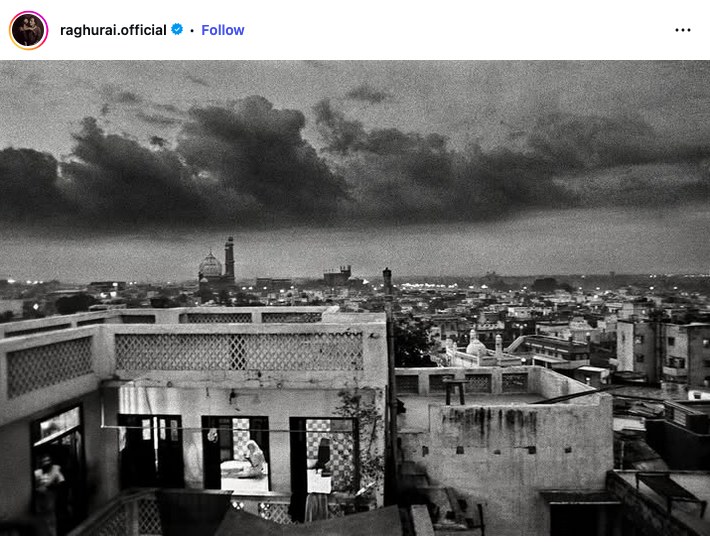
In Old Delhi, invited by a local politician to a rooftop overlooking the Jama Masjid, he waited for hours until dusk. Just as he was about to give up, dark clouds rolled in, and a woman in an adjacent building turned on a light to pray—perfectly aligning humanity, architecture, and nature in a single frame.
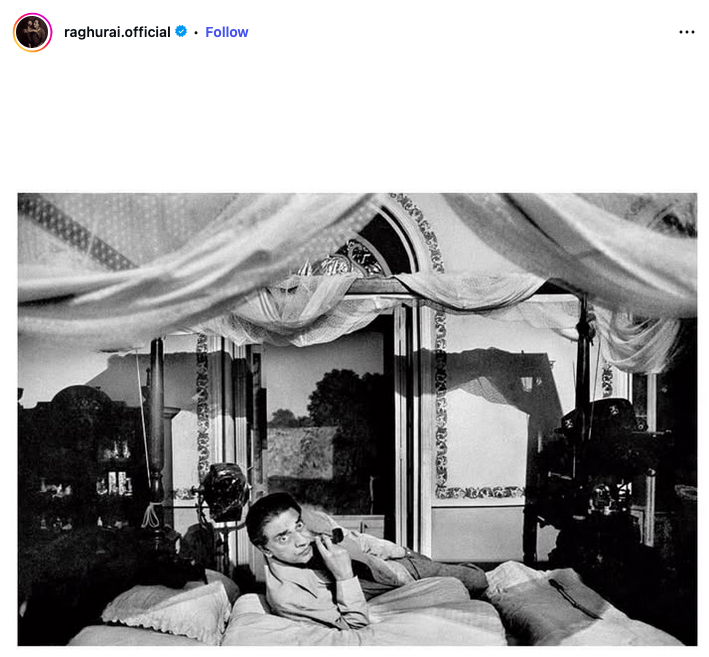
He brought this same intuitive approach to cultural titans. While photographing the legendary filmmaker Satyajit Ray (known as Manik da) on a film set, Raghu Rai lay down on the very bed the actors had just vacated, caught the director smoking his pipe, and called out, "Manik da, look back," capturing a classic portrait.
Documenting the Powerful and the Pious
That same instinct shaped how he approached those in power.
Joining The Statesman as a chief photographer in the 1960s, Raghu Rai quickly proved he was no ordinary pressman. His talent caught the eye of Henri Cartier-Bresson, who nominated him to the prestigious Magnum Photos cooperative in 1977.
Through his lens, the world watched India's most formidable figures navigate their eras. A few stand out.
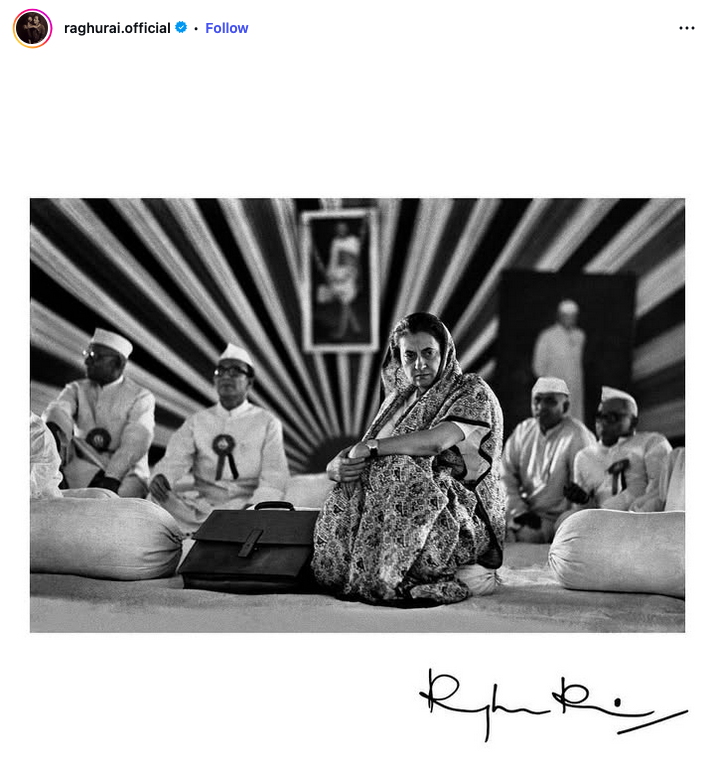
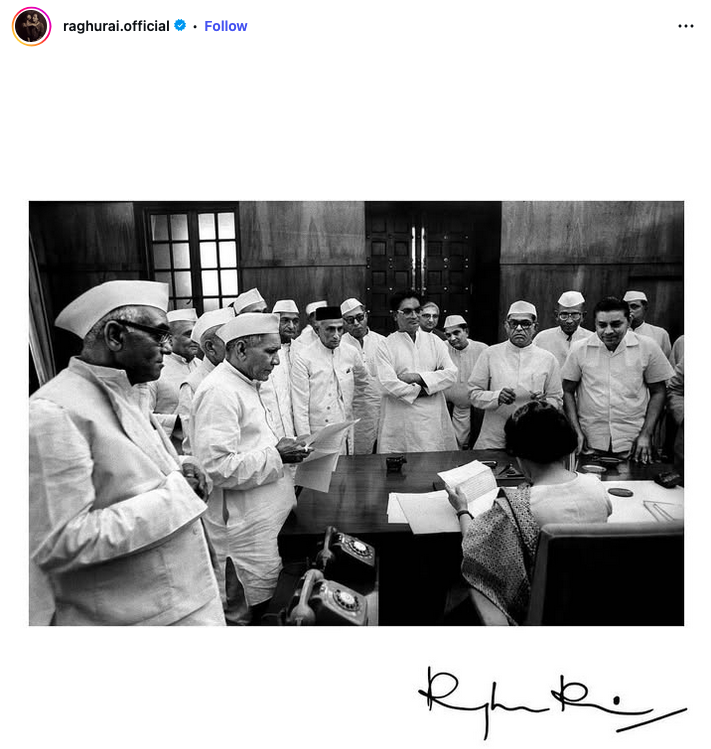
Indira Gandhi: He shadowed India's first female Prime Minister extensively from 1967 onward. He documented her transition from a lonely leader navigating a male-dominated world after the death of her father, Jawaharlal Nehru, to a ruthless authoritarian during the 1975 Emergency. In one instance in the Himalayas, he asked her to climb a three-foot parapet to get the right shot; she obliged, walking with her hand consciously held in a specific mudra.
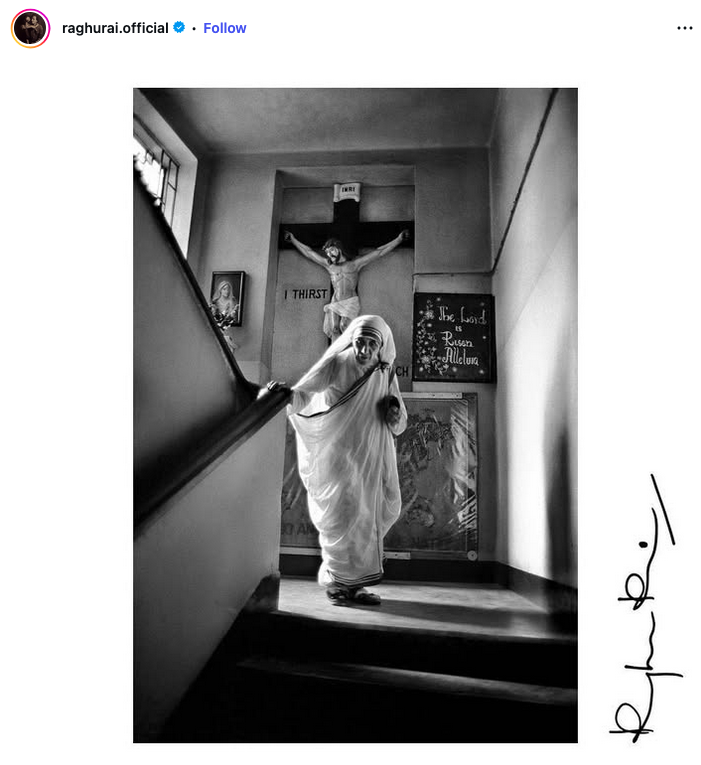
Mother Teresa: Raghu Rai photographed her for nearly 50 years. Once, she forbade him from moving around to take pictures during her Easter prayers. Unwilling to miss the divine connection he saw in her eyes, he broke his promise, quietly moving to capture her face. When he later apologised, she held his hands and told him that God had given him the assignment, and he had to do it well.
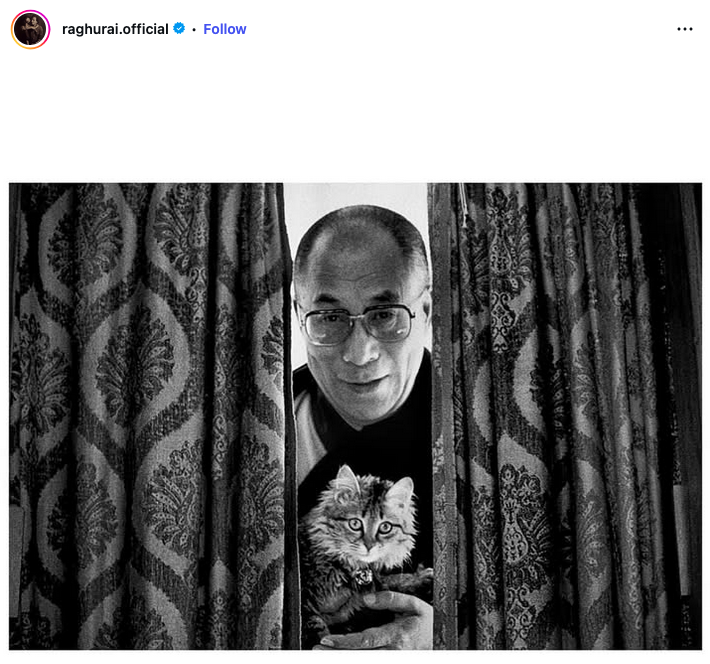
The Dalai Lama: He captured candid, everyday moments of the spiritual leader. He marvelled at his unfeigned kindness and described his spiritual energy as an indelible impression.
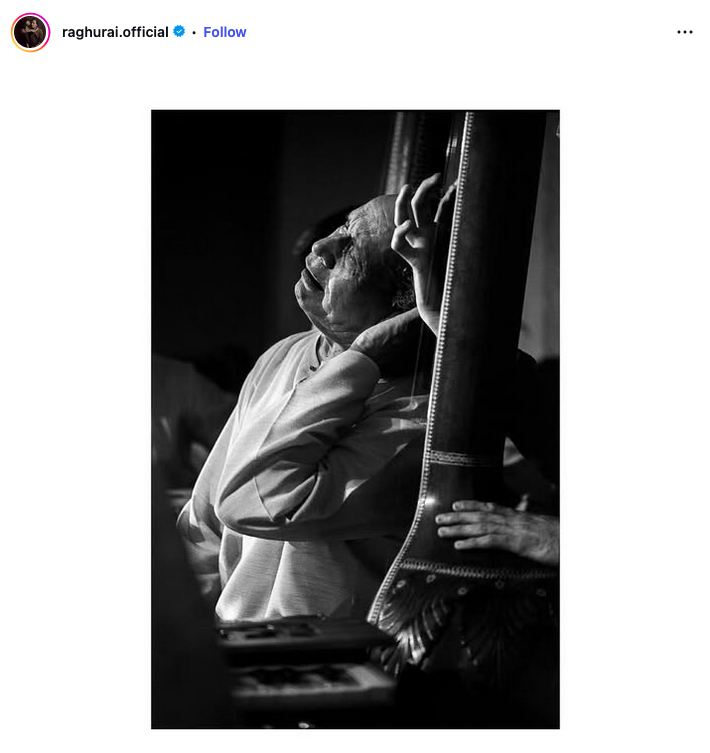
Classical Musicians: He believed that great art should restore silence in a person. He was moved by Indian classical music. Once, he captured carnatic singer M.S. Subbulakshmi with her eyes closed in devotion, preserving the visible pain and the tear. He approached masters like Pandit Bhimsen Joshi, Ali Akbar Khan, and Kishori Amonkar with the same reverence. He sat before them like a little disciple, waiting for their music to transport him to a higher spiritual plane.
An Eyewitness to History
Raghu Rai's camera did not shy away from the horrific or the controversial. During the 1975 Emergency, when the state crushed dissent, he embedded himself with the opposition leader Jayaprakash Narayan, capturing a defining front-page image of a BSF baton poised over the leader during a lathi charge in Patna.
Prior to Operation Blue Star, he gained access to the Golden Temple and photographed the militant leader Jarnail Singh Bhindranwale. Disarming the militant by calling him "paji" (brother), Raghu Rai captured a final, haunting image of a man whose eyes were red with fear and anger.
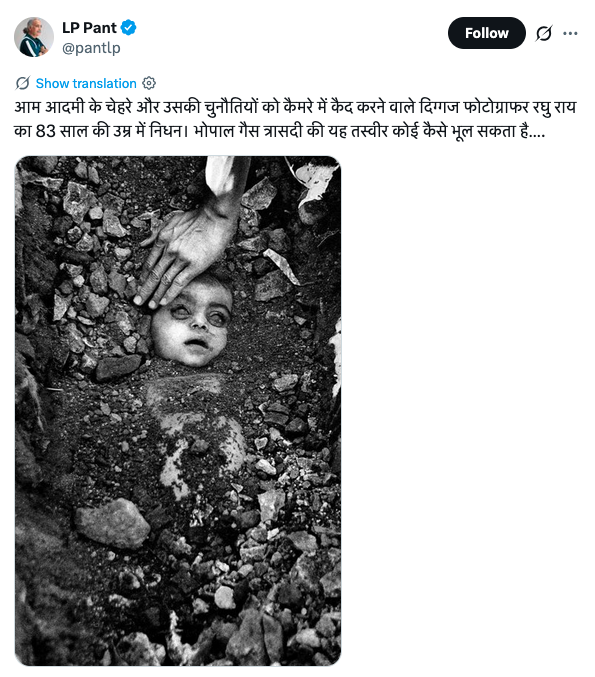
Perhaps his most globally recognized work came in December 1984, following the Bhopal gas tragedy. Arriving the morning after the lethal chemical leak, while the heavy, toxic gas still hugged the ground, he worked through the devastation to capture the "Burial of an Unknown Child". The image of a half-buried infant with unseeing, open eyes became the tragic, defining symbol of the world's worst industrial disaster.
The Final Shutter
Unlike many purists of his generation, Raghu Rai despised "nostalgic nonsense" about the past. He embraced digital technology the moment it arrived, marveling at the freedom it gave him to see his steps as he took them, much like a painter viewing a canvas. In his later years, he even published a book shot entirely on a mobile phone, proving his eye remained sharp regardless of the instrument.
He spent his final years working closely alongside his second wife, Gurmeet, an architect and conservationist, and frequently collaborated with his daughter, Avani, who followed him into photography.
“History is written and at times rewritten, but photo history cannot be rewritten,” Raghu Rai liked to say. He leaves behind a multi-layered, unvarnished visual history of his country. The shutter has closed, but the darshan he provided the world remains.
In an age of speed, Raghu Rai chose to wait. And in that waiting, he showed us how to see.
Dig deeper
Join the conversation
N S Ramnath
Senior Editor | Founding Fuel
NS Ramnath is a member of the founding team & Lead - Newsroom Innovation at Founding Fuel, and co-author of the book, The Aadhaar Effect. His main interests lie in technology, business, society, and how they interact and influence each other. He writes a regular column on disruptive technologies, and takes regular stock of key news and perspectives from across the world.
Ram, as everybody calls him, experiments with newer story-telling formats, tailored for the smartphone and social media as well, the outcomes of which he shares with everybody on the team. It then becomes part of a knowledge repository at Founding Fuel and is continuously used to implement and experiment with content formats across all platforms.
He is also involved with data analysis and visualisation at a startup, How India Lives.
Prior to Founding Fuel, Ramnath was with Forbes India and Economic Times as a business journalist. He has also written for The Hindu, Quartz and Scroll. He has degrees in economics and financial management from Sri Sathya Sai Institute of Higher Learning.
He tweets at @rmnth and spends his spare time reading on philosophy.
Beyond the noise is the signal.
FF Insights: Sharpen your edge, Monday–Friday.
FF Life: Culture, ideas and perspectives you won't find elsewhere — Saturday.

Founding Fuel is sustained by readers who value depth, context, and independent thinking.
If this essay helped you think more clearly, you may choose to support our work.

Founding Fuel is sustained by readers who value depth, context, and independent thinking.
If this essay helped you think more clearly, you may choose to support our work.
Loading comments...



Readers also liked

·Economy, Policy & Society
FF Daily #421: The state can do more by trying to do less
July 12, 2021: Raghuram Rajan on how governments can deliver impact; A crisis in Uganda; Are we prepared enough for a third wave; Shakespearzoned
FF

Founding Fuel
FF Daily #421: The state can do more by trying to do less
July 12, 2021: Raghuram Rajan on how governments can deliver impact; A crisis in Uganda; Are we prepared enough for a third wave; Shakespearzoned

·Leadership & Organisation
What Yes Bank can learn from Cognizant and Francisco D’Souza
Leadership transitions at Yes Bank and Cognizant, is the Three Horizon model still relevant, interview with Raghuram Rajan, and an ethical dilemma for Silicon Valley’s next generation
FF
Founding Fuel
What Yes Bank can learn from Cognizant and Francisco D’Souza
Leadership transitions at Yes Bank and Cognizant, is the Three Horizon model still relevant, interview with Raghuram Rajan, and an ethical dilemma for Silicon Valley’s next generation
Explore more
Dive into other themes from our network.