
The Best Stories of 2025
Ten of our best work through the year—on business, leadership, and geopolitical trends
18 December 2025· 6 min read· 1 comments
TL;DR
Founding Fuel's "Best Stories of 2025" distills vital insights for business leaders navigating an increasingly complex world. Championing context and nuance over superficial analysis, the collection highlights the critical importance of proactive digital reputation management, urging leaders to foster "big ears" through early, frontline listening to avert trust crises. Crucially, it reveals that true competitive advantage now transcends mere data; cultivating "nuance"—understanding unsaid cultural cues and contextual subtleties—is paramount. The real risk, they argue, isn't AI fabricating facts, but leaders misinterpreting meaning from overly simplistic summaries. This compilation offers actionable frameworks for discerning leadership and effective stakeholder engagement, crucial for thriving amidst structural shifts.

As the year winds down, we’ve been revisiting some of the ideas and conversations that stayed with us in 2025. Here are ten of our best stories—articles as well as videos of conversation.
They captured the deeper currents shaping business, policy, technology, and society. They surface the structural shifts, quiet tensions, and hard choices defining our times.
Together, they reflect Founding Fuel’s distinctive lens: slow journalism that values context, nuance, and first-principles thinking in a world increasingly driven by speed and certainty.
Thank you for reading—and for being part of the Founding Fuel community.
Tomorrow (Saturday, December 20) we will publish the best of FF Life, the weekend edition of our newsletter.
Warm regards,
Sveta Basraon
On behalf of Team Founding Fuel
1. FF Live: Managing Corporate Reputation in the Digital Age
Play Time 60 mins (Or read the takeaways – 7 mins)
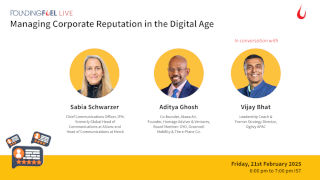
Trust crises erupt when operational failures or leadership remarks collide with public anger online, rapidly eroding confidence in a company’s intent, competence and culture, as seen with L&T and IndiGo in 2025.
This Founding Fuel Live discussion explored crisis management, trust-building, and stakeholder engagement in the digital age. The session brought together corporate leaders and communication experts to explore how reputation today is shaped in real time—by social media, AI-driven amplification, and a fragmented public discourse.
Insight: Listen early, especially to frontline colleagues who often spot risks before they explode in public.
“One of David Ogilvie's famous quotes is that [leaders should have] big ears rather than big mouths.”
Dig Deeper: How L&T completely muffed up a valuable teachable moment
2. Not the Pilot’s Fault: Inside the First 61 Seconds of AI171
By Indrajit Gupta; Read Time: 5 mins

Early narratives and preliminary reports following the tragic Air India Flight AI171 crash sparked intense speculation about pilot error. So what really happened?
Our deep-dive goes beyond surface explanations to reconstruct the first 61 seconds of the flight using preliminary data, CCTV imagery, and expert interpretation. It challenged the dominant narrative and instead explored the possibility of systems failure.
Insight: “The RAT appears deployed within a second or two after lift-off—a highly unusual event that suggests the triggering failure occurred even before the aircraft had left the ground.”
Dig Deeper: AI171: Human Error, Design Flaw, or Something Else?
This story offers a snapshot of the theories in circulation and the questions they raise; an exclusive interview with the FF authors by Anuradha Sengupta; and links to our three-part series on the crash investigation.
3. Nuance is the new differentiator
By Shrinath V; Read Time: 7 mins

In an era when every team has access to powerful AI tools and richer data pipelines, the real competitive edge lies not in collecting more numbers but in understanding what isn’t being said—the cultural cues, habits, and contextual subtleties that data alone can’t capture. In trying to build for a complex market like India, these broader invisible layers often matter more than what is measurable.
Demonstrating with real cases, Shrinath V argues that to succeed, organisations must cultivate discernment—the ability to hear hesitations, spot what’s missing, and see context that quantitative signals flatten out.
Insight: “The real risk isn’t that AI will hallucinate facts. It’s that humans will hallucinate meaning—from summaries that feel tidy, predictive, and authoritative.”
4. WPP’s Existential Dilemma: Falling Prey to the AI Narrative
By Shekar Swamy; Read Time: 3 mins
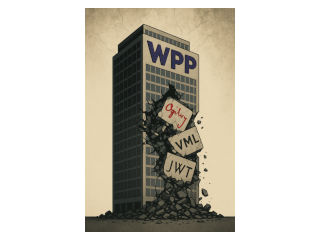
As the advertising world wrestles with technological disruption and the promise of AI, WPP—once the world’s largest advertising holding company—finds itself at a strategic crossroads.
This is a cautionary tale about strategy, culture, and hype.
Shekar Swamy argues that the appointment of a new CEO with deep tech credentials shows WPP’s over-emphasis on AI and digital transformation at the expense of the company’s foundational strengths in creativity and client insight.
Insight: “Marketing Services is a deeply nuanced business. It runs on creative excellence, deep domain knowledge, and the ability to solve client problems with empathy and insight. Technology plays a role—but this is not a technology business.”
5. The Quiet Drift Toward Precarity
By Vineet Kaul; Read Time: 5 mins
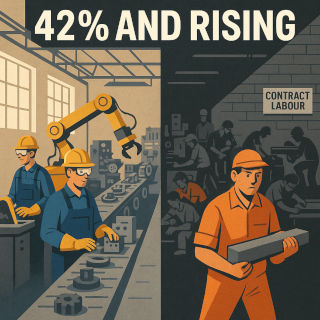
India celebrates manufacturing growth, but there’s a deeper structural shift that has barely registered in headlines: nearly 42% of organised manufacturing workers are now on contract, the highest level ever recorded. Vineet Kaul unpacks what this means for the health of India Inc and why this quiet drift toward precarious work could reshape the future of jobs, trust, and competitiveness in the economy.
The article warns that these structural inequalities carry legal risks, weaken trust inside firms, and risk erupting into bigger social and industrial conflicts if left unaddressed.
Insight: “These may appear like operational details, but they cut deep. They create a cultural fault line that can destabilise even the most efficient organisations.”
Dig Deeper: India’s Labour Codes: The Shift from Protecting Jobs to Formalising Work
6. The Paradox of Excellence
By Satish Pradhan; Read Time: 6 mins

In early December, IndiGo—India’s dominant airline and a global benchmark of operational efficiency—faced an unprecedented crisis of flight cancellations and systemic disruption. While most commentators treated it as a scheduling or staffing failure, Satish Pradhan went deeper: IndiGo’s crisis was not a lapse in competence but a failure of adaptation. The organisation’s vaunted strengths—discipline, optimisation, and relentless efficiency—became the very forces that made it fragile.
Pradhan offers a rare perspective on the limits of high-performance systems in rapidly shifting contexts. When regulatory changes tightened crew limits, the airline leaned on its institutional confidence—not recognising the deeper shift in constraint—and found that past strength didn’t guarantee future success.
Insight: “Excellence, left unexamined, can erode the very foundations that sustain it. Recognising limits is not weakness—it is the highest form of institutional maturity.”
Dig Deeper: Part 2: When A Leader Stumbles
7. The Government Works—Just Not How You Think
(Watch time: 43 min / Read Time: 2 min)
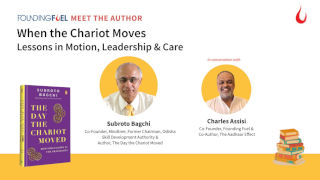
There’s often a cynical dismissal when people talk about governance and bureaucracy. This conversation reframes how we think about government. Subroto Bagchi—co-founder of MindTree, former chairman of the Odisha Skill Development Authority, and author of The Day the Chariot Moved—shows how India’s government functions not as a broken machine but as a living system quietly advancing the nation through everyday service, empathy, and idealism.
Bagchi highlights how public systems deliver during crises and continue to enable everyday progress. He argues that real corruption often lies in societal behaviour, and that idealism is not naive but essential to reignite civic spirit and strengthen institutions.
Insight: “During COVID, everything was locked down, yet food came to our plate. Freight trains moved, hospitals ran, law and order held. It wasn’t the private sector in command—it was the government.”
8. Who Will Win the MAGA Crown?
By Sundeep Waslekar; Read Time: 4 mins

As the US heads toward the high-stakes 2026 Congressional elections, the once-unified Make America Great Again (MAGA) movement shows increasing internal strain. Sundeep Waslekar’s analysis reveals a multi-sided contest over America’s future direction.
He identifies three competing currents within MAGA: the accelerationists who urge rapid AI leadership and openness to global talent; the sceptics who fear AI will centralise power and erode sovereignty; and the nationalist-pragmatists who seek a balance of technological competitiveness and domestic resilience. The internal debates will have global implications.
Insight: “The outcome of this internal MAGA contest will influence talent flows, AI investment, regulatory norms, and supply-chain alliances far beyond US borders”
9. The Year the World Learned to Live Without America
By Dinesh Narayanan; Read Time: 7 mins

Dinesh Narayanan’s essay wraps up the 2025 In Review series that he anchored. It’s a sweeping geopolitical analysis of how global power and alliances were reshaped as the US stepped back from its post-World War II leadership role. This piece weaves expert voices, on-the-ground nuance, and real diplomatic shifts into a clear account of how tariffs, shifting alliances, and strategic recalibrations from China, Europe and India produced a more diffused global order — one where nations are learning to act independently of Washington’s script.
From Europe’s complicated responses to Trump’s tariffs to China’s assertive economic moves and India’s narrower strategic room for manoeuvre, the piece shows how the world is no longer organised around American leadership but must now engage with a multipolar reality.
Insight: “China now sees India as one of only two anchors of stability in a turbulent world, the other being itself. In the past, India-China relations often shifted with the temperature of India’s ties with the US. China now appears to believe it makes sense to work more closely with India. This convergence, however, is tactical rather than structural.”
10. Alive in the In-Between
By Kavi Arasu; Read Time: 3 mins

In a culture that prizes constant motion and visible productivity, Kavi Arasu reframes pause and transition not as failures to be rushed through but as fertile spaces where renewal and deeper insight take root. Drawing inspiration from Brisbane’s “Vibrantly Vacant” initiative and legendary stories like Steve Jobs’ fallow decade, the article applies rich metaphor and psychological insight to life, leadership, and organisational growth, encouraging readers to tend the in-between—the neutral zone between endings and beginnings—with care rather than panic.
This neutral zone is where clarity, learning, and creative recombination happen.
Insight: “Being vibrantly vacant is more than sitting still. It is being alive in the in-between—attentive, reflective, open to what might emerge.”
P.S. Our long list included these:
The Tariff Trap: Why Economic Weapons Misfire in the Age of Silicon
Shishir Prasad argues, tariffs were designed for a world of steel and sugar. They’re hopelessly out of sync with the quantum-entangled world of semiconductors. (Read Time: 6 mins)
Terry Szuplat on the Art of Powerful Communication
Terry Szuplat, former senior speechwriter to President Barack Obama and author of Say It Well, and business leader and author D. Shivakumar, discuss the timeless art of moving audiences to action. (Watch Time: 31 mins/Read Time: 1 min)
The One Leadership Skill We Forgot to Teach
Kavi Arasu says, in an age of noise, overload and drifting meetings, facilitation is no longer a “tool”, it’s a core leadership discipline. (Read Time: 5 mins)
Toxic Greed: How a $12.5 Billion Crisis Exposed a Global Corporate Failure
When innovation icons turn into liability machines, Devengshu Dutta writes, it’s not chemistry that fails—it’s governance, incentives, and courage (Read Time: 4 mins)
Join the conversation
Founding Fuel aims to create the new playbook of entrepreneurship. Think of us as a hub for entrepreneurs- the go-to place for ideas, insights, practices and wisdom essential to build the enterprise of tomorrow. It is co-founded by veteran journalists Indrajit Gupta and Charles Assisi, along with CS Swaminathan, the former president of Pearson's online learning venture.
Beyond the noise is the signal.
FF Insights: Sharpen your edge, Monday–Friday.
FF Life: Culture, ideas and perspectives you won't find elsewhere — Saturday.

Founding Fuel is sustained by readers who value depth, context, and independent thinking.
If this essay helped you think more clearly, you may choose to support our work.

Founding Fuel is sustained by readers who value depth, context, and independent thinking.
If this essay helped you think more clearly, you may choose to support our work.
Loading comments...



Readers also liked
·Economy, Policy & Society
The Best Stories of Summer 2026
Ideas that help make sense of a changing world
FF

Founding Fuel
The Best Stories of Summer 2026
Ideas that help make sense of a changing world

·FF Life
The Best of FF Life 2025
11 stories that asked us to slow down, look closer, and feel more deeply
FF
Founding Fuel
The Best of FF Life 2025
11 stories that asked us to slow down, look closer, and feel more deeply

·Work, Careers & Personal Mastery
The Best Business Books of 2025
Ten essential reads on money, leadership, and navigating a changing world
DS

D Shivakumar
Operating Partner | Advent International
The Best Business Books of 2025
Ten essential reads on money, leadership, and navigating a changing world
Operating Partner | Advent International
Explore more
Dive into other themes from our network.