The Case for Knowing Things You Don’t Need to Know
The things we learn outside our fields may sharpen how we see the world. But perhaps they matter most when we stop asking what they are useful for
30 August 2026· 4 min read· 3 comments
TL;DR
This article argues for the profound value of cultivating knowledge and passions beyond one's immediate professional field. Citing figures like Peter Drucker, who deliberately studied diverse subjects from medieval history to art, and Yogi Sriram, an HR executive whose passion for model trains honed his electronics skills, the piece demonstrates how intellectual "width" is crucial for maintaining mental acuity. While corporate environments often reward specialisation, engaging with seemingly unrelated disciplines sharpens one's perspective, provides multiple "frames" for innovative problem-solving, and offers a unique source of personal satisfaction. Ultimately, embracing knowledge for its own sake enriches one's understanding of the world and strengthens approaches to complex challenges.
Peter Drucker, I read recently, had a method for keeping his mind alive. It was learning outside your field. Every three or four years, he would pick a new subject and study it seriously. At one point, he was immersed in medieval history, a subject with nothing to do with organisations at all.
Here was one of the most consequential thinkers on organisations. His method for staying sharp had nothing to do with organisations.
Drucker went further than merely study. He praised sabbaticals and parallel careers. He told people to build second identities. Turn a retirement into a new vocation. Take a side interest and make it the main thing. He thought longer lives were an argument for living in more than one dimension.
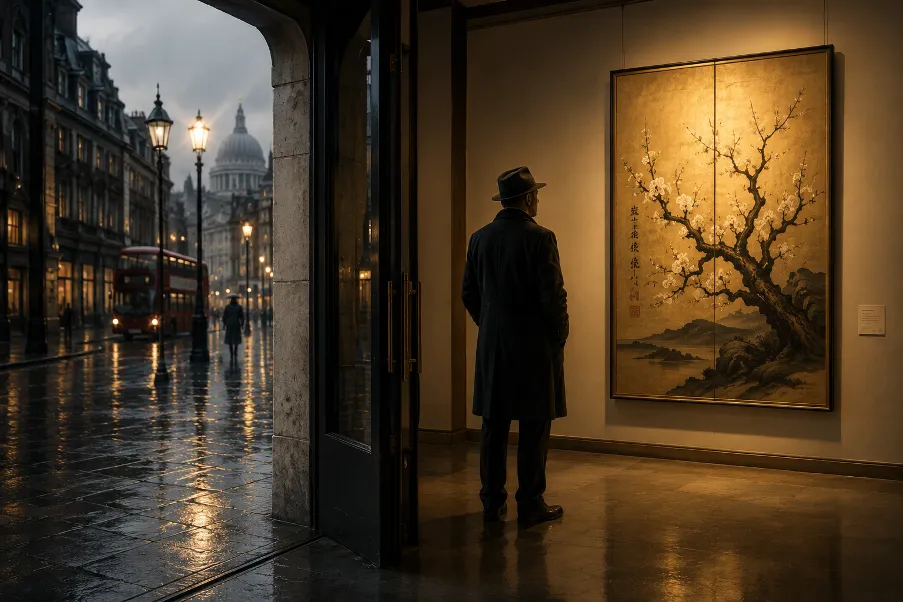
He did this himself. He wrote, taught, and consulted. His collection of Japanese art was museum quality, and it began by accident, when he stepped out of a London rainstorm into an exhibition. In his sixties he tried to become a novelist. This was not one of his successes.
I like that the width did not always pay off. It makes the point more honest. His wife Doris was wider still. A master’s degree in physics in her fifties. An invention and a company in her eighties. A memoir in her nineties. Drucker looks almost narrow beside her.
Years ago, I chanced upon a piece about Yogi Sriram, former HR head at L&T. He'd spent decades in corporate HR, trained in economics, business, and law, nowhere near engineering. His hobby was model trains, over thirty-two of them at the time, many rigged with whistles, bells, and the chuff-chuff of a steam engine, in a room he kept for them, with track running along the ceiling of his living room too.
It began at nine, when his parents took him to Hamleys in London and he chose a Tri-ang locomotive. He still had it working, fifty-one years on, when the piece was written. “I do the electronics myself,” he said. “It is my passion to learn and practice electronics.” He fitted the decoders himself, soldering twenty-one different coloured wires into a space smaller than a matchbox, hands, eyes, and concentration all pulled in at once. He called what happened there situated learning, real learning that happens inside the thing you are actually doing, not in a classroom about it.
His wife Sujata framed it differently at the time, and I think she was onto something. Corporate work runs almost continuously, a phone in every pocket. The trains gave him a kind of satisfaction that had nothing to do with the job, and that was precisely what let him disconnect from it.
The case for learning outside your field
Width is easy to admire and hard to promote inside an organisation. Most professional life rewards depth. The specialist gets promoted. The person with too many interests looks unfocused. Study twelfth-century Paris on company time and see how that lands.
And still, after years in rooms with senior people, I have noticed something. The ones who read a situation best are often the ones who have seen the most unrelated things. They catch a pattern from somewhere else. A problem in a supply chain reminds them of something in a hospital, or an orchestra, or a war they once read about.
A person with one frame sees one meaning. A person with many sees choices.
Where the frames come from
This sits close to what I keep returning to in my own work. Interpretation depends on the frames you can bring to a thing. A person with one frame sees one meaning. A person with many sees choices.
A supply chain problem looked at only as a supply chain problem stays a supply chain problem. Looked at also as a trust problem, or a timing problem, or a communication problem between two teams that dislike each other, it opens into something you can actually work with. Width is where those extra frames come from. Nobody hands them to you inside your own function.
The coffee bean reset
There is an old perfumer’s trick of smelling coffee beans between scents, supposedly to reset the nose. Without it, the second scent can blur into the memory of the first.
Medieval history may have worked the same way for Drucker. It cleared frames worn thin by decades in one field. He came back to the organisation and saw it, rather than the residue of what he had been staring at for three years.
These feel like two different claims. The frames idea is about accumulation, more perspectives, more choices available. The coffee bean idea is about perception, clearing what has gone stale so the next thing can be seen at all. Width may do both. I am not yet sure which one is doing more of the work in any given case.
Diverging from Drucker
Then there is the part I cannot settle.
Drucker treated all of this as technique. He applied the methods to himself, deliberately, for the return.
I am not sure the return comes when you chase it.
The study worked, I suspect, because he found the subject genuinely interesting, and not because he expected it to sharpen his management thinking. The moment width becomes a productivity strategy, it may stop doing the thing that made it valuable. Curiosity that only exists for a reward is a thin kind of curiosity.
So I am holding two thoughts that do not quite fit.
Width makes you a better interpreter of the world. And width probably only works when you are not pursuing it for that reason.
I cannot reconcile them yet. Maybe the answer is that you cultivate the habit and forget the purpose. You keep learning outside your field for its own sake, and let the perspective arrive as a by-product you never planned.
Or maybe some people really can do this coldly, for the payoff, and I am wrong about that.
The intensity sharpens execution. The width sharpens judgement about what is worth executing at all.
The grind and the width
The argument for intensity at work is not necessarily an argument against width. The two still cost each other. An afternoon spent on Japanese art is an afternoon not spent on the next quarter. But they are answering different questions.
Maybe the honest version is this. Work with everything you have on the problem in front of you. And keep something running alongside it that has nothing to do with that problem. The intensity sharpens execution. The width sharpens judgement about what is worth executing at all.
Drucker seemed to manage both. I am less sure the rest of us can hold that shape for very long.
I once worked with a head of supply chain, one of the sharpest minds I have worked with. He loved cricket. He was a serious collector of films. He carried a full written catalogue of his collection in his wallet, kept up to date by hand.
Watching a film to switch off for the evening is a different thing entirely. He went deep into it. He knew directors, restoration histories, which print was better than which and why.
I am not sure his width did anything for his supply chain work. I am not sure it needed to. Maybe not all width is in service of something else. Some of it just wants attention for its own sake, and that might be the healthiest version of it.
Perhaps that is reason enough to keep something in our lives that we are not trying to turn into an advantage. Something we learn simply because, for reasons we cannot quite explain, we want to know more.
Join the conversation
Kavi Arasu
Works at the intersection of people, systems, and organisational change
Kavi Arasu works at the intersection of people, systems, and organisational change. His work has taken him across multinational corporations and high-growth enterprises in India and internationally, giving him a grounded view of how transformation actually plays out, as opposed to how it gets described in strategy decks.
Over the last decade, his work has centred on partnering with CEOs and senior leadership teams through business transitions, digital transformation, and cultural change. He has supported leadership transitions, post-M&A cultural integration, and the kind of long-term stewardship of values that rarely gets noticed until it's missing. AI is now one strand of that work. Leaders are trying to work out what it changes and what it doesn't, and that question sits comfortably inside the change problems he has spent decades on.
He runs Flyntrok, an advisory practice built around change challenges that rarely arrive with instructions. He also teaches at a leading business school and speaks at leadership forums internationally. He used to run long distances. These days he runs Flyntrok instead, which he maintains is no less demanding.
He works very closely with the core team at Founding Fuel on learning and change initiatives and is a regular contributor. He lives in Mumbai, a city he finds well suited to thinking clearly amid constant motion.
Beyond the noise is the signal.
FF Insights: Sharpen your edge, Monday–Friday.
FF Life: Culture, ideas and perspectives you won't find elsewhere — Saturday.

Founding Fuel is sustained by readers who value depth, context, and independent thinking.
If this essay helped you think more clearly, you may choose to support our work.

Founding Fuel is sustained by readers who value depth, context, and independent thinking.
If this essay helped you think more clearly, you may choose to support our work.
Loading comments...



Readers also liked

·FF Life
Who Gets to Decide What Happens at the End of Your Life?
Living wills remain on the fringes, but they are forcing India to confront family power, cultural taboo, and the realities of end-of-life care—signalling a profound shift in how the country thinks about dignity and medical decision-making
SB

Sveta Basraon
Editor and Head of Operations | Founding Fuel
Who Gets to Decide What Happens at the End of Your Life?
Living wills remain on the fringes, but they are forcing India to confront family power, cultural taboo, and the realities of end-of-life care—signalling a profound shift in how the country thinks about dignity and medical decision-making
Editor and Head of Operations | Founding Fuel

·FF Life
Art under the eye of the Mother Goddess
10 best Durga Puja pandals of Kolkata 2024 | Art in the shadow of trauma: Durga Puja art is, more often than not, the art of social cause. Many of the pandals this year were muted, yet displayed a burst of breathtaking creativity
RR

Ronaan Roy
Former Deputy General Manager | Mahindra
Art under the eye of the Mother Goddess
10 best Durga Puja pandals of Kolkata 2024 | Art in the shadow of trauma: Durga Puja art is, more often than not, the art of social cause. Many of the pandals this year were muted, yet displayed a burst of breathtaking creativity
Former Deputy General Manager | Mahindra

·Work, Careers & Personal Mastery
FF Insights 714: Serena Williams unplugged
August 11, 2022: The case for diversity, The problems with Bitcoin, Change explained
FF

Founding Fuel
FF Insights 714: Serena Williams unplugged
August 11, 2022: The case for diversity, The problems with Bitcoin, Change explained
Explore more
Dive into other themes from our network.