
The System China Built, and India Has Yet to Understand
7 April 2026· 8 min read
TL;DR
China's innovation ecosystem, exemplified by CATL's battery advancements, signals a fundamental shift: it's no longer adapting technologies but redesigning entire innovation architectures. This creates an "integrated innovation machine" where state, enterprise, and academia form a tightly coupled network, driven by a "mission-oriented state" that shapes markets, fostering aggressive scaling and self-reliance. Breakthroughs strategically cascade into other sectors, compounding capabilities and establishing global dominance. However, this massive, state-directed coordination is far from flawless. When the state places huge bets, the failures are correspondingly spectacular.
The contrast with India is not a lack of ambition, but a lack of integration. Technological cross-pollination into new niches with conscious intent is notably less prevalent. Understanding this re-engineered, self-sustaining innovation engine is crucial, as India competes against a formidable system, not just individual firms.

Earlier this year, CATL, the world’s largest electric vehicle battery maker, announced a quiet breakthrough. It had redesigned the battery cell architecture to eliminate the graphite anode, a key battery component that accounts for a third of a lithium-ion battery’s weight. Graphite anodes have also been a constraint in the EV supply chain. At the same time, the company pushed forward on sodium-ion batteries, once dismissed as impractical, making them viable even in extreme cold.
On the surface, these look like incremental advances. In reality, they signal something more consequential. China is no longer catching up. It is redesigning the system itself. That changes the nature of competition.
This has a huge implication for India, which is not merely competing against a set of companies or technologies. It’s competing against an integrated innovation machine, one where breakthroughs in one sector spill over into others, and scale turns into sustained advantage.
From Breakthroughs to Dominance
The battery story is not an isolated one. With CATL and BYD together controlling an estimated 60–70% of the global EV battery supply chain, China has moved from participation to dominance. Scale is no longer just an economic advantage; it is strategic. It allows Beijing to shape cost curves, technical standards, and the direction of the energy transition itself.
China is no longer catching up. It is redesigning the system itself.
What appears as a technological lead is, in fact, the visible output of a deeper shift. China is no longer adapting Western technologies. It is building the architectures that define how technologies evolve. This pattern is now visible across sectors—AI, quantum computing, biotechnology, advanced manufacturing. To understand what this means, one has to move beyond individual breakthroughs and ask: what makes this system possible?
Decoding the Machine
China’s innovation landscape is best understood not as a collection of sectors, but as a complex adaptive system where the state, private enterprise, and academia operate not in silos, but as a tightly coupled network. Three interlocking forces drive this system.
1. The Mission-Oriented State
At the core sits a strategic state that does not merely regulate markets: it shapes them. Dan Wang, the Canadian tech commentator, aptly characterises this in his widely acclaimed book Breakneck: China’s Quest to Engineer the Future by calling China an “Engineering State”. A 2024 commentary from China’s Ministry of Science and Technology framed it starkly: technological competition is ultimately a contest of political systems.
As Wang's work underscores, this is not rhetoric; it is operational doctrine.
Over two decades, China has pursued self-reliance in areas ranging from quantum communications and semiconductors to electric mobility, following a consistent rhythm: start early, scale aggressively, and reduce dependence on external systems. Consider the display industry.
In 2004, Chinese firms had virtually no presence in global LCD production. By 2024, companies like BOE and TCL accounted for over 70% of global output. This was not a market accident. It was the result of sustained state support, coordinated subsidies, patient capital, and deliberate, long-term capability-building.
But the deeper insight lies beneath the surface. Mastering display technologies did more than build a competitive industry; it created capabilities that could be carried into adjacent sectors, including semiconductors. Each industrial push becomes a stepping stone into more complex domains. This is how systems compound. This represents a deliberate strategy of edging into adjacencies, using a breakthrough in one domain to systematically unlock use cases in others. This cascading effect is a distinctive feature of China's innovation machine, whereas in India, technological capabilities rarely cross-pollinate into new niches with such conscious intent.
2. The Execution Machine: Private Sector Dynamism
State direction alone does not create innovation. Under Xi Jinping, China’s science and technology programme, characterised as top-down (dingceng sheji), laid guidelines entailing strategic considerations to ensure comprehensive, coordinated, and sustainable reforms.
Chinese policymakers have shown remarkable ingenuity in ensuring coordinated development. For instance, in June 2024, Zheng Shanjie, chairman of China's National Development and Reform Commission (NDRC), met with representatives of five high-tech private firms to gather strategic inputs for the 15th five-year plan (2026-30) to develop “new quality production forces”. These private firms embody pillars of China’s strategic development in AI, underscoring the leadership’s intent to make innovation a driver of national cohesion and integrating business into national planning to overcome external bottlenecks.
China’s private sector is the execution engine that translates this intent into capability. Beyond giants like Alibaba, Tencent, Huawei, and BYD lies a dense, hyper-competitive ecosystem. This ecosystem operates as a "gladiator pit" where only the most agile survive.
Researchers such as Mark Greeven, professor of Innovation and Strategy at the International Institute for Management Development, identify this layer as a matrix of “hidden champions” and “tech underdogs”—firms like Lens Technology, which quietly cornered the global market for precision sensor modules, or Weihua Solar, which engineered flexible solar cells with world-leading efficiency. This vitality is further evidenced by “change makers” like Ele.me, a startup born in a university dorm that scaled to over $1 billion in revenue before being acquired by Alibaba. These examples dismantle the stereotype of a rigid economy, revealing a brutal meritocracy that forces rapid iteration.
According to Greeven and his fellow researchers, these hidden champions pursue ceaseless product innovation, scale up to international markets within five to ten years, and move with an agility that consistently catches non-Chinese competitors off guard. A notable example is Elon Musk’s early dismissal of Chinese New Energy Vehicle (NEV) players like BYD, only for BYD to surprise Tesla and the world by taking the lead in the EV industry.
The result is speed with coordination. Consider BYD’s massive overseas push: Nikkei Asia notes that BYD has expanded aggressively into Southeast Asia (traditional strongholds of Japanese automakers) resulting in a significant loss of regional market share for giants like Toyota, Honda, and Mitsubishi. This dominance stems from how BYD designs its own batteries, semiconductors, and power electronics, integrating them in tightly controlled cycles. What might take years across fragmented supply chains elsewhere can be compressed into months.
This dynamic execution is actively repeating in new sectors. According to Nikkei Asia, over 100 Chinese companies, including established heavyweights like CATL and BYD alongside highly agile startups like UtmoLight, are currently racing to mass-produce advanced perovskite solar cells. Benefiting from an open development environment and an influx of overseas-trained talent, these firms are quickly launching gigawatt-scale production lines, severely threatening the slower, more cautious development cycles seen in competing nations like Japan.
In hubs like Shenzhen, component suppliers, tooling experts, manufacturers, and logistics providers are tightly clustered, allowing rapid testing and scaling. What creates real advantage is not invention alone, but how quickly invention becomes deployable reality.
The real advantage is not invention alone, but how quickly invention becomes deployable reality.
3. The Transmission Belt: Academia, Industry, State
The third pillar is the lab-to-market pipeline. Elite institutions like Tsinghua and Peking University function as incubators of national capability. The ignition of China's innovation, from EV batteries to AI, is fueled by a massive surge in R&D investments, which have tripled in the past decade, moving China into second place globally. According to studies by the Australian Strategic Policy Institute, researchers in China lead the world in widely cited papers across 52 out of 64 critical technologies. In the EV battery sector, China boasts nearly 50 graduate programmes focused on battery chemistry and metallurgy, motivated by a deep-seated policy urge to translate scientific investments into sweeping economic efficiency gains, as observed by The New York Times.
Consider Tsinghua University. Its research labs incubated Zhipu AI, founded by Professors Tang Jie and Liu Juanzi. From there, knowledge and talent flowed outward, shaping newer ventures like Moonshot AI, co-founded by Yang Zhilin, a former student of Zhipu AI’s founders. What begins as academic research is quickly translated into products and strategic capabilities.
This is the “triple helix” in action—where the state sets direction, academia generates knowledge, and industry executes at scale. Government guidance funds reinforce this system. Over 2,000 such funds, totalling nearly a trillion dollars, pool public and private capital to target strategic sectors.
Ultimately, the underpinning 'glue' of this entire machine is alignment. The system holds together because state capital, academic research mandates, and the commercial survival of private enterprises are all tethered to the exact same set of enforced geopolitical targets.
The Cost of a Top-Down Machine: Systemic Blowouts
However, this massive, state-directed coordination is far from flawless. When the state places huge bets, the failures are correspondingly spectacular. The semiconductor “Big Fund,” for instance, became a glaring example of systemic imperfection; despite immense funding, it faced leadership probes and tighter oversight following massive underperformance and misallocation of capital. Several high-profile chip projects have also been shut down after failing to deliver. While officials and institutions are eventually evaluated on outcomes, creating strong incentives to translate policy into results, the sheer scale of these blowouts reveals the deep inefficiencies of a state-led machine.
Much of China’s innovation drive stems from what has been described as an “entrepreneurial state”—one that actively takes risks by building a highly networked R&D ecosystem in pursuit of national objectives. In such a system, taking risks on a massive scale makes spectacular failures an inevitable price of doing business. However, the system's method for dealing with these setbacks is telling. It does not rely on organic market corrections; instead, it enforces course correction through brutal, top-down accountability. When humongous capital injections into flagship science projects breed corruption, the state responds ruthlessly—such as handing a 12-year prison sentence to leading geneticist Li Ning for embezzling millions in strategic biotech funds, and similarly purging other “academic warlords” at elite institutes.
Yet, this creates a profound paradox. Because the state insists on “picking winners” based on geopolitical priorities rather than market-driven scientific advancement, the overarching policies that created these vulnerabilities become institutionalised and resistant to change. The system can jail an errant scientist or shut down a bad project, but it struggles to pivot away from suboptimal development paths once political capital is locked in. Consider the development of state-sponsored tech parks: driven by top-down economic targets, local governments heavily subsidized Foreign Direct Investment (FDI) over fostering clusters of innovative startups. This inadvertently created "high-tech enclaves" that favoured multinational corporations, actively starving domestic startups of incentives and forcing them into unfair competition. It undermined the very grassroots innovation the state sought to foster, but because the policy was so deeply entrenched, the structural inertia made it incredibly difficult to reverse.
The Mirror: India’s Paradox
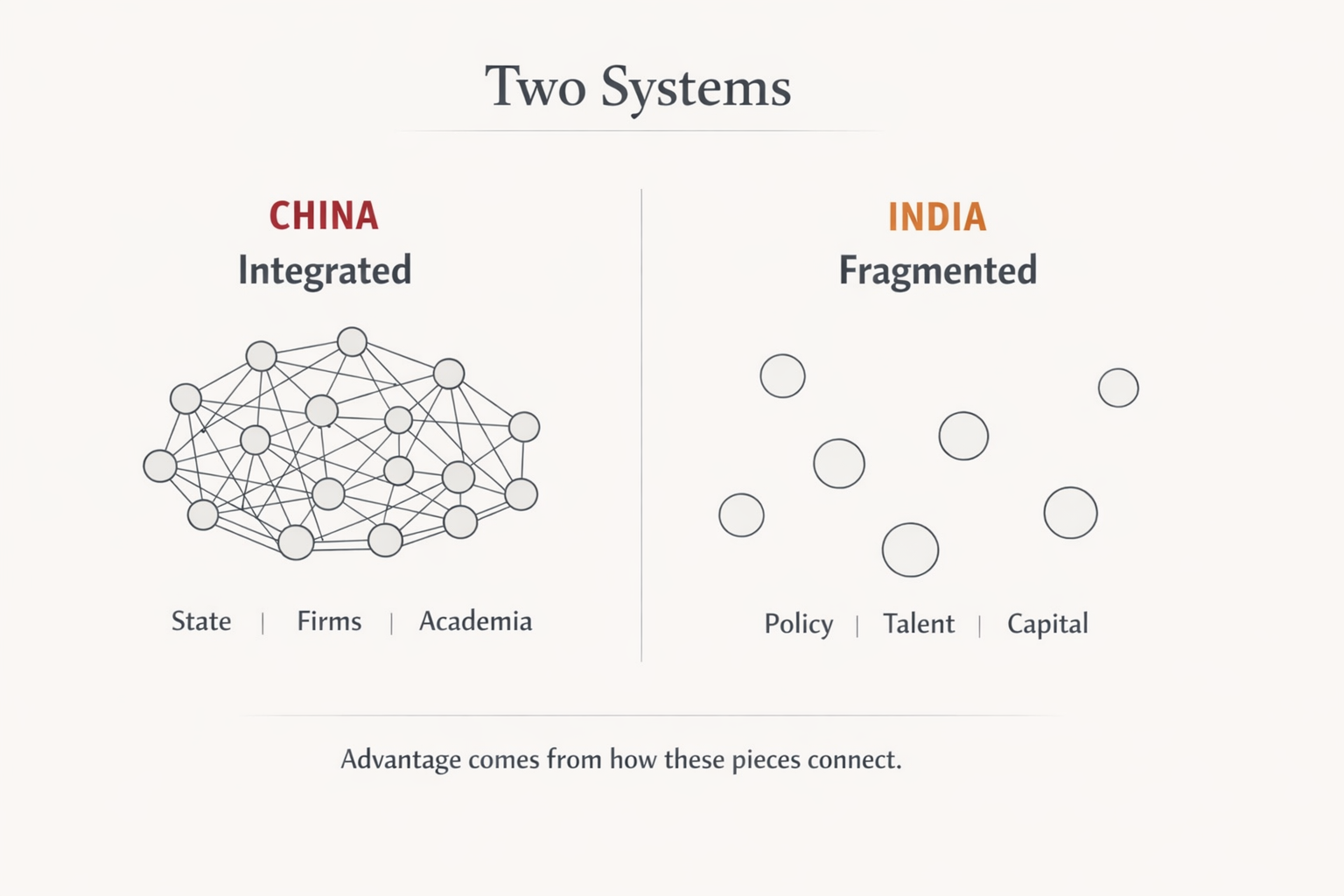
The contrast with India is not a lack of ambition, but a lack of integration. The semiconductor sector illustrates this clearly. Despite capital mobilisation and policy intent, efforts remain dispersed, lacking the scale, coordination, and long-term alignment needed to move beyond assembly into deep capability. This is a question of system design.
India’s successes are real, but they remain isolated, not yet part of a system that compounds them.
India’s startup ecosystem has produced unicorns at scale, but intellectual property remains shallow, revealing a gap between valuation and foundational innovation. There are exceptions, such as India’s space programme and the defence innovation ecosystem under iDEX, which demonstrate what mission-oriented approaches can achieve. But these remain islands of coherence in a broader landscape of fragmentation.
Besides, historically, such successes have relied heavily on the sheer brilliance of visionary individuals. When these figures exit, they often leave behind a leadership vacuum. China’s system is different; it is designed for institutional continuity, ensuring that momentum survives the departure of any single leader.
Thus, while India’s successes are real, they remain isolated, not yet part of a system that compounds them.
What Is at Stake
China’s rise in deep tech is geopolitical. By dominating critical sectors, China is shaping not just markets, but dependencies.
Dependence is not always coercive. It is often structural. It shows up in supply chain chokepoints, standards that lock ecosystems in, and technological architectures that limit strategic choice. Consider electric vehicles. With a majority share of global battery production concentrated in Chinese firms, any country seeking to scale EV adoption must, in practice, align with that ecosystem, whether in sourcing, technology standards, or supply chains. There may be no explicit pressure. But the range of viable choices narrows. Constraint, in such cases, is not imposed. It is built into the system.
The Choice Ahead
India does not need a new set of ideas. Many of the elements are already in place: policy intent, capital, talent, and entrepreneurial energy. The difficulty lies elsewhere. These pieces rarely come together in a sustained, coordinated way.
Consider semiconductors. Over the past decade, multiple efforts have been launched, backed by incentives, partnerships, and policy support. Yet projects have struggled to move from announcement to execution at scale, often slowed by shifting priorities, coordination challenges, and gaps across the value chain. The problem is not starting. It is sustaining. Initiatives begin with momentum, but often operate in silos. Policies evolve, but institutions do not always move in sync.
The challenge, then, is not to replicate China’s model. It is to build mechanisms that ensure continuity, coordination, and accountability across the system. That means aligning policy, capital, and capability around strategic sectors; strengthening the academic–industry interface; building firms that operate as integrators, not just participants; and creating pathways that allow innovation to scale, not stall.
Above all, it requires a shift in mindset. From isolated initiatives to coordinated systems. Because in the emerging technological order, advantage does not come from individual breakthroughs. It comes from the ability to make those breakthroughs compound.
In the end, the contest is not over technology. It is over who can build systems that turn technology into power.
Join the conversation
G Venkat Raman
Professor, Humanities and Social Sciences | Indian Institute of Management, Indore
Dr G. Venkat Raman is Professor at the Indian Institute of Management Indore. A Sinologist by training, he received his PhD from Peking University, Beijing, and is fluent in Mandarin. He was a Fulbright Fellow at the Schar School of Policy and Government, George Mason University, during 2023–24, where he taught The China Challenge and researched US–China strategic rivalry.
His current research focuses on China, global governance, multilateralism, geopolitics and international political economy, with particular interest in India and China’s engagement with the evolving global order. He teaches courses on geopolitics and international business, global governance, China, and business ethics. He has held research and teaching affiliations with Fudan University, Shanghai, and ICN Business School, France, and is an Honorary Fellow at the Institute of China Studies, New Delhi.
Venkat has published academic research and case studies on China and related themes and is co-editor of Locating BRICS in the Global Order: Perspectives from the Global South (Routledge). He also contributes regularly to leading English-language newspapers and international policy platforms, including East Asia Forum, The Interpreter and Asia Times, writing on China, geopolitics, global governance and the changing international political economy.
Beyond the noise is the signal.
FF Insights: Sharpen your edge, Monday–Friday.
FF Life: Culture, ideas and perspectives you won't find elsewhere — Saturday.

Founding Fuel is sustained by readers who value depth, context, and independent thinking.
If this essay helped you think more clearly, you may choose to support our work.

Founding Fuel is sustained by readers who value depth, context, and independent thinking.
If this essay helped you think more clearly, you may choose to support our work.
Loading comments...


Readers also liked

·Economy, Policy & Society
Who Was the School Day Built For?
India’s school system was built to educate at scale. Its classrooms, exams and incentives reveal what that design rewards—and the individual child it struggles to see.
NA

Nandita Abraham
Founding Dean | BITS Design School, Mumbai
Who Was the School Day Built For?
India’s school system was built to educate at scale. Its classrooms, exams and incentives reveal what that design rewards—and the individual child it struggles to see.
Founding Dean | BITS Design School, Mumbai

·Economy, Policy & Society
How the Iran War Is Reshaping the Global Economy
The conflict is no longer just a military confrontation. It is rapidly becoming a struggle over the global energy system, maritime trade and geoeconomic power—with the Gulf caught in the middle
VK

Vivek Y. Kelkar
Researcher, Analyst & Columnist on Geo-economics, Geopolitics and Sustainability
How the Iran War Is Reshaping the Global Economy
The conflict is no longer just a military confrontation. It is rapidly becoming a struggle over the global energy system, maritime trade and geoeconomic power—with the Gulf caught in the middle
Researcher, Analyst & Columnist on Geo-economics, Geopolitics and Sustainability

·Leadership & Organisation
The Battle Cry in the Boardroom
What looks like motivation—war footage, heroic narratives, calls to crush the competition—is often something else entirely: a system of thinking that rewires how organisations see markets, customers, and themselves
KA

Kavi Arasu
Leadership and Talent Development Professional
The Battle Cry in the Boardroom
What looks like motivation—war footage, heroic narratives, calls to crush the competition—is often something else entirely: a system of thinking that rewires how organisations see markets, customers, and themselves
Leadership and Talent Development Professional
Explore more
Dive into other themes from our network.