Trendspotting 2026: India Cannot App Its Way to Prosperity
Another 50 tech IPOs won’t build a middle class
1 February 2026· 8 min read
TL;DR
This compelling analysis critiques India's growth model, arguing that reliance on tech IPOs and consumption-driven platforms creates an illusion of prosperity, delivering convenience but failing to address fundamental challenges like mass employment, industrial capacity, or a robust middle class. The article powerfully asserts that digital dividends cannot substitute for deep structural development, hard tech innovation, or global-scale R&D. For business leaders, this offers a vital insight: as the global economy hardens, sustainable growth demands moving beyond fleeting market cycles. The imperative shifts to investing in foundational industrial strength, advanced skills, and frontier science—truly building a resilient future, not just narrating it.

Editor’s Note: The Union Budget and the Economic Survey are annual moments of stock-taking—when numbers, narratives, and national priorities briefly come into sharper focus. This year’s emphasis on sustaining public investment, even as the conditions for broader private capex remain uncertain, raises a deeper question: what kind of growth model is India actually building toward?
In this year’s Trendspotting essay, Haresh Chawla steps back from the optimism of the platform decade to examine what it delivered—and what it did not. His argument is not that digital progress was illusory, but that convenience and liquidity cannot substitute for capacity, mobility, and a widening middle. The piece offers a structural diagnosis of why India finds itself at this inflection point—and why the next phase may demand a different kind of building altogether.
India is living through a tech IPO moment.
Platform companies with glass ceilings on their total addressable markets are trading at multiples that assume the next decade is already here. Liquidity is abundant, optimism is priced in, and India One is congratulating itself on having arrived.
Another fifty tech IPOs, and then what?
We will still have all the problems that apps do not solve: mass employment, industrial capacity, productivity growth, and the missing middle.
This is the illusion of our moment. We are mistaking a market-cap cycle for national progress.
Much of India’s consumer internet boom has been consumption-driven. It has created convenience, not breakthroughs. Aggregation, not frontier technology. Wrappers, not deep moats. We have built very good businesses on top of India One’s consumption base, but very little hard tech, very little global scale R&D, and even fewer companies that truly shift the global frontier.
We are enjoying high valuations while the story holds.
Markets will, eventually, make sense.
The deeper question is what lies beneath the liquidity.
Because a nation cannot IPO its way to prosperity.
The digital dividend of the past decade—fuelled by cheap capital, smartphones, and a certain digital optimism—has largely been realised.
Over ten years, India built a world-class convenience layer. Aggregation scaled. Payments became frictionless. Delivery became instant. What once felt like disruption became infrastructure.
The easy work was done.
But convenience was never the end goal. It was supposed to be the beginning. Digital tools can compress friction, yes—but they cannot substitute for capacity, productivity, or institutional depth. A payments stack is not a development strategy. A food-delivery network cannot and should not be a nation’s employment engine.
“A nation cannot IPO its way to prosperity.”
The Shift Beneath the Shift
And timing matters.
India is entering this post-platform phase at precisely the moment the world itself is hardening. Trade is no longer frictionless. Supply chains are geopolitical. AI is reshaping labour. The assumptions of the post-China, post-globalisation order are being rewritten in real time.
Trump is not the story—but he is the alarm clock.
America is forcing India, and every other nation, to confront an uncomfortable truth: in a harsher world, talk is cheap. Only builders matter. Only nations with real industrial capacity, real skills, world class security infrastructure, frontier science and deep tech will shape the new order.
For too long, India has been very good at narrating its rise. The next decade will demand something harder: building it.
What We Built — and What We Didn’t
This is not a sudden realisation for me.
A decade ago, in two essays for Founding Fuel—Making Money off the Lazy Economy (2015) and How India’s Digital Economy Can Rediscover Its Mojo (2016)—I argued that India’s digital story would succeed only if it built bridges beyond a narrow consuming elite.
We did build the convenience layer. Spectacularly so.
We created a hyper-efficient lazy economy: frictionless payments, instant commerce, aggregation at scale. India became one of the most sophisticated digital consumer markets anywhere in the world.
But on the deeper question—broad-based prosperity—the verdict is far less flattering.
We monetised India One. We failed to build a bridge to the rest.
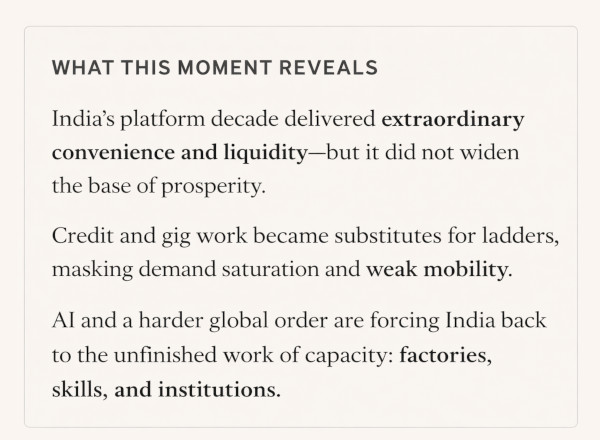
Looking back from 2026, the result is an economy with a narrow, hyper-consumptive elite and a vast aspiring population—but a missing middle. For too long, we tried to solve structural problems with simple digital solutions, believing an app could fix retail, agriculture, even employment.
Digital tools delivered real value. But an app layer cannot substitute for under-investment, weak institutions, or the absence of standardised operating systems across industries.
That is the central lesson of the past decade:
We cannot software-engineer our way to prosperity without building the hardware of a nation.
This gap—between digital sophistication at the top and economic thinness beneath—is now being exposed not just domestically, but globally. India remains, per capita, a poor country. We speak like a $10,000-per-capita nation, but we still live closer to $2,000. Vietnam has already crossed us. The world is not grading India on potential anymore. It is grading us on productive strength.
Size without prosperity can become a drag, not a dividend.
The digital decade gave us convenience. It did not give us the middle engine of growth. And that is where the real work begins.
When Convenience Hits Its Ceiling
For a decade, founders pitched investors on the story of a “1.4-billion-consumer” market.
By 2026, it is time to admit an uncomfortable truth. We do not have 1.4 billion consumers. We have roughly 100 million transactors—and over a billion scrollers.
The consumer internet hit a ceiling not because the apps were bad, but because the demand beneath them was narrower than the story we told ourselves. The convenience layer scaled brilliantly, but it ran out of people with the disposable income to pay for subscriptions, speed, and instant delivery.
Quick commerce illustrates this perfectly. It works brilliantly in Indiranagar and Bandra, where time is scarce and money is available. But it breaks down as you move into India Two. Delivering a Rs 50 item in ten minutes only works with density and disposable income. Outside India One, the economics simply don’t hold.
This is why so many sectors—from FMCG to automobiles—are now talking about premiumisation.
We are selling more expensive products to the same narrow base of consumers. Luxury housing, premium SUVs, and iPhones boom, while entry-level cars and mass FMCG volumes stagnate. Premiumisation, in this sense, is not evidence of widening prosperity. It is evidence of demand concentrating upward.
If your growth model depends on volume from the bottom 80%, you are walking into a structural trap.
The Narrowing of Demand
And this is where the digital decade has produced a deeper distortion.
India One has enjoyed a remarkable convenience and liquidity moment, while India Two and India Three remain structurally fragile. We have become very good at monetising a narrow consuming elite—very good at building wrappers of ease and access—without widening the base beneath it.
A nation does not become economically strong by recycling the same small cohort through ever richer transactions.
The middle engine has not arrived. Capacity creation has lagged. Builders have lost appetite.
It is telling that even in her Union Budget speech on Sunday morning, the Finance Minister reaffirmed the state’s continued reliance on public investment, raising the capital expenditure outlay to Rs 12.2 lakh crore. The government is still trying to hold up growth through the public balance sheet—building roads, rails, and infrastructure, and even creating new instruments such as an infrastructure risk guarantee fund to crowd private developers back in. But this is precisely the point: public capex can buy time, not substitute for a private investment engine. The next phase cannot be carried indefinitely by the state alone. Builders have to return.
Unable to expand demand, the ecosystem found another lever: credit.
Payments became free. Commerce margins collapsed. And every app—food delivery, ride-hailing, payments—began acting like a bank. Credit was pushed aggressively into India Two. Buy Now, Pay Later masked weak income growth, lending to consumers with stagnant wages to sustain consumption levels incomes could no longer support.
Over the past three years, household credit growth has accelerated to its fastest pace in over a decade, driven largely by unsecured retail lending. Regulators have repeatedly warned that borrowing is now growing far faster than incomes—a clear signal that demand is being pulled forward rather than earned.
“Credit here is not the engine of growth; it is the painkiller.”
This is not building prosperity. Credit here is not the engine of growth; it is the painkiller.
And beneath all this sits the most stubborn reminder of all: India remains, per capita, a poor country. Our size allows us to sound inevitable. Our per-capita reality makes us exposed.
Taken together—demand saturation, premium concentration, credit dependence, and stalled mobility—point to the same conclusion: a consumption-first, platform-led growth model has hit its structural limits.
The question now is not how many more apps we can build.
It is whether we can return to building the nation.
Work Without Upwardness
The labour consequences of this model are now becoming visible.
A decade ago, I celebrated the rise of the “smart worker”—the delivery partner who would use a smartphone to earn independence. The narrative was seductive: technology would create flexible work, decentralised income, and a new kind of upward mobility.
I was wrong.
What we created was not a ladder, but a holding pattern.
The gig economy has become a holding pattern for millions of young Indians. Quick cash pulls 18-year-olds away from college and vocational training. A scooter, a smartphone, and an app login become the easiest available path into earning.
Five years later, many have no new skills, no exit velocity, and a resume that leads nowhere.
Platforms are not the enemy. In many ways, they transfer income from India One to India Three. But liquidity is not mobility.
Without reskilling, without hard-asset job creation, without industrial depth, gig work becomes a trap rather than a bridge. India’s platform decade created millions of jobs of movement. It did not create enough jobs of progress.
The Demographic Question Returns
For decades, India spoke of its demographic dividend as destiny.
By 2026, it is clear that demography alone is not destiny. A demographic dividend exists only when young people can be absorbed into productive work—when economies build factories, skill pathways, and institutional capacity.
India is now entering its peak workforce phase at precisely the moment the world economy is entering a different age—AI, fractured trade, and industrial competition.
We are bringing a knife to a gunfight.
Pressure on H1B pathways is not an immigration story. It is an economic reminder: India cannot take its place in the global order by exporting people alone.
We have to build capacity at home.
The Ladder Moves
“AI doesn’t just replace jobs. It removes the learning pathway those jobs once provided.”
AI is beginning to put India’s old service ladder under pressure.
For two decades, a large part of India’s growth story came from routine service work—back-office processing, basic analytics, customer support, entry-level coding. It was not glamorous, but it played an essential role. It absorbed millions of young graduates, gave them their first job, and provided the training ground where skills were built over time.
Generative AI changes that structure.
It does not just replace jobs at the top. It eats into the middle layer of routine cognitive work that once served as an entry point. The problem is not only job loss. The deeper problem is that AI removes the learning pathway those jobs once created.
Routine work was an on-ramp. You started small, learnt the system, gained experience, and moved up.
Now that on-ramp pathway is thinning out.
Young workers increasingly face a paradox: you need experience to get hired, but you cannot get hired to gain experience. The ladder that helped India build a service middle class is being quietly shortened.
You now need experience to get a job—but you cannot get a job to gain experience. AI doesn’t just compress wages. It compresses ladders.
India can no longer rely on exporting cheap labour as its growth engine. The question now is where the new ladders will be built.
Where Scarcity Lives Now
Digital layers have become commoditised. Payments are infrastructure. Delivery is infrastructure. Aggregation is table stakes.
Real scarcity—and real moats—are forming elsewhere.
In the physical world.
You cannot code a semiconductor plant into existence. You cannot build an energy grid, a battery factory, or a defence system with a pitch deck.
Factories create ecosystems. Energy systems create resilience. Manufacturing creates learning curves and export power.
The countries that win will not be the ones with the most apps.
Because in 2026, an AI agent will build your app before you reach the end of this paragraph. That is the point. The back-office ladder that powered India’s middle-class expansion is being sawed off in real time.
The ones that win will be the ones that can still make things.
The Builder Decade
We spent the last decade constructing a digital layer over India. That layer delivered real gains in access and efficiency. But it did not build the middle engine of prosperity.
Demand saturated. Credit filled the gap. Labour ladders weakened even as the workforce wave crested. And now, thanks to AI, the very first rungs of white-collar work are beginning to disappear.
The world is no longer forgiving. Trade is hardening. Our labour arbitrage is collapsing. Size without productive strength is being exposed.
The next decade cannot be another cycle of convenience loops and digital symbolism. It has to be about rebuilding foundations—capacity, skills, factories, energy systems, and the institutions that allow labour to compound into productivity. The nation needs to pave the way for the builders.
The easy work is done. The real work begins now.
India cannot software-engineer its way to prosperity without building the hardware of a nation.
Join the conversation
Haresh Chawla
Investor | Entrepreneur
Haresh Chawla is an investor, entrepreneur and business builder with over three decades of experience across media, consumer businesses and the digital economy in India.
He currently invests independently in consumer, food and digital businesses, working closely with founders and management teams to help build and scale enduring companies.
He also serves as a visiting faculty at SPJIMR where he teaches a course that lies at the intersection of Digital Transformation and Entrepreneurship.
Previously, Haresh was a Partner at True North (formerly India Value Fund Advisors), one of India’s most respected private equity firms, where he focused on investments in the food and consumer sectors and worked closely with management teams to transform and scale mid-sized businesses.
He is widely recognised for his role in building and transforming the Network18 Group into one of India’s most influential media networks. As Founding CEO, he led Network18 through a period of extraordinary growth, turning it into India’s fastest-growing media and entertainment company. Over a 12-year tenure, he scaled revenues from $3 million in 1999 to over $500 million in 2012.
In his dual leadership roles across Network18 and Viacom18, he helped create a multi-platform media conglomerate reaching more than 300 million households across television, print, film, mobile and digital. Under his leadership, the group expanded from a single TV production business into India’s leading multimedia network with over 11 television channels, including Colors, CNBC-TV18, CNN-IBN, MTV India and Nick India. He also forged landmark partnerships and joint ventures with global media leaders such as NBC (Comcast), CNN, Viacom, Forbes and A&E Networks.
Haresh has been closely associated with India’s consumer internet evolution since its early days and has played a role in building several of the country’s most recognised digital platforms, including Moneycontrol and BookMyShow.
He continues to mentor and invest in emerging consumer and technology ventures.
Earlier in his career, he was part of founding teams at HCL Comnet; ABCL, where he set up the film distribution business; and the Times of India Group, where he launched Times Music.
Haresh holds a Bachelor’s degree in Engineering from IIT Bombay and a Master’s degree in Business Management from IIM Calcutta.
Beyond the noise is the signal.
FF Insights: Sharpen your edge, Monday–Friday.
FF Life: Culture, ideas and perspectives you won't find elsewhere — Saturday.

Founding Fuel is sustained by readers who value depth, context, and independent thinking.
If this essay helped you think more clearly, you may choose to support our work.

Founding Fuel is sustained by readers who value depth, context, and independent thinking.
If this essay helped you think more clearly, you may choose to support our work.
Loading comments...


Readers also liked

·Economy, Policy & Society
FF Daily #268: The road ahead
January 8, 2021: Trendspotting with Nandan Nilekani and Haresh Chawla; Jacqueline Novogratz on understanding communities; Seven types of rest; Time and distance: Special Theory of Relativity
FF

Founding Fuel
FF Daily #268: The road ahead
January 8, 2021: Trendspotting with Nandan Nilekani and Haresh Chawla; Jacqueline Novogratz on understanding communities; Seven types of rest; Time and distance: Special Theory of Relativity

·Economy, Policy & Society
Trendspotting: 2020 can make or break
The pace of change is accelerating. Uncertainty is growing. Businesses are on tenterhooks. And on the cusp of a new decade, India’s digital economy is yet again poised for a reset
HC

Haresh Chawla
Investor | Entrepreneur
Trendspotting: 2020 can make or break
The pace of change is accelerating. Uncertainty is growing. Businesses are on tenterhooks. And on the cusp of a new decade, India’s digital economy is yet again poised for a reset
Investor | Entrepreneur

·Work, Careers & Personal Mastery
FF Daily #265: How often do you experience a state of flow?
January 5, 2021: Trendspotting with Haresh Chawla (and a conversation with Nandan Nilekani); A curator’s reflections on 2020; Our blessed homeland, and their barbarous wastes, updated
FF
Founding Fuel
FF Daily #265: How often do you experience a state of flow?
January 5, 2021: Trendspotting with Haresh Chawla (and a conversation with Nandan Nilekani); A curator’s reflections on 2020; Our blessed homeland, and their barbarous wastes, updated
Explore more
Dive into other themes from our network.