
When Protest Becomes Theatre
From a mock parliamentary hearing in Delhi to Vietnam War theatre, how performance gives personal testimony a public voice.
20 November 2026· 4 min read
TL;DR
This article argues that performance transforms personal testimony into powerful public protest. It details a mock parliamentary hearing in Delhi where citizens, denied institutional recourse, symbolically ‘impeached’ the Chief Election Commissioner. This creative protest enabled individuals to share accounts of wrongful electoral roll deletions and their profound personal costs. By artfully recreating a formal setting, the event amplified individual grievances into a public spectacle, borrowing institutional authority. The author links this to their research on Vietnam War theatre, where productions like ‘Tracers’ similarly gave veterans’ experiences a visceral public voice, underscoring performance’s enduring power in dissent.
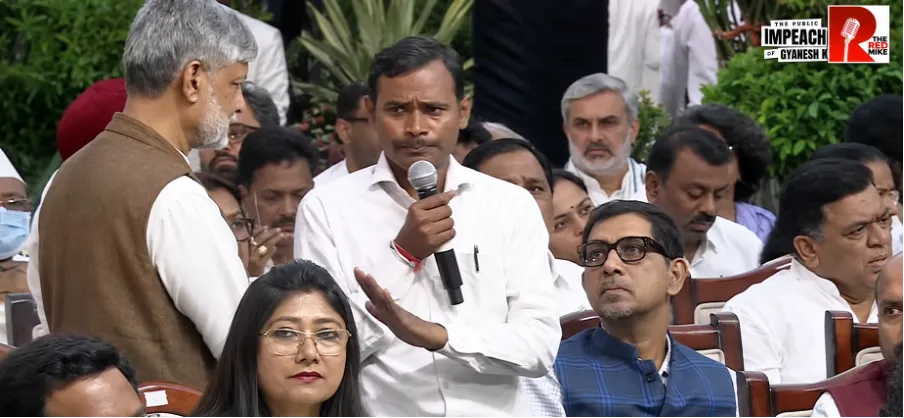
A garden has been arranged to look like Parliament. Chairs form a crescent, a panel provides the backdrop, and former Lok Sabha Speaker Meira Kumar presides. There is a motion to be introduced, speeches to be heard and a vote to be taken. The trees and the chirping birds belong to the garden; the rules and rituals belong to the House.
Watching the recording in Mumbai, I am struck by the choice of setting. This is the Opposition’s mock impeachment of Chief Election Commissioner Gyanesh Kumar, held on October 31, 2026, on the lawns of Congress president Mallikarjun Kharge’s official residence in Delhi.
Kharge sets out the Opposition’s allegations of wrongful deletions from electoral rolls and misuse of the Election Commission’s authority. The organisers say they have been denied an adequate institutional hearing. Now they are borrowing Parliament’s form to bring their case before the public. The proceedings have no power to remove the CEC, but they draw on the authority of the institution they recreate.
Then citizens speak.
Kanta Prasad keeps producing documents, one after another. He has exceeded his allotted time, but there is something he needs his audience to understand: he is alive.
He tells the gathering that he has lived in Mangolpuri and voted in Lok Sabha and Assembly elections for 35 years. Now, he says, he has been recorded as dead and removed from the electoral roll. He describes an official taking his son’s signature on a blank sheet of paper, supposedly to help. Later, he was told that his son had reported his death.
Anita Jaisawal, a daily-wage labourer and single mother, describes the time and wages lost in repeated visits to seek answers about her voting status. Her account moves between documents, work and anxiety about her daughter’s future. She asks who gave the authorities this power over her life.
Maya Devi speaks about the loss of her home and her voter identification, listing the other documents she possesses. She wants her old identity as a voter recognised.
The seasoned political speakers make allegations about institutions and electoral processes. The citizens describe what it costs to find yourself unable to get an answer. Placed within this parliamentary setting, their individual complaints become accounts an assembled audience is asked to hear.
I recognise something I have encountered before: the ability of performance to give a grievance a face, a voice and a public setting.
Theatre and the experience of war
My interest in this form of protest goes back to my Fulbright Fellowship project in the United States in 1992-93, on American theatre and the experience of the Vietnam War. I read scores of scripts, watched recordings and met playwrights to understand how they had brought the war and its aftermath to the stage.
Some were veterans writing from their own experience. Others used theatre to question the war and the language in which it was presented to Americans. Their work gave me a wider understanding of protest: it could be visceral without relying on a shouted slogan. Grief, restraint, humour and direct address could carry an argument.
On a cold winter evening in New York, I watched a production of Tracers, conceived by John DiFusco and developed with fellow Vietnam veterans. I remember a small venue and a small audience. I cannot now be certain whether any members of the original cast were performing.
First staged in Los Angeles in 1980, Tracers follows young soldiers before, during and after their service in Vietnam—from training and combat to the struggle to return to civilian life. Veterans’ experiences are shaped into characters and scenes, bringing both the war and its lasting consequences to the stage.
A performance can make an audience stay with its human consequences.
One scene is especially difficult to watch. Soldiers mime gathering dismembered bodies on a blanket, trying to put the parts together so that families can receive their dead. The practical task makes the horror almost unbearable. The men must do something that no amount of training could make ordinary.
The delivery matters as much as the words. Short sentences give way to pauses; dark humour interrupts grief; the performers embody experiences that are difficult to describe. They do not have to announce their sorrow at every turn for us to feel it.
This is what theatre can bring to an account of events. A fact can be stated in a sentence. A performance can make an audience stay with its human consequences.
Reaching into the audience
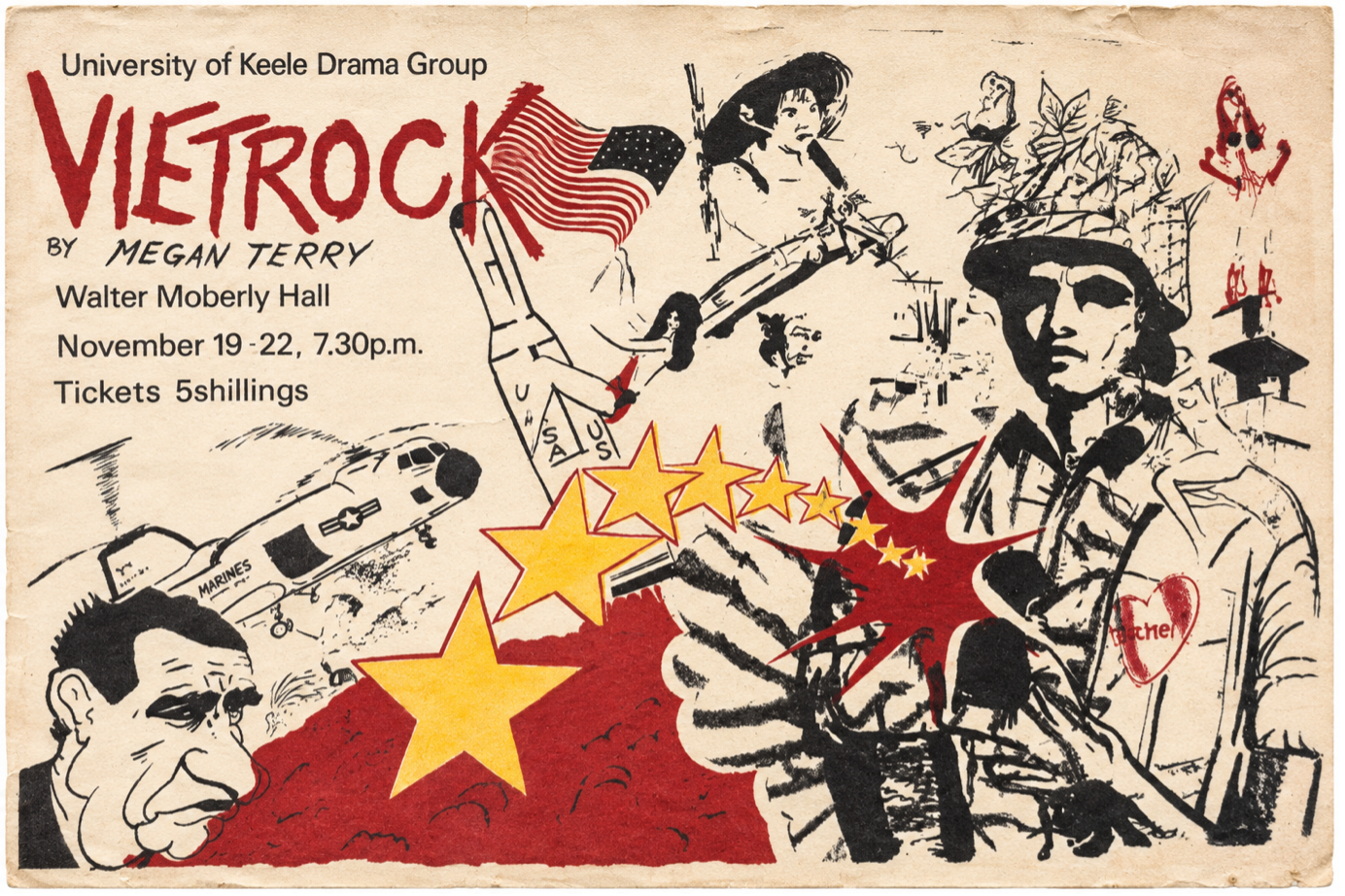
My conversations with Megan Terry offered another way of understanding this relationship. Her Viet Rock, first staged in 1966, used music, movement and rapid transformations to confront the war. Performers moved between soldiers, politicians and other characters, and between human figures and objects.
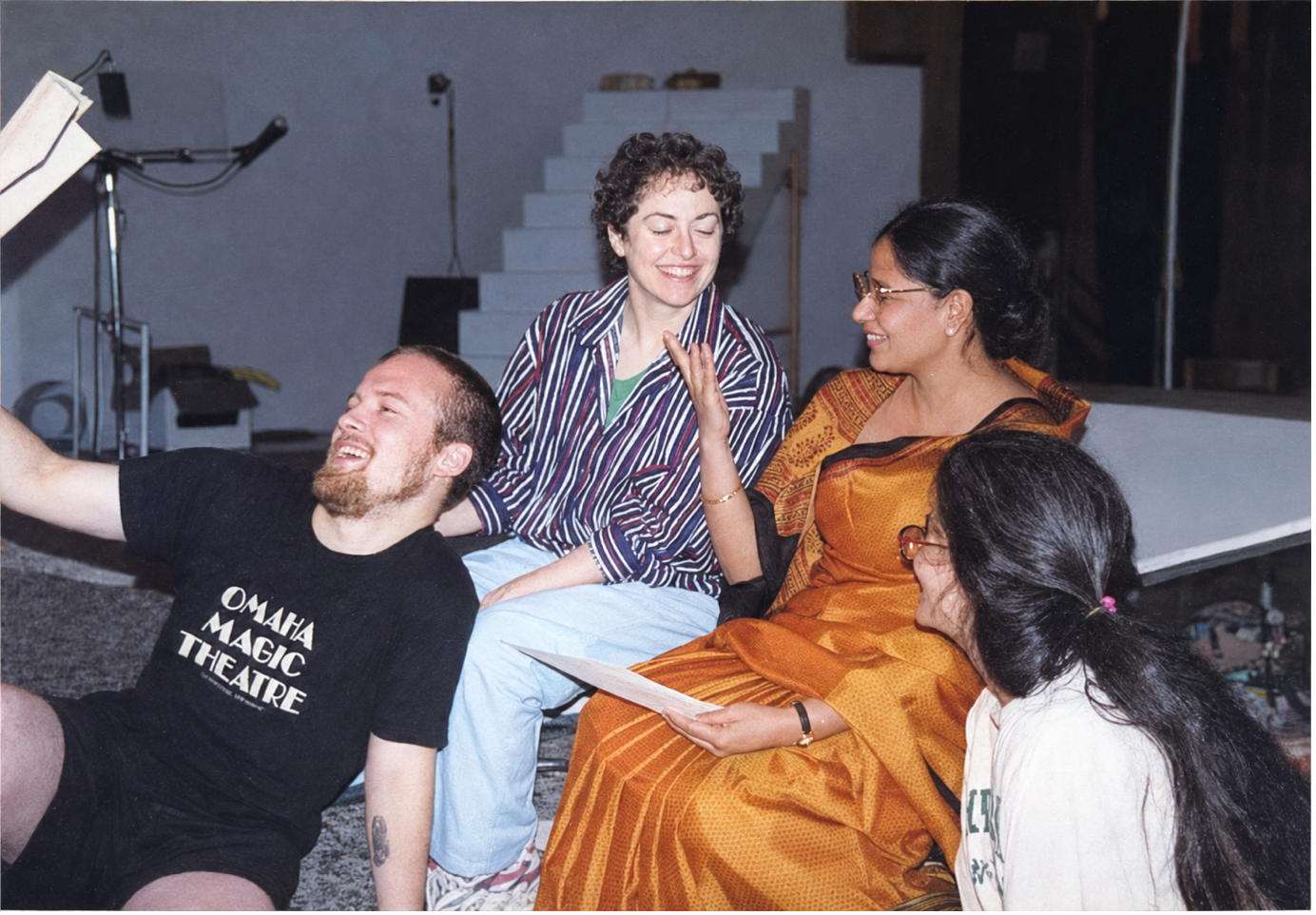
In Omaha, Terry spoke to me about the production’s creative process. Our conversation also touched on the “Freedom Bird”—the soldiers’ slang for the commercial aircraft contracted by the US military to carry them between Vietnam and home. The phrase held the promise of leaving the war behind.
What overwhelmed me most was her description of performers moving into the audience and addressing people directly, asking them to consider a different course from war. The audience could no longer remain quite so distant from the appeal. Someone was looking at them, speaking to them, asking for a response.
That encounter helped me understand how protest theatre can work. It gives an argument a physical presence and changes the relationship between the person speaking and the person listening.
The Vietnam plays and the Delhi gathering differ in their circumstances, intentions and artistic form. But both brought me back to the question of what happens when an audience is asked to attend to an experience it might otherwise encounter only as a headline, statistic or political claim.
A hearing, and what follows
At the mock impeachment, the politicians appear as themselves. In Tracers, lived experience is transformed into a scripted production. Neither is an unmediated account: someone has selected the speakers, arranged the sequence and decided what the audience will see.
Performance does not settle the accuracy of an allegation. Nor does conviction alone make a speaker trustworthy. What it can do is make an account harder to ignore and create a setting in which people are asked to consider it.
The Delhi proceedings culminate in a symbolic vote. Meira Kumar closes with poetry. The following day's rally at Ramlila Maidan extends the protest beyond the garden.
Whether the mock impeachment changed minds beyond the Opposition's supporters, or will lead to institutional action, remains uncertain. Its achievement as a public performance is easier to describe: it assembled a political case, gave citizens a place within it and created a record that people elsewhere could watch.
I return to Kanta Prasad and his documents. A public hearing, however, is only the beginning of securing redress. His repeated effort to demonstrate that he is alive reminds us why the hearing matters and how much remains to be done after the audience has listened.
Join the conversation
Uma Narain
Former Founding Dean | School of Liberal Arts, NMIMS University
Uma Narain is a Fulbright fellow, former Founding Dean, School of Liberal Arts, NMIMS University and former Professor, General Management at S.P. Jain Institute of Management & Research.
Currently, she is an independent Consultant, advising universities and schools on New Education policy and Liberal Arts Education.
Uma is an avid reader, a movie buff, a theatre enthusiast, and an enterprising traveller interested in different cultures and people.
Beyond the noise is the signal.
FF Insights: Sharpen your edge, Monday–Friday.
FF Life: Culture, ideas and perspectives you won't find elsewhere — Saturday.

Founding Fuel is sustained by readers who value depth, context, and independent thinking.
If this essay helped you think more clearly, you may choose to support our work.

Founding Fuel is sustained by readers who value depth, context, and independent thinking.
If this essay helped you think more clearly, you may choose to support our work.
Loading comments...


Readers also liked

·Artificial Intelligence
When More Intelligence Makes Strategy Harder
AI has made intelligence abundant. Why, then, is strategy becoming harder?
DM

AB

Debleena Majumdar & Arjo Basu
When More Intelligence Makes Strategy Harder
AI has made intelligence abundant. Why, then, is strategy becoming harder?
Debleena Majumdar & Arjo Basu

·FF Life
When Thinking Starts Making Noise
As speech-to-text tools become eerily good, they are changing not just how we write, but how we think, remember, and inhabit private space
CA

Charles Assisi
Co-founder and Director | Founding Fuel
When Thinking Starts Making Noise
As speech-to-text tools become eerily good, they are changing not just how we write, but how we think, remember, and inhabit private space
Co-founder and Director | Founding Fuel

·Artificial Intelligence
When Trust Becomes Infrastructure
Part 4 of The Future of Work and Agentic AI series: As agents begin working together, trust shifts from intelligence to standards, governance, and control.
AB
DM
Arjo Basu & Debleena Majumdar
When Trust Becomes Infrastructure
Part 4 of The Future of Work and Agentic AI series: As agents begin working together, trust shifts from intelligence to standards, governance, and control.
Arjo Basu & Debleena Majumdar
Explore more
Dive into other themes from our network.