·FF Life
Where the Warm North Meets the Cool South
At a quiet Australian headland, I discovered that the most meaningful journeys aren’t about how far we go—but how still we learn to be
KA

Kavi Arasu
Leadership and Talent Development Professional
What happens when a centuries-old knowledge system—held in practice, not institutions—meets a world changing faster than it can adapt? The Changpas of Changthang are living that question.

On a cloudy July morning in 2017, Tsering Gurmet and I set off for Korzok, his home near the high-altitude lake of Tso Moriri. Gurmet, who had grown up in Changthang, was looking to build a wool-based enterprise rooted in this landscape. At the time, I did not fully grasp what that would entail. Over the years, I came to see that what sustains life here is not just livelihood, but a finely evolved way of knowing—of reading land, sky and season—that has been built and transmitted across generations.
Changthang (Chang = North and thang = plains) is a vast high-altitude area in southeastern Ladakh at the edge of the Tibetan Plateau. The Changpas, or people of the North, inhabit this unforgiving yet stunning landscape, roaming the areas in well-defined groups along ancient seasonal migratory routes with their herds of yaks, goats, sheep and horses. The Changpas of Korzok Tegazung, whom we were visiting, form the largest group of over 250 pastoral nomadic families in Changthang, still continuing a way of life lived in close rhythm with the landscape they roam.
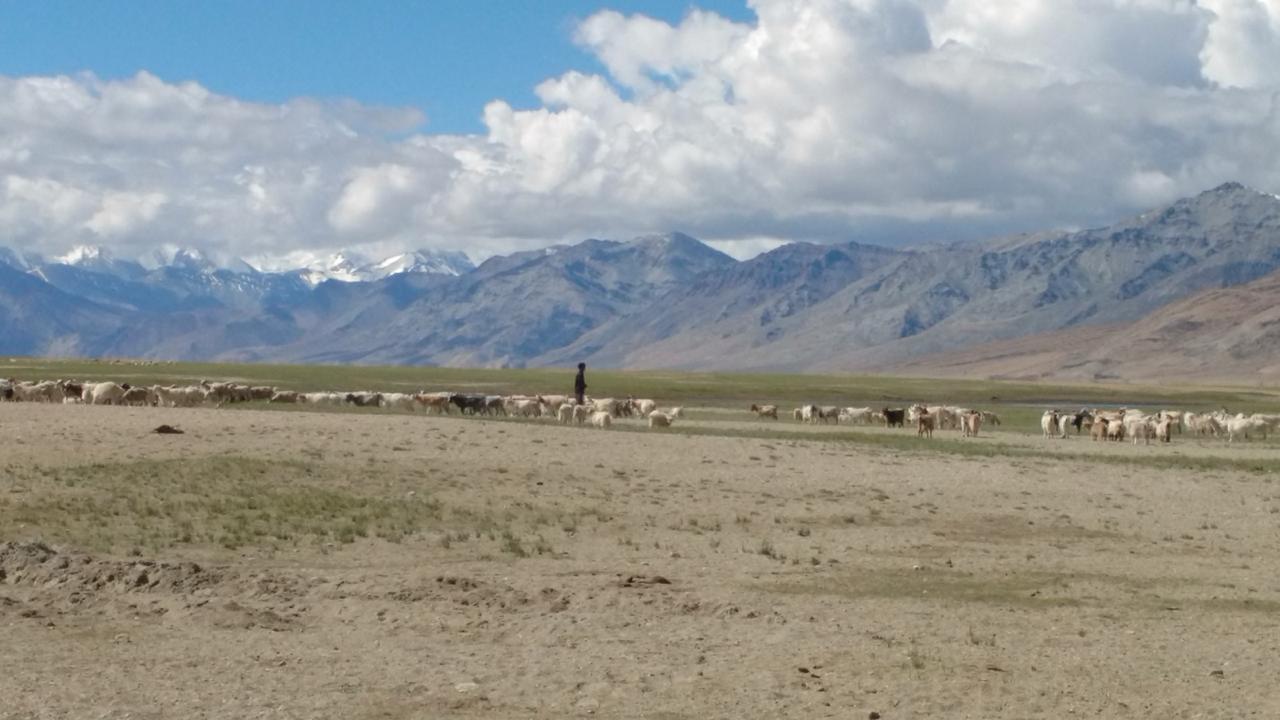
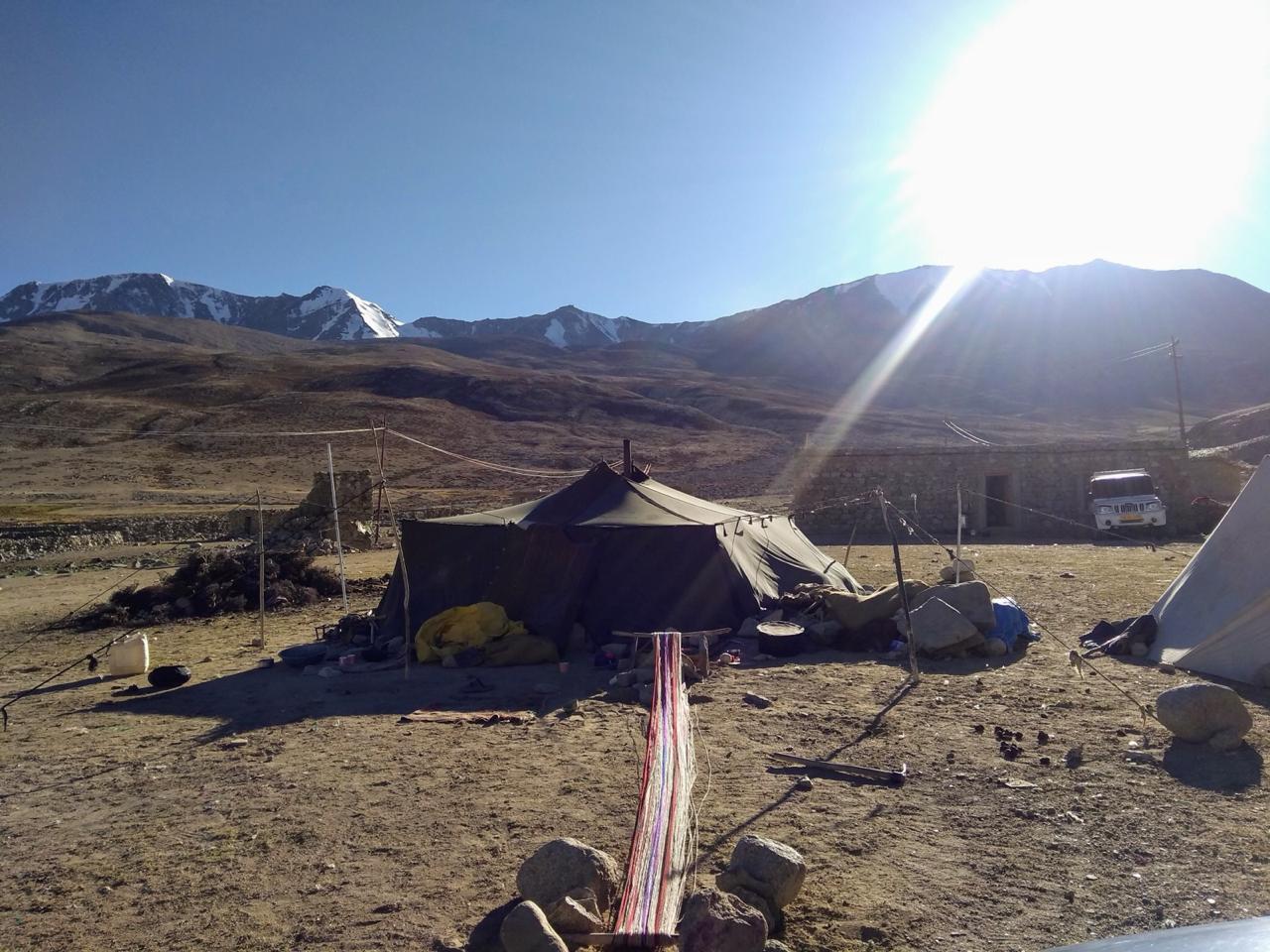
Without a clear idea of what we could do, we began by visiting a number of rebos (traditionally, a term used to describe the nomadic tent woven from yak hair, but now used synonymously for any residential tent, including canvas tents). In early summer, the Changpas are camped at Peldo along the eastern edge of Tso Moriri and then shift, around the time of the monastic annual festival, to the upper pastures or phu. At almost every rebo, we met nomadic women weaving—carpets (tsogdan), tent wall covers (phugshar), blankets (tsogthul)—from wool sourced from their herds. To this is mixed colourful acrylic wool for a burst of colour. In the past, women would dye sheep wool using dyes brought up by traders from the plains.
The skills of Changpa women lie in the deftness of their fingers as they spin sheep wool (bal) and yak wool (khullu) into yarn on a wooden spindle (phang). While today the focus is on pashmina—the fine down of the Capra hircus (changthangi goat or changra)—traditional skills developed around the humble sheep and yak wool, from which the Changpas have for centuries woven their storage bags, furnishings, saddle bags, and braided a variety of ropes for tethering animals or tying goods to pack animals. It spoke of a culture evolved over centuries where the Changpas derived everything from their herds and their landscape.
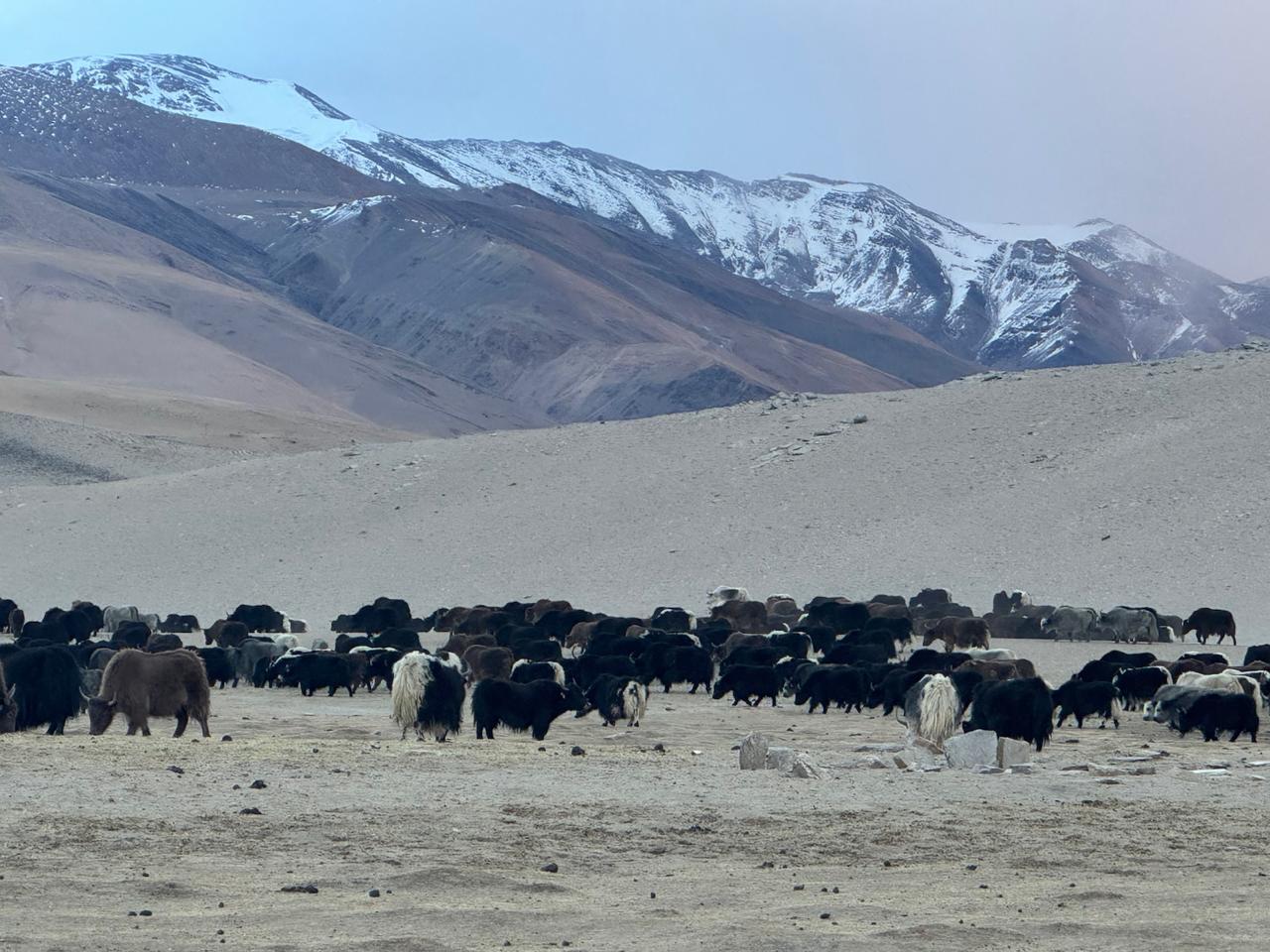
Migration routes follow age-old ancestral knowledge—of the best pastures, sources of water, and campsites protected from formidable winds and snow. Camps are pitched on the leeward side of a mountain, on higher, middle or lower reaches depending on the season, or in the natural shelter of an overhang. Even the landscape is read with nuance: mountains recognised not only by their colour but also their shape, a small boulder in the form of a monk’s cap, isolated mud hills in the middle of a plain. Their dialect has many words for mountain, reflecting this nuanced understanding.
The magnificent night sky of Changthang holds another layer of this knowledge. On a windy and cold October night in 2012, we camped at a Changpa campsite, watching the night sky unfold and hearing stories of the stars.
The first time I heard these stories, they felt like fragments of folklore. Over the years, I began to understand them as a system of reading time, risk and movement in a landscape where precision mattered.
The Changpas follow the lunar calendar and, like the Tibetans, recognise lunar mansions—the passage of the moon across the stars. Yet their astronomy differs from Tibet’s in its stories and practices. The thol, a reading of the moon’s passage across the lunar house of Lak sor (Scorpius), was traditionally used to determine the fortunes of the coming year. The hand is held out, fingers spread against the sky: if the moon passes over the little finger, it will be a good year for milk; if across the forearm, a year of loss, when many animals will die.
When herders moved with their animals, they marked time by the rise of constellations, deciding when to begin their journey so as to reach their destination on time. Every hour, a new constellation emerges till dawn. Today, few elders remain who hold this knowledge. Indigenous stories of the night sky are an endangered knowledge system.
The Changpa world extends beyond the visible. It includes wildlife—snow leopard, wolves, foxes, ibex, blue sheep, kiang, the endangered Tibetan gazelle—and also other realms: the lha (protector deities of the mountains), the lhu (underworld serpent deities who protect water), and the tsan (spirits of the earthly realm who, if angered, can cause devastation). Rituals seek to placate these forces and restore balance. This knowledge, held by elder monks of Korzok Monastery, forms an intrinsic part of the intangible cultural heritage of Korzok.
The 17th-century monastery is central to the Changpa’s way of life. The monks’ guidance shapes their spiritual as well as physical world—for instance practices that help keep Tso Moriri pristine.
Yet, this continuity is fraying. Most weavers and spinners today are over the age of 40. As young people move out of Changthang for education or work, the traditional transmission of knowledge—from mothers to daughters—weakens. Within Changthang too, the demand for traditional goods is slowly declining with the availability of modern alternatives.
What is fraying here is not just a way of life, but a way of knowing—one that is carried in practice, memory and movement rather than in formal institutions. When younger generations leave, it is not only skills that are lost, but the conditions that make such knowledge possible.
At the same time, the landscape itself is becoming less predictable. Over the past decade, unseasonal snowfall in early spring—when lambs and kids are most vulnerable—has led to devastating livestock losses. For the Changpas, whose wealth travels on the backs of their animals, this is a crippling blow. Many communities are forsaking their nomadic life and settling on the outskirts of Leh, working as labourers, running taxis or small eateries. While government support exists—fodder, veterinary services, tents, solar panels—a single extreme weather event can undo generations of resilience.
The anxiety about climate unpredictability was not unfamiliar—it echoed, in another form, the uncertainties that shape lives far removed from this plateau.
Movement too, once fluid across vast rangelands, is increasingly constrained. Migration routes that followed ecological logic now intersect with administrative and geopolitical boundaries, reshaping access to pastures and altering long-held rhythms of transhumance.
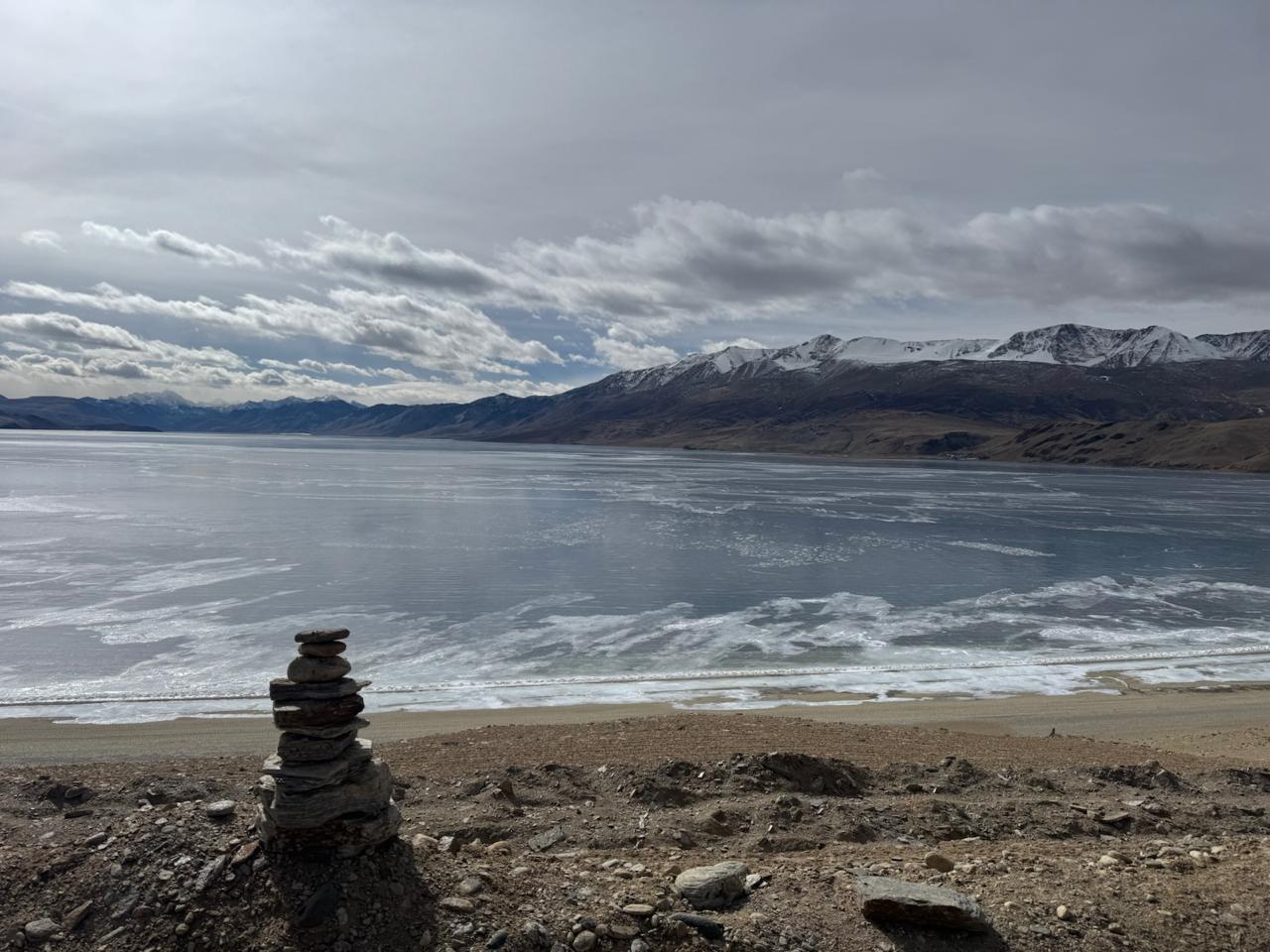
It was within this landscape—of deep knowledge and emerging fragility—that our work began to take shape. As we left Korzok on that first visit, storm clouds that had loomed finally broke. A young Tibetan nomad raced past us with a grin, trying to outrun the storm towards Kyagar Tso.
In 2018, Jungwa Foundation was born—a Section 8 non-profit that seeks to safeguard cultural and natural heritage, foster sustainable livelihoods, and promote education of indigenous knowledge and stories. Together with a small but committed team, we have spent the past eight years working alongside the Changpas.
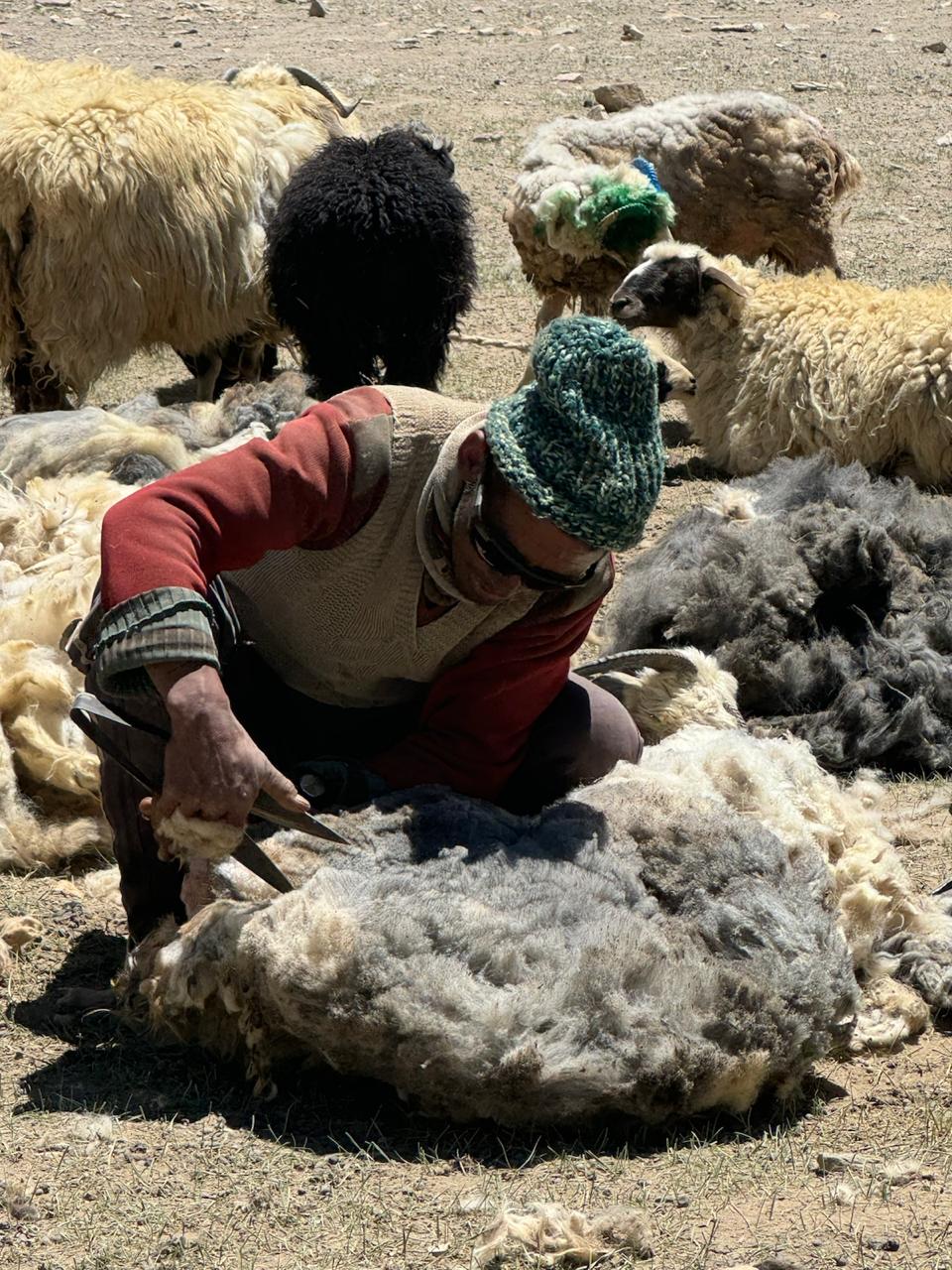
One of the earliest initiatives focused on sheep wool-based livelihoods, working with herders and nomadic women to sustain the intangible heritage of backstrap loom (sked thags) weaving. Beginning with two weavers, the work involved documenting motifs and techniques rooted in Changpa culture. Wool was sourced directly from herders, supporting mixed herd pastoralism at a time when goat populations were rising to meet global demand for pashmina. The weaving programme is now run in partnership with InterGlobe Foundation.
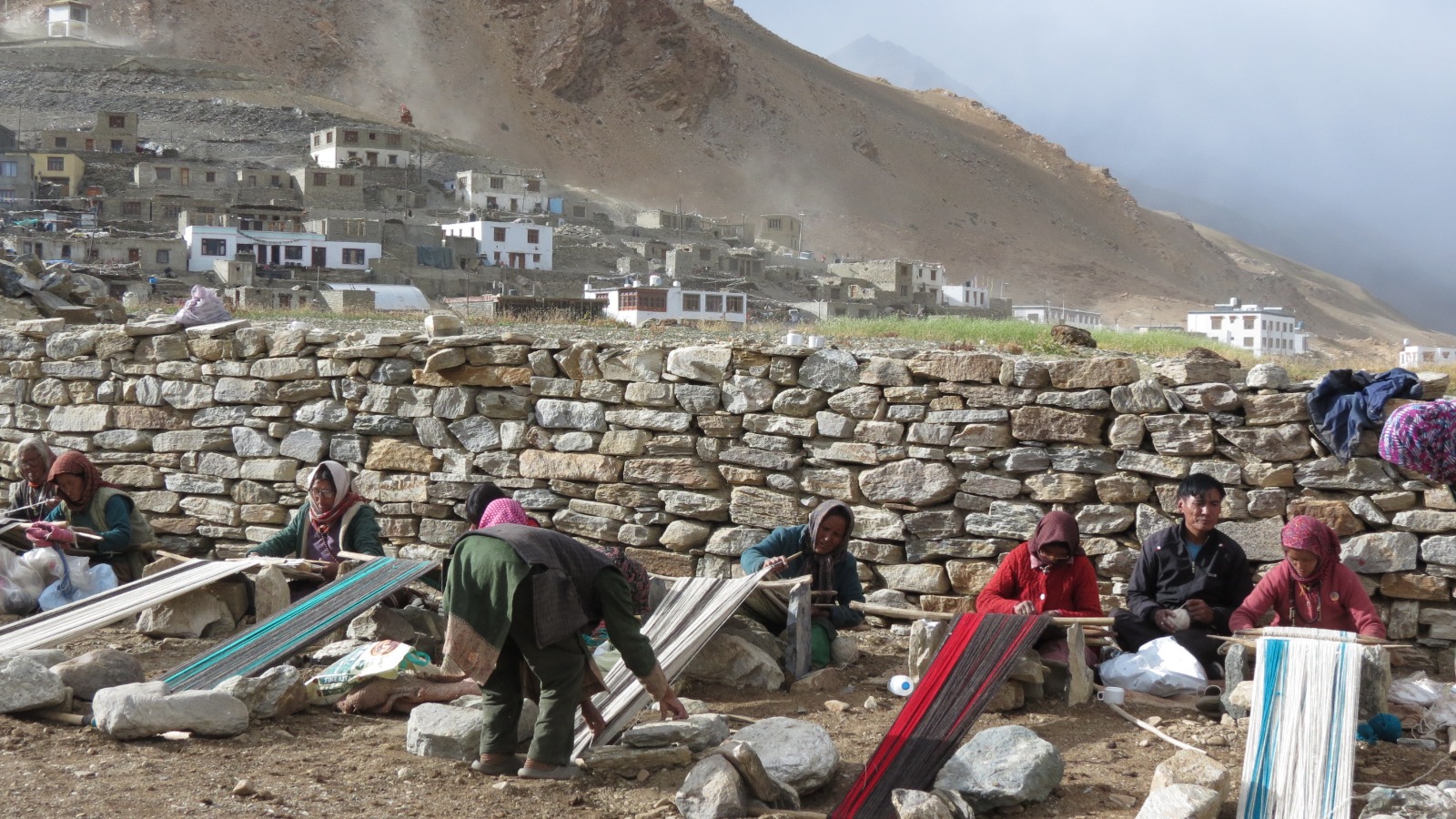
Today, the network reaches around 80 herding and weaving families in Korzok, producing a range of textiles and leather products that are increasingly finding resonance with Ladakh’s hospitality sector.
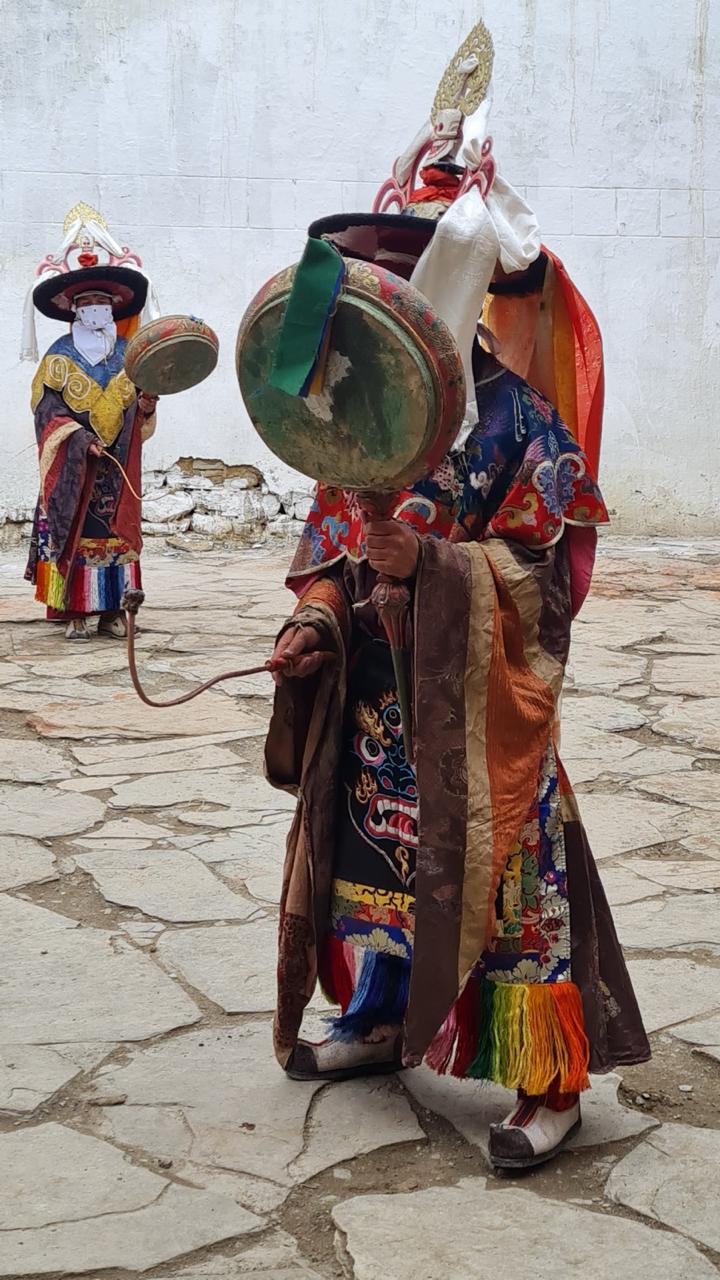
From 2019, a partnership with the Korzok monastery led to a series of workshops on ritual arts—kilkhor (mandalas), torma (dough sculptures), thread sculptures and sacred chams dances. Elder monks shared their knowledge with younger novices, alongside teachings on meaning: how ritual restores natural order and confronts the forces within and without. Workshops led by senior astrologers imparted training in skartsis rigpa, the science of astrology, including reading the almanac and forecasting for life-cycle rituals.
Alongside, efforts to document traditional landscape knowledge grew through long walks and conversations with Changpa elders—recording ecological, navigational and water knowledge that they carry in memory. Since 2024, partnerships have enabled further research, including a value chain study on sheep wool and a baseline socio-economic survey to better understand pastoral life today.
To address the break in transmission, a young weavers’ incubation programme was initiated, where elder women train younger Changpa women in spinning and weaving. Ten young women trained in the first cohort, with more to follow.
The work with the monastery, the documentation of landscape knowledge, and livelihood initiatives together form a web of efforts centred around a pastoral nomadic landscape—one that has historically remained under-recognised in comparison to settled, architectural cultures. Yet, increasingly, there is a growing recognition of such landscapes and their knowledge systems.
This archive of memory—of land, sky, ritual and livelihood—may, in time, become a record of a way of life that is gradually fading.
It is important that the Changpas articulate their own vision for their future. That vision may differ from those in Leh, emerging as it does from a different bio-cultural worldview.
In cities, home is often a fixed address, something owned or rented, bounded by walls. Here, it is an ongoing relationship with a landscape that could not be possessed.
Elder Changpas like Tashi Nurboo speak of what is lost in settling down: the open landscape, the clean mountain air, the freedom of inhabiting a tent.
Years ago, he described the Changpa idea of home—not as a fixed dwelling, but as a landscape held in care. In summer, concern turns to winter pastures; in winter, to the promise of summer grazing. Home is belonging to a place, not within walls but across seasons.
This, perhaps, is the Changpas’ greatest wealth: a solidarity with the earth that cannot be measured economically.
It is also a way of knowing—rooted in movement, memory and attention—that does not easily survive when the conditions that sustain it begin to change.
Founder | Jungwa Foundation
FF Insights: Sharpen your edge, Monday–Friday.
FF Life: Culture, ideas and perspectives you won't find elsewhere — Saturday.

Founding Fuel is sustained by readers who value depth, context, and independent thinking.
If this essay helped you think more clearly, you may choose to support our work.

Founding Fuel is sustained by readers who value depth, context, and independent thinking.
If this essay helped you think more clearly, you may choose to support our work.
At a quiet Australian headland, I discovered that the most meaningful journeys aren’t about how far we go—but how still we learn to be
Kavi Arasu
Leadership and Talent Development Professional
At a quiet Australian headland, I discovered that the most meaningful journeys aren’t about how far we go—but how still we learn to be
Leadership and Talent Development Professional

They don’t work for Google. But they’re the brotherhood you’ll want when the road disappears

Charles Assisi
Co-founder and Director | Founding Fuel
They don’t work for Google. But they’re the brotherhood you’ll want when the road disappears
Co-founder and Director | Founding Fuel

Five days in a small country with a large narrative, exploring history, the art of dissent, and an old wine culture

Uma Narain
Former Founding Dean | School of Liberal Arts, NMIMS University
Five days in a small country with a large narrative, exploring history, the art of dissent, and an old wine culture
Former Founding Dean | School of Liberal Arts, NMIMS University
Dive into other themes from our network.