Who Can Break the Tata Deadlock?
Noel Tata is trying to convert stewardship into authority. N Chandrasekaran must turn a contested board decision into shareholder support. Shapoor Mistry holds votes both men may need—and needs liquidity neither can promise alone.
16 November 2026· 23 min read
TL;DR
A pivotal power struggle grips Tata Sons, involving three key figures vying for control. Noel Tata, chairman of Tata Trusts, seeks to assert authority by proposing a restructuring and a vital liquidity plan for the Shapoorji Pallonji (SP) Group. N. Chandrasekaran, the incumbent chairman, aims to secure his third term, needing clear shareholder backing. Shapoor Mistry, holding a crucial 18.37% stake, endeavours to unlock value and secure his family's financial stability. This intricate deadlock, exacerbated by impending deadlines, has transcended internal conflict to become a national debate on corporate governance. The coming weeks will determine who can convert their leverage into decisive authority.
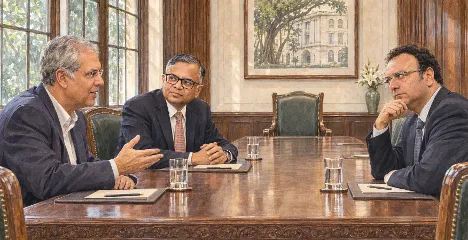
On the fourth floor of Bombay House, the Tata Sons boardroom occupies the west wing and is designed to make history present. A bust of the founder and oil portraits of former chairmen look over wood-panelled walls and a carved teak table. The room survived the changes elsewhere on the floor largely intact. Across in the east wing, the chairman’s office—altered after Ratan Tata stepped down—was restored in 2017 broadly to the form it had taken during his tenure.
When the board is expected to gather there on November 26, that carefully preserved continuity will frame a struggle over who has the authority to carry it forward.
For most of his life, Noel Tata stayed away from the front page. Chandra built his reputation as a marathon-running technocrat who rarely allowed public emotion to intrude on corporate execution. Shapoor Mistry was more readily associated with the thoroughbreds at his family's Manjri Stud Farm than with the politics of Bombay House. All three men have now been pulled into a contest none can fully control.
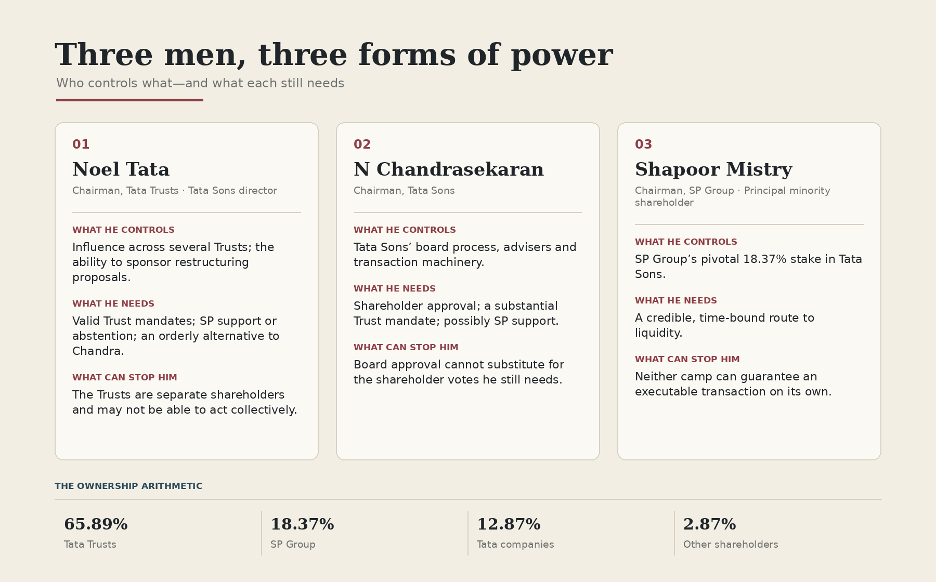
Noel chairs Tata Trusts, whose seven shareholding trusts together own about 65.3% of Tata Sons. The separate M K Tata Trust owns roughly 0.6%, taking total philanthropic ownership to about 65.9%. But Noel cannot be certain that every shareholder trust can—or will—vote with him. Chandra has the support of the Tata Sons board, but no visible shareholder majority for the directorship on which his third term depends. Shapoor controls the 18.37% block both men may need, while the family group he leads searches for liquidity and a durable escape from debt.
Their interests converge at the Tata Sons board meeting expected on November 26. Noel wants the board to examine a restructuring that could keep Tata Sons private and the SP Group’s proposal, tabled by him, to provide it with at least ₹25,000 crore of liquidity. Chandra must decide how far the company should engage with proposals sponsored by the man challenging his continuation. Shapoor must judge whether either side can unlock the value trapped in his family’s holding.
The fight is no longer being waged only through resolutions and private letters. Noel and Chandra are building rival public narratives. Two of India's most celebrated lawyers have argued their positions on national television. Parsi organisations have written to the Prime Minister. The Leader of the Opposition has accused India's business establishment of cowardice. A dispute that began inside the Tata system is becoming a national argument over ownership, regulation, professional management and political power.
The calendar is unforgiving. The Charity Commissioner is due to hear matters involving the governance of the Trusts on December 3. Tata Sons has reportedly been given until December 31 to complete the annual general meeting that failed for want of quorum in August. Chandra's present term ends on February 20.
The meetings ahead will show whether any of them can convert that leverage into an outcome the others are prepared—or forced—to accept.
Noel steps into the light
At the Hindustan Times Leadership Summit on November 14, Noel opened with a line that captured both his discomfort and his predicament. He had spent 69 years trying to stay away from the front page, he said—and had paid a price for that silence over the previous year.
The remark was witty, but no longer quite literal. By then Noel had begun a deliberate public campaign.
On September 29, less than two weeks after the stormy Tata Sons board meeting, he sat down with Arnab Goswami at the Republic Summit. It was an unusual choice for a man known for reserve. Noel used the platform to disclose that the Trusts had sent Tata Sons a restructuring proposal. If the proposal genuinely changed the nature of Tata Sons’ business, he argued, RBI should examine the restructured company afresh rather than treat listing as inevitable.
In the week before the HT Leadership Summit, he addressed a closed-door gathering of chief investment officers and analysts brought to Mumbai by Goldman Sachs. The audience included investors from India and abroad—precisely the constituency that might ordinarily be expected to welcome a Tata Sons listing. On the sidelines, however, a senior analyst who attended the conference heard several global analysts question the rationale for dismantling the group's distinctive Trust-owned model. There is no basis for saying those questions were put directly to Noel. But the exchange suggested that investor opinion on listing was less uniform than the public debate sometimes assumed.
At HT, the argument became broader and more personal. Noel described an ownership model in which "charity owns commerce" and the owner cannot die, retire or be bought. He defended Tata Sons' ability to act as a backstop when a group company runs into difficulty. Public investors, he suggested, could one day prefer quicker returns to philanthropy or long-gestation projects of national importance.
Noel said he did not question the direction of the group's investments in semiconductors, batteries, electronics and other strategic industries. He questioned, sometimes, their delivery: the discipline of execution and the allocation of capital.
This was not simply a family representative invoking heritage against modernity. Noel could point to an operating record of his own. At Trent, he backed private labels, patient experimentation and the steady expansion of Westside. Zudio was built without conventional advertising or a large ecommerce operation and grew into a mass-market retail network.
The results were substantial. Over Noel’s years as chairman, Trent’s annual revenue rose nearly nine-fold—from about ₹2,300 crore in FY14 to more than ₹20,000 crore in FY26. By March 2026, it operated more than 1,250 large-format fashion stores across 321 cities and reported a consolidated profit after tax of about ₹1,720 crore. Its market value rose dramatically over the same period.
That does not make Noel’s role at Trent directly comparable with Chandra’s stewardship of a sprawling conglomerate. But it gives Noel a record of disciplined scaling and patient capital allocation from which to question Tata Sons’ execution.
The Trusts reinforced Noel’s campaign with statements challenging Chandra’s reappointment, opposing listing and disclosing the SP proposal. By September 28, they had also published a detailed restructuring plan.
Tata Sons could tell the simpler opening story. Four directors had supported the continuation of a professional chairman associated with a decade of growth and expansion. Noel alone had opposed him. To the general reader, it looked like an ordinary board decision settled by a four-to-one majority.
Noel’s case was harder to explain. He said Tata Sons’ Articles give directors nominated by its two principal shareholder Trusts—Sir Dorabji Tata Trust (SDTT) and Sir Ratan Tata Trust (SRTT)—a special say in board decisions. There were only two such directors: Noel and Venu Srinivasan. Noel argued that both therefore had to agree. Tata Sons disputed that interpretation and said the chairman’s casting vote had settled the decision.
That left Noel with a harder task. He had to explain why RBI had classified Tata Sons as an upper-layer non-bank financial company in the first place—and why his proposed restructuring should cause the regulator to reconsider the resulting pressure to list. Each issue was complicated and contested. Together, they made his case far harder to communicate than Tata Sons’ argument for continuity.
His public appearances were therefore doing something the statements could not. They were turning a complicated institutional case into a human argument about stewardship.
Yet public advocacy cannot solve Noel's central problem: he chairs Tata Trusts, but does not command a single unified shareholder.
“Tata Trusts” is an umbrella description, not a single shareholder. Seven trusts within the organisation own Tata Sons shares separately and together hold about 65.3%. The M K Tata Trust, which owns roughly 0.6%, is a separate charitable shareholder. Each shareholder trust must decide how its shares will be voted under its own deed, charity law and any applicable regulatory or court directions.
In practical terms, that ordinarily requires the trust to act through its authorised decision-making process, determine its voting position and authorise whoever will represent the registered shareholder at the AGM. But the exact procedure may differ from one trust to another. Their deeds and complete governing provisions are not public.
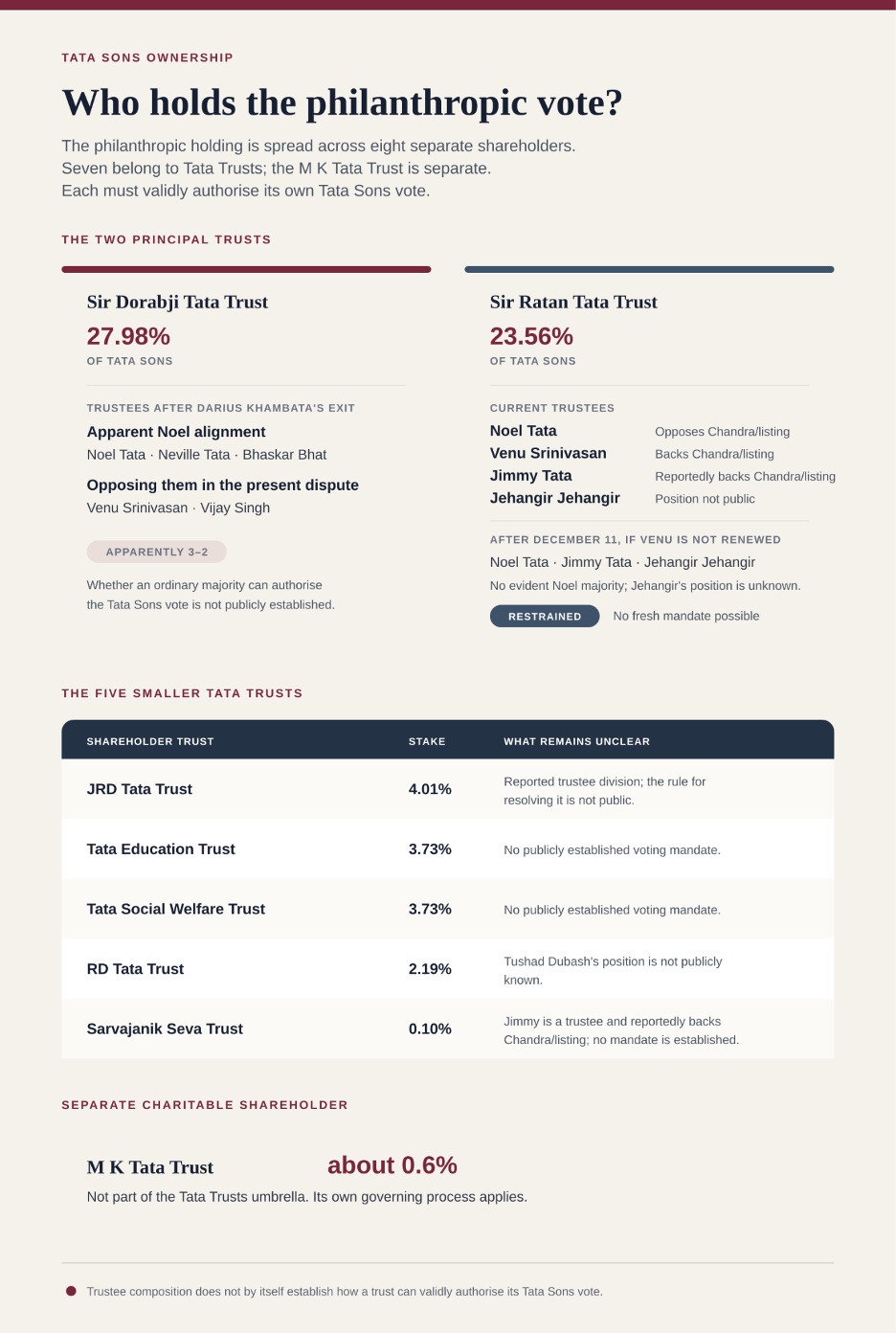
That matters because the trustees overlap, but their alignments do not always coincide. Venu Srinivasan and Vijay Singh have supported Chandra’s continuation, defended the September 17 board vote and favoured listing. Noel, Neville Tata and Bhaskar Bhat appear aligned on the other side at Sir Dorabji Tata Trust (SDTT). The opposition to Noel now appears broader. Jimmy Tata, Sir Ratan Tata Trust’s (SRTT’s) longest-serving trustee and one of its three perpetual trustees, has reportedly backed Chandra’s continuation and listing, while questioning Noel’s growing control over the Trusts.
This is not the first time Jimmy has challenged those running the Tata institutions. During the Ratan Tata–Cyrus Mistry battle in December 2016, he handed The Times of India six files containing hundreds of pages of letters to SRTT trustees and the Tata Sons board, many expressing dissatisfaction with decisions taken over the years. He also said he would abstain from the resolutions to remove Cyrus. The record suggests a long-standing independent—and often dissenting—streak, rather than settled loyalty to any camp.
But the position taken by an individual trustee does not automatically become a voting mandate. It cannot be assumed that a numerical majority is always sufficient to authorise a Trust’s vote—or that its chairman possesses a casting vote when trustees are divided. SRTT is widely understood to have operated through consensus, although the precise requirement has not been publicly established. The position at SDTT and the smaller Trusts is also unclear. If a Trust cannot reach a decision through the procedure prescribed by its deed or governing scheme, it may be unable to issue a fresh mandate until the deadlock is resolved.
SRTT, which owns 23.56% of Tata Sons, has been restrained from holding meetings while the Charity Commissioner examines questions surrounding its composition. It therefore cannot presently convene its trustees to issue a fresh voting mandate. Its inability to join SDTT in nominating the representative required under Article 86 prevented the August AGM from achieving quorum.
Jimmy’s intervention does not alter that position. His views were conveyed in a documented exchange rather than through a Trust resolution. But they change the prospective alignment. If Venu leaves SRTT when his term ends on December 11, Noel would not necessarily gain control of the smaller board. Jimmy would appear opposed to him on the central questions of Chandra and listing, while Jehangir Jehangir’s position is not publicly known.
The smaller Trusts have no nominee directors on the Tata Sons board; their power lies in voting their shares at a general meeting. The special nomination rights belong jointly to SDTT and SRTT, which appointed Noel and Venu. The Tata Sons Articles provide a mechanism for the two principal Trusts to act jointly, but that does not resolve a deadlock within an individual Trust—or the present problem that SRTT cannot meet. Nor would the reported end of Venu’s SRTT term on December 11 necessarily terminate his Tata Sons directorship. Nothing in the public record establishes an automatic lapse. His continuing SDTT trusteeship—reportedly extending into 2028—would strengthen his argument that he remains until he retires or the two principal Trusts validly replace him.
At SDTT, Tata Sons’ largest shareholder with 27.98%, Noel appears to command three of the five trustees: himself, his son Neville Tata and Bhaskar Bhat. Venu Srinivasan and Vijay Singh form the opposing two. That gives Noel an apparent working majority if SDTT can decide by ordinary majority. But the Trust’s governing provisions are not public, so the arithmetic alone does not establish that the three can issue a valid Tata Sons voting mandate.
No comparable claim can yet be made over the Tata Education Trust, Tata Social Welfare Trust and Sarvajanik Seva Trust. Noel may have support within them, but no reliable public evidence establishes that their votes are available to him.
Nor can Noel simply claim the smaller Trusts. JRD Tata Trust, with 4.01%, appears divided two-two. RD Tata Trust, with 2.19%, is more difficult to read. Noel, Maya and Neville Tata occupy three of its six trustee positions. Venu Srinivasan and Vijay Singh have opposed Noel in the present dispute, while Tushad Dubash’s position is not publicly known. Even this arithmetic may not be conclusive: the internal voting rules of the two Trusts are not public. Noel therefore needs each participating Trust to authorise its vote in a legally valid manner—not a general assertion that the Trusts stand behind their chairman.
The divisions are personal as well as institutional. Before declining reappointment to both SDTT and SRTT, Darius Khambata described September 17 as a day that would “live in infamy”. He acknowledged that he had earlier supported another term for Chandra, but said subsequent events had overtaken that position. Khambata backed Noel’s elevation, defended his own independence and argued that opposition to listing had to be accompanied by a credible answer to SP’s liquidity problem.
Venu Srinivasan and Vijay Singh responded in a joint letter of November 11. They said Khambata’s account omitted important parts of the history: all the then-serving trustees had supported another five-year term for Chandra in July 2025, before the induction of Neville Tata and Bhaskar Bhat altered the balance within SDTT. They also alleged that Venu’s temporary removal and subsequent reappointment had been used to facilitate those appointments. These are contested claims, not established findings. But they show that the dispute now extends to how the present power structure inside the Trusts was created.
The exchange also exposed the central disagreement over nominee directors. Khambata argued that a Tata Trusts nominee sits on the Tata Sons board to protect the Trusts’ interests. Venu and Vijay countered that nomination does not turn a director into a delegate bound to follow a trustee mandate regardless of his duties to Tata Sons. That unresolved distinction lies at the heart of the September 17 vote.
Noel has so far avoided rushing to court. Instead, he has challenged the process followed on September 17, sought the recording of the meeting, commented on the draft minutes and created a contemporaneous paper trail. Tata Sons says the board approved Chandra 4-1 and that Noel participated fully. Noel says the discussion remained subject to legal and shareholder conditions when he left.
Time may clarify whether SRTT can resume acting, allow SDTT to establish its authority and give Shapoor room to decide which side can help him. But Jimmy’s reported position means Venu’s departure would not by itself deliver SRTT to Noel.
Noel may possess enough power to stop Chandra. He has not yet shown that he can bring the Trusts together, carry the shareholder vote and produce an orderly alternative.
Chandra makes the case for continuity
Under Cyrus Mistry, he was the outstanding operating-company chief who ran TCS, not a member of the chairman's strategic inner circle. Cyrus created a hand-picked Group Executive Council to shape the long-term group agenda. Chandra was not part of it, although operating-company CEOs were not ordinarily members. His elevation after Cyrus's removal was therefore a sharp break, not an orderly succession.
The leap was considerable: from running the group's most successful company to stewarding a federation spanning steel, automobiles, power, hotels, consumer products, aviation and a new generation of capital-intensive bets.
Over the decade that followed, Chandra built a group-wide record of his own, but it is a mixed one. Tata Sons consolidated its grip over important businesses. Several established operating companies strengthened, and the market value of the major listed Tata companies rose sharply. Those gains are real. They do not, however, settle the argument over the large new businesses and projects identified most closely with his tenure.
Air India remains deep in the red after an expensive acquisition and integration. Its consolidated loss more than doubled to ₹22,238 crore in FY26, although the result was also hit by the AI171 crash, airspace disruptions and foreign-exchange losses. Tata Digital lost ₹4,974 crore in the same year after Tata Sons’ direct equity investment in it had reached about ₹22,903 crore, with additional share-application money outstanding; Tata Neu is now being refocused on financial services and loyalty after the original super-app ambition failed to deliver as planned. The semiconductor fab at Dholera is an important national bet, but it is still being built. Its execution and returns lie years ahead. It cannot yet be counted as a success.
This distinction between strategic direction and delivery lies at the heart of Noel’s challenge. At the HT Leadership Summit, Noel welcomed the group’s semiconductor and battery projects as examples of Tata’s continuing role in nation-building. But he drew a careful line. Noel said he did not question the direction of these investments. His concern was whether very large, long-gestation projects were being executed with sufficient discipline—and how capital would be allocated among them. He did not single out individual businesses for criticism. But, read alongside his earlier calls for greater clarity on losses, capital commitments and turnaround plans, the remarks amounted to a broader challenge to Tata Sons’ record of execution.
Semiconductors require a further qualification. The Dholera fabrication plant is not simply another commercial bet by the group. It is a government-backed strategic project, supported under the India Semiconductor Mission and tied to India’s ambitions in technological self-reliance and national security. Noel’s argument, therefore, is not that Tata should retreat from it. It is that national importance does not remove the need for execution discipline, capital oversight and accountability.
Chandra’s case rests on the established portfolio, board support and the risks of disruption. His critics argue that the uneven record of the new ventures is precisely why his continuation—and future capital commitments—require closer scrutiny.
The present battle sharpened abruptly on August 12, when Chandra said he would not offer himself for another term. The Trusts accepted the decision and initiated a succession process. Barely five weeks later, Tata Sons announced that its board had approved another five-year term beginning February 21, 2027. Noel voted against it and disputes both the legal basis and the procedure followed.
That vote has also attracted a separate conflict-of-interest allegation. Mint reported that a company whose directors include Chandra’s wife and son had leased 17 acres from TVS Motor for a warehouse project. Venu is chairman emeritus of TVS Motor, a Tata Sons director and a member of the nomination and remuneration committee that reviews Chandra’s performance. Tata Sons said the formation of the family company had been disclosed and that the transaction itself did not require disclosure because TVS Motor is an independent listed company with no dealings with the Tata group. Tata Trusts said Venu had made no disclosure to its trustees. The reporting raises a legitimate governance question about disclosure and recusal; it does not by itself establish wrongdoing or prove that Venu’s vote was influenced.
Chandra has seldom answered Noel directly in public. Instead, his appearances have constructed their own argument.
On September 27, dressed in traditional white at Sringeri, Chandra proposed bringing the Hindu Shastras into conversation with computer science and artificial intelligence. The images were striking: India’s most prominent technology executive presenting himself as a bridge between civilisational knowledge and the future.
A fortnight later, at the Bloomberg New Economy Forum in Delhi, he appeared alongside former UK prime minister Rishi Sunak and Blackstone president Jonathan Gray. There, he defended Tata’s semiconductor investment as a long-term national bet. Near-term spreadsheets, he argued, could not determine whether India built an industry it fundamentally needed.
The direction was certain. Tata's ability to execute was certain. What remained uncertain was the speed of the ramp-up.
There is no evidence that these appearances were coordinated as a response to Noel; several would have been scheduled well in advance. But amid a leadership dispute, they projected a coherent image of Chandra: the globally connected technocrat, nation-builder and executor carrying the group into India’s strategic future.
Read against Noel’s subsequent remarks, the two men appeared to be conducting a debate without addressing each other. Chandra’s appearances projected confidence in the group’s direction, the patience its investments required and its ability to deliver. Noel accepted the direction, but questioned execution discipline and the allocation of capital.
Yet the public debate and the institutional contest are taking place on different grounds. Chandra’s immediate vulnerability is arithmetical. Tata Sons has announced that its board approved another term for him as chairman, but he can hold that office only while he remains a director. Shareholders must first reappoint him as a director at a valid AGM. The board can recommend him. It cannot supply the shareholder votes.
Chandra has won the boardroom vote. He has not yet won the shareholder vote on which his chairmanship depends.
Chandra's strongest asset is Tata Sons' ability to evaluate and execute transactions. The company can appoint bankers, lawyers and valuers. It can examine how SP might obtain liquidity, test Noel's restructuring proposal and negotiate a deal. Noel can sponsor proposals. He cannot commit Tata Sons' funds or deliver a transaction on his own.
That gives Chandra an opening with Shapoor. He can argue that an incumbent chairman with board support is better placed to convert a proposal into an executable process. But corporate action cannot look like the price of a shareholder's vote. Any transaction must serve Tata Sons, withstand independent valuation and satisfy company law and regulatory requirements.
If both principal Trusts participate, Chandra still needs a sufficiently large Trust mandate. His path therefore depends not on generic dissent inside the Trusts but on one or more Trust boards producing usable votes. Even with SP, his victory is not assured. If one or both principal Trusts cannot participate, SP’s importance increases and the arithmetic must be recalculated.
His meeting with Mehli Mistry has therefore attracted attention. Mehli remains supportive of Chandra's stewardship, and his complaints could complicate Noel's authority. But Mehli is not seeking reinstatement to either principal Trust, and there is no public evidence that the meeting produced an alliance. Proceedings that weaken Noel would not automatically manufacture votes for Chandra.
Time is short. Delay helps Chandra only if he uses it to build a majority, begin a credible SP process or negotiate an orderly transition. Board support and the absence of an agreed successor raise the cost of removing him. Neither substitutes for the shareholder resolution he needs before February 20.
Chandra has built a powerful public case for continuity. He has not yet assembled the votes to make it decisive.
Shapoor carries Cyrus's unfinished battle
The most important fact about Shapoor Mistry is also the one nobody outside his closest circle knows: how he will vote.
Fifteen years ago, the two Mistry brothers appeared to inhabit different worlds. Cyrus was the workaholic who immersed himself in projects, finance and the family group's infrastructure businesses. Shapoor was the more visible racing enthusiast, happiest among the thoroughbreds at the 200-acre Manjri Stud Farm outside Pune.
That description never told the whole story. Shapoor had overseen the restructuring of Forbes Gokak after its acquisition from the Tatas, brought in professional managers and separated its engineering and textile operations. But Cyrus was widely regarded as the more analytical and deeply engaged operator. He helped turn around Afcons, personally pursued troubled projects and later brought the same forensic attention to Tata Sons.
Time reversed the brothers' circumstances brutally.
Cyrus's removal from Tata Sons in 2016 made him the strategist of the family's legal and governance battle. He knew the Tata system from inside. He challenged his dismissal, the treatment of the minority shareholder and the restrictions surrounding the family stake. The Supreme Court eventually ruled against him.
In 2022, Shapoor lost his father Pallonji and, three months later, Cyrus. He inherited not only leadership of the operating group but responsibility for Cyrus's family, the debt accumulated across a sprawling portfolio and a Tata dispute his brother had not resolved.
The SP Group has sold valuable businesses and repaid substantial borrowings. But the harder question is whether it moved early and decisively enough to stop losses and reshape the portfolio. The pandemic intensified the crisis; it did not create every underlying weakness. Liquidity from Tata Sons can buy time. It cannot substitute for an operating turnaround.
That is why describing Shapoor as a kingmaker is inadequate. He is not a neutral shareholder choosing between rival leaders. He heads an enterprise fighting to protect what remains. Its Tata Sons holding is enormously valuable but difficult to sell, pledge or otherwise convert into cash. The family's greatest asset has become the asset on which the survival of the rest increasingly depends.
SP has proposed selling enough shares to raise at least ₹25,000 crore. Noel placed that proposal before the Tata Sons board. It contemplates a selective capital reduction in two tranches over 18 months, supported by a valuation process. The board has yet to adopt it.
One rational course would allow Shapoor to avoid choosing the next Tata chairman at all. He could abstain, preserve his relationship with Noel and wait for the Trusts chairman to deliver a credible liquidity process. That would keep SP out of the succession battle while retaining pressure on both sides.
But abstention requires trust.
Noel is Shapoor’s brother-in-law, but kinship has not determined their institutional choices. Noel maintained a relatively low public profile during the battle over Cyrus’s removal as chairman. Yet in February 2017, he and Simone Tata supported the shareholder resolution removing Cyrus from the Tata Sons board. Family ties did not prevent the two sides from ending up on opposite sides then. Nor do they guarantee alignment today. Noel can place SP’s proposal before the board, but he cannot ensure that Tata Sons, RBI or the National Company Law Tribunal (NCLT) will approve it. Shapoor needs more than reassurance from a relative. He needs a credible process that can survive independent valuation, regulatory scrutiny and the opposition of those who may prefer another outcome.
Noel may now need the support of the family whose representative he helped remove.
November 26 therefore matters for Shapoor. Appointment of independent advisers, a valuation, authority for management to negotiate and a deadline for returning to the board would show that his request had moved beyond family assurances. It would not commit Tata Sons to a transaction. It would create a process he could assess.
A refusal even to evaluate the proposal could push SP back towards listing, renewed litigation or other routes to liquidity. A credible process could influence its vote. But nobody outside Shapoor's closest circle knows what would be sufficient: serious engagement, a binding timetable or an agreed first tranche.
Chandra can offer access to the corporate machinery required to execute a deal. Noel can offer the prospect of a different long-term relationship if he consolidates the Trusts. Neither offer is complete.
Shapoor's choice is therefore not simply between Noel and Chandra. It is between an uncertain promise of liquidity, whatever firmer process the incumbent can offer, and the risk that choosing either camp too early will destroy his leverage with the other.
He may hold decisive votes. He cannot yet know which vote will save the enterprise he leads.
When the battle escaped the boardroom
Harish Salve, who disclosed that he was advising Chandra, appeared on national television to defend both the reappointment and Tata Sons’ interpretation of its Articles. He argued that nominee directors were not puppets of their nominations and that a disagreement between Noel and Venu could not be allowed to paralyse the company.
Salve’s intervention was unusually combative—and personal—for a dispute ostensibly about the interpretation of a company’s Articles. He warned that litigation could bring questions about Noel’s Irish passport, Dubai residence and accumulation of positions across the Trusts into public view. He dismissed an interpretation that could paralyse Tata Sons as lacking basic sense, and said he had personally told Chandra that he “owed it to the country” to continue.
Chandra’s continuation was thus presented not merely as a question of one individual remaining in office, but as a matter of national interest and institutional stability.
Abhishek Manu Singhvi answered for the Trusts. He invoked shareholder authority, the special protections in Tata Sons' Articles and the Supreme Court's earlier recognition of those rights in the Cyrus Mistry litigation. An independent board, he argued, could not become a runaway board insulated from the company's 66% owner.
Television could not decide which interpretation would survive in court. But Singhvi's appearance ended any early impression that legal authority and establishment credibility belonged entirely to Chandra's side.
The same contest appeared in the reporting. The Economic Times foregrounded Tata Sons' institutional account of September 17: Noel participated, the board voted 4-1, draft minutes were circulated and he could record his objections. Mint foregrounded Noel's version: the apparent decision remained subject to legal clarity and shareholder approval when he left, yet was announced within the hour.
One version presents a chairman validly reappointed by an independent board. The other presents the controlling shareholder's representative as having been overtaken by events after he left. The disagreement over a recording is therefore also a battle over which account becomes the historical record.
Another constituency has remained largely invisible: the people who work inside Tata companies. In a post on X on Monday, an experienced corporate reporter said he had received several calls from CEOs and employees of Tata companies who supported the Tata family and wanted Tata Sons to remain unlisted. Some appeared to view the challenge to family stewardship less as a governance dispute than as an act of disloyalty to the Tata institution.
These were self-selecting calls and cannot establish a group-wide position. But they suggest that, for at least some insiders, the Trust structure is not merely an ownership arrangement. It is bound up with the Tata identity, the values attached to the brand and their own reasons for working within the group.
Six prominent Parsi and Zoroastrian organisations wrote to the Prime Minister defending the Trust-led ownership model and warning that listing could alter Tata Sons' ethos. The intervention was not merely nostalgic. It asserted that the Tata structure formed part of a community's philanthropic inheritance.
But the community is not monolithic. Vada Dasturji Khurshed Dastoor, high priest of the Iranshah Atash Behram at Udvada, subsequently appealed for restraint and lawful reconciliation while drawing attention to SP's own substantial support for Zoroastrian institutions. The Trusts carry one philanthropic legacy; the Mistrys carry another.
Rahul Gandhi accused business leaders of remaining silent while Tata was being “criminally destroyed”. Finance Minister Nirmala Sitharaman accused him of politicising a commercial and legal dispute. Gandhi responded by pointing to an earlier meeting between Tata representatives and Home Minister Amit Shah—using it to question the government’s claim of distance from the affair. There is no public evidence that the government directed the corporate outcome or the regulator involved. But once national politicians entered the contest, even a legally tidy settlement risked becoming entangled in suspicions of political influence.
The interventions revealed why the contest can no longer be settled as a narrow boardroom quarrel. Tata Sons is being claimed simultaneously as a company governed by its board, an asset owned by charitable Trusts, a source of liquidity for a distressed minority shareholder, a symbol of Parsi stewardship and an institution of national importance.
The institutions can change the arithmetic
The three men are not playing on a fixed field. The Charity Commissioner, RBI and NCLT can change which options remain open and which shareholder can participate.
The immediate uncertainty concerns SDTT. Mehli Mistry says he is not seeking reinstatement as a trustee. He has nevertheless challenged the circumstances in which his trusteeship ended, questioned trustee eligibility and sought scrutiny of the Trusts' administration.
The proceedings may remain confined to pleadings, maintainability and disputed change reports. But if they produced a restraint on consequential decisions, SDTT could be prevented from issuing a Tata Sons voting mandate. Its shares would not move to Chandra. Noel's largest usable block would simply disappear from the immediate contest.
If both principal Trusts were unable to vote, shareholders owning 51.54% of Tata Sons would be outside the decision. SP would become the largest shareholder able to participate. Five smaller trusts within Tata Trusts together hold about 13.76%. The separate M K Tata Trust adds roughly 0.6%, taking the smaller philanthropic holdings to about 14.36%. Tata operating companies hold about 12.87%, while other shareholders hold approximately 2.87%.
The arithmetic would then shift sharply towards SP. If SP voted for Chandra and the Tata operating companies did the same, their combined 31.24% would exceed half of the share capital still able to participate—even before the other shareholders were counted. Chandra would not necessarily need support from a smaller Trust.
If SP abstained, the contest would become much tighter. The smaller philanthropic shareholders together hold about 14.36%, against 15.74% held by the Tata operating companies and other shareholders. Noel could not win simply by bringing all the smaller trusts together. He would also need support from outside the Trusts—or need SP to vote against Chandra rather than remain neutral.
The legal and legitimacy questions would then diverge. One side would argue that the regulatory difficulty of controlling shareholders cannot paralyse the company indefinitely. The other would say that a leadership vote held while owners representing more than half the company are incapacitated may comply with an order and still lack legitimacy.
The NCLT can open the meeting room without choosing the winner. If Tata Sons fails to complete its AGM by the reported December 31 deadline, a shareholder can ask NCLT to direct that the meeting be held and to relax the quorum requirement that blocked the August AGM. In an extreme case, the Tribunal can deem one shareholder sufficient to constitute the meeting.
The Tribunal would not ordinarily decide who is authorised to represent each Trust. That may remain for the Trust boards, the Charity Commissioner or the courts. But by deciding whether the AGM proceeds while one or both principal Trusts cannot vote, it could transform the arithmetic.
RBI affects a different part of the struggle: Noel’s attempt to keep Tata Sons private. The central bank rejected Tata Sons’ request to surrender its registration and advised it to comply with the framework for upper-layer NBFCs, which requires listing within three years. The reach of that requirement remains contested. Senior lawyer and former RBI director H P Ranina argues that RBI can regulate an NBFC but cannot compel its owner to convert a private company into a public one. The contrary case rests on RBI’s broad authority over systemically important financial institutions and the explicit listing requirement in its upper-layer framework.
Shanghvi Finance provides a useful comparison. It entered the upper layer in 2022, repaid its borrowings and was permitted in May 2023 to surrender its registration. Tata Sons also became debt-free and sought deregistration, but RBI refused. Hardeep Sachdeva of AZB & Partners has described the earlier case as an instructive precedent. Yet the comparison is not exact: Tata Sons is vastly larger, sits at the head of a systemically important group and may retain indirect access to public funds through group companies. Shanghvi does not settle the issue, but it strengthens the case for RBI to explain the different treatment.
Noel’s restructuring proposal creates the next test. If the merger of operating businesses genuinely takes Tata Sons outside the definitions of an NBFC and a core investment company, should RBI assess the changed entity afresh? Or does the listing obligation survive its existing upper-layer classification? Tata cannot demand an exemption from rules that apply to everyone else. But an intervention that appeared to pre-empt the board’s examination of a potentially lawful restructuring could make RBI appear to be determining the ownership structure of a private company. The regulator therefore needs to explain clearly both the reach of its listing rule and how it would treat a genuine change in Tata Sons’ business profile.
A public-interest petition asking the Bombay High Court to compel listing and restrain the restructuring is listed for admission on December 2. Unless the court considers interim relief, there remains pressure surrounding the debate rather than a determining event.
Four ways the deadlock could break
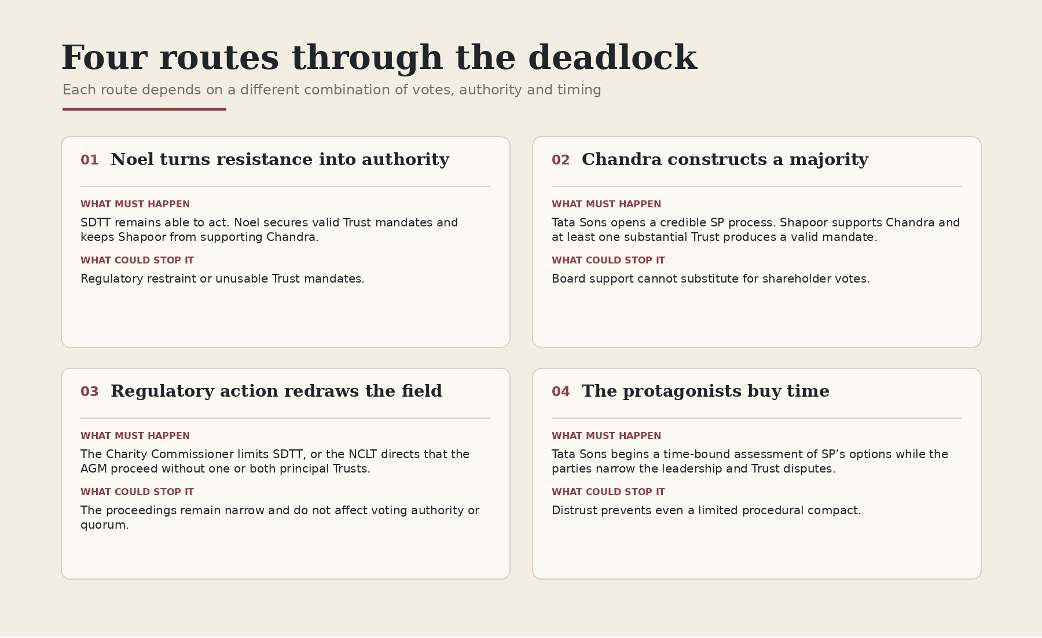
The contest can still move in four broad directions. These are not predictions. Each depends on decisions that have not been taken and voting mandates that may not exist.
Noel turns resistance into authority
SDTT remains legally able to act. Noel secures valid mandates from enough Trusts and keeps Shapoor from supporting Chandra. He can then defeat the incumbent at the AGM.
Jimmy’s intervention makes that path harder. Noel can no longer assume that a smaller SRTT board after December 11 would align with him.
But that is only half an outcome. Noel must present a credible successor or transition plan and demonstrate that the Trusts can govern coherently after using their power to block. Otherwise he will have proved that he can stop the existing order, not that he can create a workable alternative.
Chandra constructs a majority
The Tata Sons board opens a credible, independently governed process for SP's liquidity proposal. Shapoor concludes that the incumbent offers the more executable route and supports him.
Jimmy’s support strengthens Chandra’s position inside the Trusts. But it does not become a shareholder vote unless SRTT is permitted to meet and can validly authorise one.
Chandra still needs a sufficiently large Trust mandate. His path depends not on generic dissent inside the Trusts but on one or more Trust boards producing usable votes. Even with SP, his victory is not assured.
Regulatory action redraws the field
The Charity Commissioner restrains or limits SDTT, or the NCLT directs that the AGM proceed without one or both principal Trusts. Shapoor and the smaller Trusts then gain greater weight.
The resulting vote could be legally valid and still face a political and moral challenge: should the leadership of Tata Sons be settled while its controlling charitable owners are unable to participate?
The protagonists buy time
Noel, Chandra and Shapoor conclude that an immediate showdown carries more risk than a temporary accommodation. Tata Sons begins a time-bound assessment of SP's options. The AGM advances after the parties clarify what shareholders are being asked to approve—and what would follow from the vote. Succession planning begins quietly. Legal disputes are narrowed rather than enlarged.
There is little evidence that such an understanding is close. A recent attempt to find common ground between Noel and Chandra reportedly produced no breakthrough. But accommodation need not begin as a grand bargain. It could emerge from smaller decisions that prevent liquidity, leadership and Trust governance from being forced into one destructive vote.
What to watch
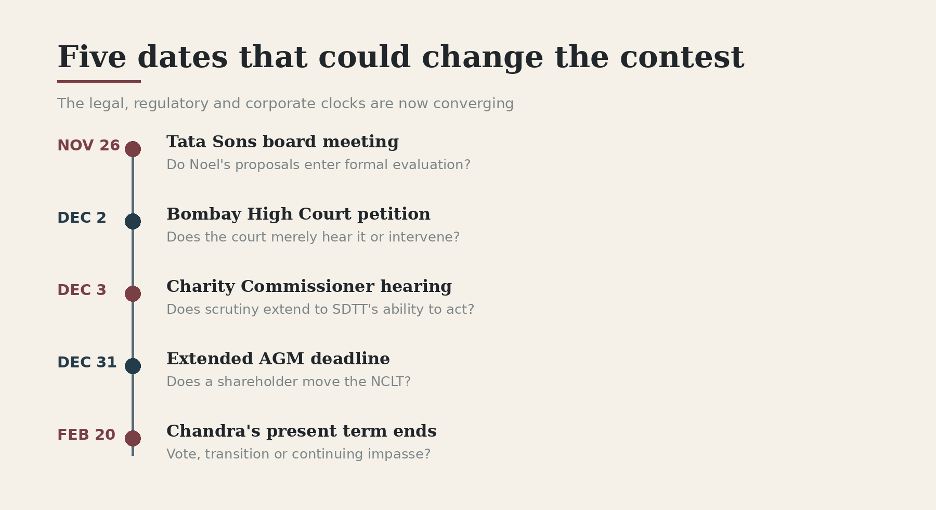
The first clues should emerge from the Tata Sons board meeting expected on November 26. The test is not whether Noel's proposals are immediately accepted. It is whether they enter credible evaluation.
The appointment of advisers, an independent valuation, authority for management to negotiate with SP, a formal assessment of the restructuring and clear reporting deadlines would signal movement. Another refusal to engage would show that positions remain frozen.
The Charity Commissioner hearing on December 3 may be more consequential than the third-party High Court petition the previous day. The question is whether Mehli's complaints remain confined to trustee changes and eligibility or widen into scrutiny that affects SDTT's ability to issue a voting mandate.
If the AGM remains incomplete on December 31, the identity of any NCLT applicant and the relief sought will reveal the underlying strategy: force Chandra's vote, complete limited statutory business or delay until the principal Trusts can participate.
All these processes run into February 20. By then, Tata Sons needs a valid shareholder decision, a negotiated transition or another legally sustainable arrangement. The September 17 board resolution cannot indefinitely substitute for shareholder approval of Chandra's directorship.
What survives the contest
The Tata structure was not designed for this combination of pressures: charitable owners divided among themselves, a principal Trust immobilised, a large minority shareholder in urgent need of liquidity and a corporate board seeking leadership continuity.
For decades, personal relationships and unwritten conventions bridged the gap between charitable ownership and corporate authority. Pallonji Mistry rarely challenged Tata management publicly. Ratan Tata combined moral authority, influence over the Trusts and an intimate understanding of the operating group. Those arrangements did not survive the transitions that followed.
Nominee directors owe duties to Tata Sons and must exercise their own judgement. The Trusts that nominate them expect their stewardship interests to carry weight. SP wants the economic value of its property recognised. RBI must enforce a framework designed to protect the financial system. No accepted mechanism reconciles these claims when they collide.
A lasting settlement will therefore require more than deciding whether Chandra stays or Tata Sons lists. It will need clearer rules on information sharing, shareholder mandates, the selection and evaluation of nominee directors, the boundary between ownership and board authority, liquidity for a locked-in minority shareholder and the resolution of future disputes.
For the moment, each protagonist controls only part of the outcome. Noel has moved from private resistance to leading a public case for stewardship, but has not united all the Trusts behind him. Chandra has built a formidable public case for continuity and retains the board’s backing, but still needs votes the board cannot supply. Shapoor may possess the decisive block, but no guaranteed route out of his own crisis.
The question is no longer simply who owns Tata Sons or who should chair it. It is whether any of the three can construct an outcome that the institutions around them can validate—and that the others can live with.
Dig Deeper:
- The Real Question Behind a Tata Sons Listing — Indrajit Gupta, September 15
- The Battle for the Tata Inheritance — Indrajit Gupta, September 28
- What a Lasting Tata Settlement Must Resolve — Satish Pradhan, October 7
Join the conversation
Indrajit Gupta
Co-founder and Director | Founding Fuel
Indrajit Gupta is a business journalist and editor with over two decades of experience. He was the Founding Editor of the Indian edition of Forbes magazine. Within four years of its launch, Forbes India became the most influential magazine in its space.
He is the co-founder and director at Founding Fuel.
He has served in leadership positions at many of the leading media brands in the country. Before taking up the assignment to start up the India edition of Forbes magazine, Gupta was the Resident Editor of The Economic Times in Mumbai and before that, the National Business Editor of The Times of India.
Over the years, Gupta has built a reputation for grooming talent and creating highly energised and purposeful newsrooms. He has interviewed several leading global thought-leaders and business leaders including CK Prahalad, Ram Charan, Wayne Brockbank, Sumantra Ghoshal, Carlos Ghosn and Nitin Nohria, and also led cutting-edge joint research-based projects with McKinsey & Co, The Great Place to Work Institute, Boston Consulting Group, KMPG and Coopers & Lybrand.
He won the Polestar journalism award in 2010 and was awarded the Chevening fellowship by the British Foreign office in 1999. Gupta is an alumnus of the SP Jain Institute of Management and Research, Mumbai and a B.Com (Hons) graduate from St Xavier's College, Calcutta.
Gupta teaches a course on Business Problem Solving at his alma mater. He writes a column named Strategic Intent in Business Standard’s edit page. He lives in Mumbai with his wife and two young daughters.
Beyond the noise is the signal.
FF Insights: Sharpen your edge, Monday–Friday.
FF Life: Culture, ideas and perspectives you won't find elsewhere — Saturday.

Founding Fuel is sustained by readers who value depth, context, and independent thinking.
If this essay helped you think more clearly, you may choose to support our work.

Founding Fuel is sustained by readers who value depth, context, and independent thinking.
If this essay helped you think more clearly, you may choose to support our work.
Loading comments...



Readers also liked
·Economy, Policy & Society
Who Was the School Day Built For?
India’s school system was built to educate at scale. Its classrooms, exams and incentives reveal what that design rewards—and the individual child it struggles to see.
NA

Nandita Abraham
Founding Dean | BITS Design School, Mumbai
Who Was the School Day Built For?
India’s school system was built to educate at scale. Its classrooms, exams and incentives reveal what that design rewards—and the individual child it struggles to see.
Founding Dean | BITS Design School, Mumbai

·Leadership & Organisation
Who Owns the Fire?
A leader can light the spark. The harder question is what happens to the fire afterwards?
SP

Satish Pradhan
Independent Consultant
Who Owns the Fire?
A leader can light the spark. The harder question is what happens to the fire afterwards?
Independent Consultant
·Business & Strategy
The Battle for the Tata Inheritance
The struggle inside Tata Trusts is exposing a question that goes far beyond personalities: can an unusual compact between philanthropy, ownership and corporate power survive the loss of the steward who held it together?
IG

Indrajit Gupta
Co-founder and Director | Founding Fuel
The Battle for the Tata Inheritance
The struggle inside Tata Trusts is exposing a question that goes far beyond personalities: can an unusual compact between philanthropy, ownership and corporate power survive the loss of the steward who held it together?
Co-founder and Director | Founding Fuel
Explore more
Dive into other themes from our network.