WFH Daily #186: Manage energy, not time
September 25, 2020: Tony Schwartz & Catherine McCarthy on working long hours; Forecasting fallacy; Telling stories, communicating vision; Rise & fall of Zoom backgrounds
25 September 2020· 4 min read
TL;DR
This article urges business leaders to shift focus from managing time to managing employee energy, especially pertinent in the current WFH environment. Drawing from Schwartz and McCarthy, it argues that sustained productivity combats fatigue by renewing energy across four vital wellsprings: body, emotions, mind, and spirit. Organizations must invest in holistic employee well-being through intentional rituals to boost engagement. Simultaneously, the piece critically examines the 'forecasting fallacy,' cautioning against over-reliance on often-inaccurate long-term predictions. Leaders are encouraged to prioritize adaptability and critical thinking over illusory certainties, fostering both energetic teams and robust, realistic strategic planning.

Good morning,
The October 2007 edition of Harvard Business Review (HBR) carried a seminal essay by Tony Schwartz and Catherine McCarthy headlined Manage your energy, not your time.
We believe this essay is important and urgent because most of us now exist in a space where our professional and personal spaces have merged (in other words, the WFH life). Perhaps, that is why people believe they have more time on hand to get work done. Commutes and endless meetings are a thing of the past. But the truth is, people are feeling fatigued. And when the data is examined, it is because on average, most people are working three hours longer than they used to before the pandemic. How are we to cope with the fatigue then?
Schwartz and McCarthy write, “The core problem with working longer hours is that time is a finite resource. Energy is a different story. Defined in physics as the capacity to work, energy comes from four main wellsprings in human beings: the body, emotions, mind, and spirit. In each, energy can be systematically expanded and regularly renewed by establishing specific rituals—behaviours that are intentionally practiced and precisely scheduled, with the goal of making them unconscious and automatic as quickly as possible.
“To effectively reenergise their workforces, organisations need to shift their emphasis from getting more out of people to investing more in them, so they are motivated—and able—to bring more of themselves to work every day. To recharge themselves, individuals need to recognise the costs of energy-depleting behaviours and then take responsibility for changing them, regardless of the circumstances they’re facing.”
Slow down. It’s a Friday.
In this issue
- The forecasting fallacy
- Telling stories, communicating vision
- The rise and fall of Zoom backgrounds
Have a great day!
The forecasting fallacy
All of us look at forecasts made by consulting firms, media outlets, and analysts very closely. Our intent is to gauge the future. Forecasts fascinate us. Why?
After poring over the data, Alex Murrell, strategy director at Epoch Consulting based in Bristol, explains: “To understand the extent of our forecasting fascination, I analysed the websites of three management consultancies looking for predictions with time frames ranging from 2025 to 2050. Whilst one prediction may be published multiple times, the size of the numbers still shocked me. Deloitte’s site makes 6,904 predictions. McKinsey & Company make 4,296. And Boston Consulting Group, 3,679.”
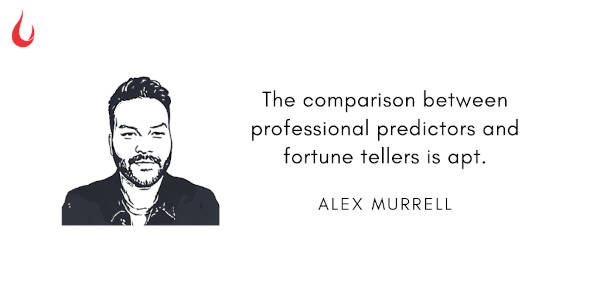
“In total, these three companies’ websites include just shy of 15,000 predictions stretching out over the next 30 years.
“But it doesn’t stop there.
“My analysis finished in the year 2050 not because the predictions came to an end but because my enthusiasm did.
“Search the sites and you’ll find forecasts stretching all the way to the year 2100. We’re still finding our feet in this century but some, it seems, already understand the next.
“I believe the vast majority of these to be not forecasts but fantasies. Snake oil dressed up as science. Fiction masquerading as fact.”
He offers some big takeaways
- We can’t predict recessions
- We can’t predict GDP
- We can’t predict interest rates
- We can’t predict exchange rates
- We can’t predict media spend
- We can’t predict much at all
To hammer his point home, he writes, “Still don’t believe me? Take a look at the research of political scientist Philip Tetlock. In 1984, the National Research Council held a meeting to discuss American-Soviet relations. Philip Tetlock, the committee’s youngest member, was struck by how frequently his more experienced colleagues made perfectly contradictory policy predictions. In that moment, Tetlock decided to put expert forecasting to the test.”
The finding:
“It didn’t matter whether the experts were making predictions about economics, domestic politics, or international affairs; their judgement was equally bad across the board.”
Dig Deeper
Telling stories, communicating vision
In an interview with India Development Review, Shaheen Mistri, founder and CEO of Teach For India (TFI), an education-focused nonprofit, shares important lessons on building an organisation, and a brand. Here are three lessons we found interesting.
Start with why: “A big part of what builds a great organisation is being able to answer the ‘why’ of the work you’re doing, how deeply you understand the ‘why’, and your evolving understanding of the ‘why’.”
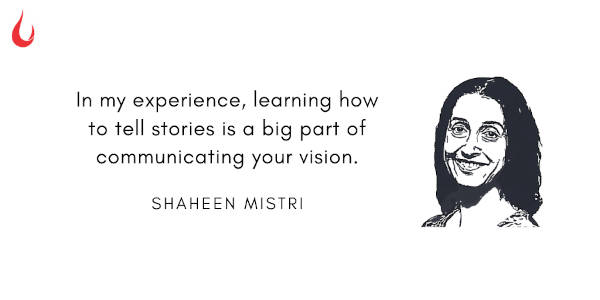
Overcommunicate: “You can never communicate enough. The way in which you communicate is also important—and this has been a big learning for me at both Akanksha and TFI. In my experience, learning how to tell stories is a big part of communicating your vision.”
Believe in your vision: “Another interesting evolution for me was moving away from thinking that people are doing you a favour by giving you something, to actually saying, ‘I’m giving you an opportunity to change India.’ And it took me a long time to make this shift.”
Dig Deeper
The rise and fall of Zoom backgrounds
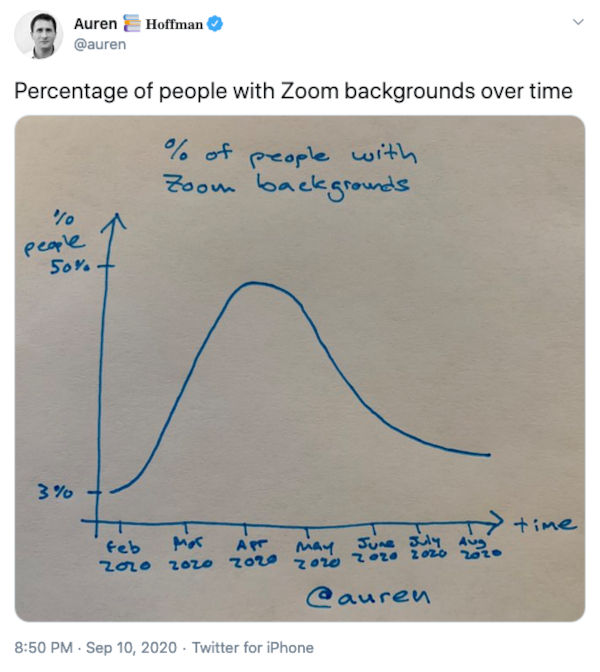
(Via Twitter)
Saw something interesting? Share on our Slack channel.
And if you missed previous editions of this newsletter, they’re all archived here.
Bookmark Founding Fuel’s special section on Thriving in Volatile Times. All our stories on how individuals and businesses are responding to the pandemic until now are posted there.
Warm regards,
Team Founding Fuel

Founding Fuel is sustained by readers who value depth, context, and independent thinking.
If this essay helped you think more clearly, you may choose to support our work.

Founding Fuel is sustained by readers who value depth, context, and independent thinking.
If this essay helped you think more clearly, you may choose to support our work.
Founding Fuel aims to create the new playbook of entrepreneurship. Think of us as a hub for entrepreneurs- the go-to place for ideas, insights, practices and wisdom essential to build the enterprise of tomorrow. It is co-founded by veteran journalists Indrajit Gupta and Charles Assisi, along with CS Swaminathan, the former president of Pearson's online learning venture.
Loading comments...


Readers also liked

·Work, Careers & Personal Mastery
WFH Daily #207: FF Recommends | How to make your online presence hack-proof
October 17, 2020: Once an email address you use to login and the password patterns are exposed, it leaves you vulnerable. Here’s how to minimise the risk
FF

Founding Fuel
WFH Daily #207: FF Recommends | How to make your online presence hack-proof
October 17, 2020: Once an email address you use to login and the password patterns are exposed, it leaves you vulnerable. Here’s how to minimise the risk

·Work, Careers & Personal Mastery
WFH Daily #197: Ground report from Bengaluru—how are commercial spaces faring?
October 6, 2020: When to change your mind; Working in the flow; How the mind works
FF
Founding Fuel
WFH Daily #197: Ground report from Bengaluru—how are commercial spaces faring?
October 6, 2020: When to change your mind; Working in the flow; How the mind works

·Work, Careers & Personal Mastery
WFH Daily #205: Why do people “go green”?
October 15, 2020: The Elephant in the Brain; The art of the start; How to prevent burnouts; An Indian twist
FF
Founding Fuel
WFH Daily #205: Why do people “go green”?
October 15, 2020: The Elephant in the Brain; The art of the start; How to prevent burnouts; An Indian twist
Explore more
Dive into other themes from our network.