Founding FuelFounding Fuel

Are you persuadable?

An ability to change decisions is not about inconsistency, it is about flexibility. Insights from Al Pittampalli’s book ‘Persuadable: How Great Leaders Change Their Mind to Change the World’
10 June 2016· 1 min read· 1 comments

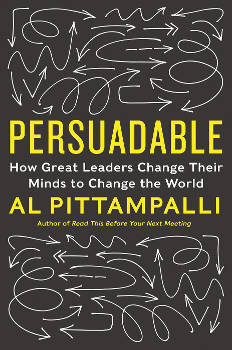
Persuadable: How Great Leaders Change Their Mind to Change the World

By Al Pittampalli

Slide

Persuadability is a critical skill

The book is about persuadability, a genuine willingness and ability to change your mind in the face of new evidence.

It is one of the most critical skills of modern leadership.

The willingness and the ability to change is essential in today's world.

Question pet beliefs

This involves actively seeking criticism and counterarguments for your long-standing beliefs.

Valid criticism, wherever it comes from, helps a leader improve.

Six practices of persuadable leaders

  • Consider the opposite
  • Update your belief incrementally
  • Kill your darlings
  • Take others’ perspectives
  • Avoid being too persuadable
  • Take on your own tribe

Strong leaders are supposed to be consistent

Our culture teaches us that strong leaders possess three Cs: confidence, conviction and consistency.

A good leader must also adapt

The enemy constantly changes and adapts, hence good leaders must also adapt.

Be actively open minded

Open-mindedness means being receptive to new information. Being actively open minded means seeking out unpleasant information before it hits you.

Why we often don’t see the truth

We are unwilling to see the truth because the truth threatens something we care about.

Upton Sinclair once wrote: “It is impossible to make a man understand something, when his salary depends on him not understanding it.”

Why we resist the truth

The most powerful resistance to truth comes when the truth threatens our identity.

Perils of information overload

Leaders cannot spend all their time soliciting and processing new information. This will paralyse them.

When it comes to the quality of any decision, the incremental value of more information diminishes over time.

Meetings are sometimes called to stall decisions

Meetings are the most convenient and socially accepted forums to stall decisions. It requires a good leader to force decisions.

Good decisions require a robust debate

But that cannot happen without unbiased, candid opinions at the table.

In many companies debate is seen as a zero sum game and being persuaded is tantamount to being defeated—nothing could be further from the truth.

Great leaders do change their minds

The more I researched, I realised that great leaders do change their minds and have always done so.

Responding to continuous feedback

We live in a world of continuous feedback and we need the organizational nimbleness to respond.

Practice and be attentive to feedback

The path to mastery in any field is not talent, it is practice.

And deliberate practice needs one critical element to improve—attentiveness to feedback.

We tend to reward consistency

Our brain is a prediction making machine, set up in a way that rewards consistency.

Integrity and consistency are often hard to separate in our mind.

People see inconsistency as hypocrisy

Inconsistency is a big winner for the media because audiences love nothing more than to jeer at hypocrisy.

Changing a decision is not inconsistency

When the facts change, so should our decisions.

Seek out all angles before deciding

Many leaders resort to motivated reasoning, i.e. start with a conclusion and adjust the argument accordingly. Good leaders seek a debate to consider all angles and opposite views before committing to an answer.

Look at multiple scenarios

If you want to consider the opposite, you should be willing to look at multiple scenarios before choosing one.

Think in greys

Human beings do not like ambiguity.

But to be persuadable, we need to move from thinking in black and white to thinking in grey.

Stay focused on your vision

Good leaders are stubborn on vision but flexible on details.

The worst can happen, but weak leaders amplify the fear

Worst case scenarios are always possibilities, and sometimes reality.

In organizations people are always thinking of worst case scenarios about restructuring, job losses, etc. and weak leaders amplify that feeling they hear and make things worse.

The power of an imagined future

What makes people quit is not the future but the imagined future.

Power and perspective

Power diminishes perspective taking.

Power and perspective are a terrific combination for leaders. Good leaders arrive at a good perspective beyond their own view.

Leaders solicit opinions through meetings

Meetings are often called with good intentions. A persuadable leader doesn’t want to be hasty and therefore solicits opinions to ensure the team is making the right decision.

Striving for perfection is silly

Leaders who strive for silly perfection are dinosaurs in this fast changing world.

Be receptive

The truth is the truth, whether it comes from your best friend or your worst enemy.

Persuadable: How Great Leaders Change Their Mind to Change the World

By Al Pittampalli

Buy it on Amazon

Buy it on Flipkart

Founding Fuel is sustained by readers who value depth, context, and independent thinking.

If this essay helped you think more clearly, you may choose to support our work.

Illustration of supportersIllustration of supporters

Beyond the noise is the signal.

FF Insights: Sharpen your edge, Monday–Friday.
FF Life: Culture, ideas and perspectives you won't find elsewhere — Saturday.

Readers also liked

The secret of power: Not ruthlessness, but empathy
·Leadership & Organisation

The secret of power: Not ruthlessness, but empathy

American psychologist Dacher Keltner says, those who gain power are the ones who work for the good of others. But paradoxically, power can lead to selfishness—and loss of power

AU

Author

How to be an objective leader
·Leadership & Organisation

How to be an objective leader

Seeing things as they are, without letting our biases distort things, is key to taking the right actions, says Elizabeth Thornton in her book, 'The Objective Leader'

AU

Author