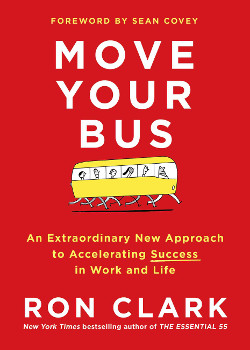
Move Your Bus
By Ron Clark
In his book ‘Move Your Bus’, Ron Clark talks about the different kinds of people companies typically have—high performers, the dependables, average workers and deadweights—and what leaders can do to get the best out of their teams
By Ron Clark
There are many parallels to running a business and a school.
The true success of a school lies in the success of its students.
The key is to have high expectations of people, because when you do, people will rise to meet those expectations. A leader must hold himself accountable for equipping the people.
Runners carry the load and provide momentum. They come early to work, never complain and bring a positive energy.
Runners are driven by the goal of professional excellence and take pride in contributing to an entity that wants to be top notch.
Their impetus to work hard isn’t led by personal accomplishments, but is more about the good of the organization as a whole.
Runners don’t let their egos come in the way of tackling the problems at hand.
They put a lot of effort at work and hence tend to neglect their personal side.
As a leader, don’t break the runner’s spirit. Let him be even when you see some slippages—he will bounce back. But challenge him.
Runners need coaching in terms of working with slower colleagues and that frustrates them.
Joggers are steady and dependable, and have some amount of success. Joggers do not maintain the high energy needed to succeed consistently.
They feel they are doing the best. They are not inherently lazy, but lack confidence in their abilities to make a larger difference.
Joggers tend to take on one large project every year and try their best to ensure that everyone notices their effort on that project.
They need praise and recognition and hence tend to see runners as threats.
Walkers love to point out what is wrong in the organization and they do nothing to help.
They are uninspiring and negative. Their subordinates suffer the most.
They tend to focus on themselves and are always wondering out loud why they didn’t get the last promotion.
Walkers tend to improve in a system or culture that focuses on performance and doesn’t let them explain things.
One of the biggest challenges an organization has is riders—they are deadweight. They don’t like the seats in the bus, the smell of the bus, they moan and groan about everything.
Maybe because riders are adept at hiding themselves in plain sight and also because there is a lack of performance orientation in the company.
Riders keep tabs on their colleagues to stay in the role, in a self-serving manner.
I don’t care how good you are, if you don’t have a strong work ethic, you are slowing down the organization.
Having a runner maintain speed is far more important for an organization than trying to get a rider to walk.
When you consistently arrive before a meeting and are also prepared for the meeting, you give your boss peace of mind. It also elevates your status in the group.
Always be smartly turned out for meetings. You cannot be a runner and have a sloppy appearance.
If you want to stay ahead, always ask for help and, more important, give help without expecting anything except the good of the organization.
Employees do not have to prove that they have all the answers. Seek help and direction.
Good leaders take criticism as an opportunity to improve their game. They do push back on people at the right time when their people are complaining or not being reasonable.
Good leaders know how to pick their battles. Great leaders focus on the ones that are long term and strategic; they are happy to lose the smaller skirmishes.
Great leaders have the patience to listen more than they talk. They rarely interrupt and always give others the right to speak first.
The shortest route from one point to another is a straight line, so stay focused and don’t meander in confusion.
Change the conversation to change the culture. Speak about performance, talk about good things and have the ability to call poor performance.
People mistake urgency for action with movement; calm-thinking leaders have great urgency too. Always aim to find solutions.
There are many others who can do it as well and maybe better.
Credibility has a lot to do with being reliable, but it is more than that. Credibility improves when you take responsibility for things when they go wrong.
If you value credibility you will communicate that to your boss and subordinates and people will instinctively know that they can trust you to do the right thing.
Allow runners to shine and hold the spotlight for them. Help joggers to be better by giving them confidence.
Their failure lies in not having good role models. Get that spark for them, force them to think of possible role models.
As a leader, go to the source when there is a problem, don’t let levels distract that.
Always show appreciation, thank people for their contributions.
By: Ron Clark

Founding Fuel is sustained by readers who value depth, context, and independent thinking.
If this essay helped you think more clearly, you may choose to support our work.

Founding Fuel is sustained by readers who value depth, context, and independent thinking.
If this essay helped you think more clearly, you may choose to support our work.


FF Insights: Sharpen your edge, Monday–Friday.
FF Life: Culture, ideas and perspectives you won't find elsewhere — Saturday.

Founding Fuel invited How India Lives, a Delhi-based data start up to analyse public data and present the state of entrepreneurship in India.
Author
Founding Fuel invited How India Lives, a Delhi-based data start up to analyse public data and present the state of entrepreneurship in India.
Author
Dive into other themes from our network.