Founding FuelFounding Fuel

Ideas from outside can jumpstart your innovation effort

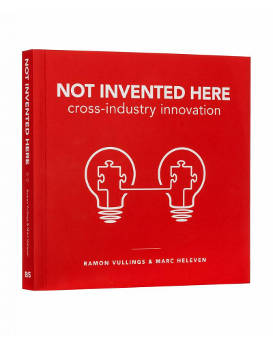
Every industry thinks it is unique and has little to learn from someone else. Ramon Vullings and Marc Heleven’s book, 'Not Invented Here: Cross-Industry Innovation', shows how you can learn from other industries
13 September 2015· 1 min read

Not Invented Here: Cross-Industry Innovation

By Ramon Vullings and Marc Heleven

Slide

Resistance to third-party solutions

‘Not invented here’ is the phenomenon of people blocking out ideas from outside.

But radical solutions are necessary

Organizations need more radical and game changing innovation to be able to meet the challenges they will be facing.

Jumpstarting your innovation effort

Cross-industry innovation is a clever way to jumpstart your innovation efforts by drawing analogies and transferring approaches between contexts.

BMW’s iDrive system was inspired by the video game industry; Nike Shox was adapted from Formula 1 racing shock absorbers.

The route:

  1. Concept – ask why
  2. Combine – ask what If
  3. Create – ask how

Adapt, don’t copy

The strategy in cross-industry innovation is not copy and paste, but copy, adapt and paste.

Cross-industry innovation is the commitment we make to the process of asking questions, combining elements, finding patterns and testing concepts.

The art of powerful questions

  • They generate curiosity in the listener
  • Are thought provoking
  • Surface underlying assumptions
  • Channel attention
  • Focus inquiry
  • Stimulate reflective conversation
  • Generate energy
  • Evoke more questions

Ask the right question

If I had an hour to solve a problem, and my life depended on it,  I would spend the first 55 minutes determining the proper question to ask.

Questioning is a strategic asset

In Germany, companies such as Daimler, Bayer, Siemens and SAP all have an entire department—a department of fundamental questions, and they see questioning as a strategic asset.

Tips for better questions

  • Refuse to accept current reality
  • Invite outsiders to ask questions about your work and industry
  • Imagine the perfect situation
  • Detect real customer insights by analyzing their actual behaviour
  • Challenge everything

Learn from others

“No one lives long enough to learn everything by starting from scratch” – Brian Tracy

Spend time learning from other markets, other sectors. Apply the best ideas from one sector into another.

Connecting the dots

“We can only connect the dots that we collect” – Amanda Palmer

10 disappearing jobs that won’t exist in 10 years

  • Retail cashier
  • Telemarketer
  • Freight storage provider
  • Newspaper delivery boy
  • Travel agent
  • Postal worker
  • Taxi dispatcher
  • Typist
  • Social media manager
  • Meter reader

Which jobs will disappear in your industry?

“We are preparing students for the jobs that do not exist” – Sir Ken Robinson

Conflict drives innovation

War and human conflict have always been a source of misery, at the same time, one cannot deny that they have been incredible drivers of innovation.

Lessons from F1

A 5 second pit stop in Formula 1 racing has lessons for: machine maintenance in factories, rehearsal for Broadway shows and fast food drive throughs.

Look for business synonyms

Business synonyms is a great way of looking at other industries that treat the same word and experience differently. That’s a great place to start.

Synonyms for ‘customer’

Customer = Client = Student = Patient = Shopper = Buyer = Purchaser = End user = Patron = Prospect = Supplier = Pain in the *ss = King = Queen = Employee = Stakeholder

Synonyms for ‘service’

Service = Help = Support = Listening = Aid = Life-support = Account = Advantage = Applicability = Benefit = Business = Check = Courtesy = Dispensation = Duty = Employ = Employment

5 Business lessons from Lego

1. From the beginning Lego was designed to be modular

2. It is unafraid to experiment with emerging new technologies

3. It gives its designers cost parameters

4. It is not just for children

5. It combines different types of innovation.

On the art of copying

“Good artists copy, great artists steal” - Picasso

Try something new

When was the last time you did something for the first time?

“No candle maker has become a bulb manufacturer, no carriage maker has become a car manufacturer and the post office did not invent e-mail” – Prof. Marc Giget

A meeting of different contexts

Cross-industry innovation can be described as a profitable meeting of contexts, where previously there was no connection.

Growing your business

  1. Simplify
  2. Cut the crap
  3. Virtual buying
  4. Try before you buy
  5. Freemium
  6. Aim high

Learning from uncommon businesses

What can we learn from strange, uncommon businesses or even illegal businesses?

  • Really jump at opportunities
  • Outsource to specialists
  • Collborate across borders

A different angle

Try the following prefixes and see what happens to your innovation:

  • Mixed
  • Dual
  • Hybrid
  • Functional
  • Smart

Break your thinking silos

Many industries stay within their thinking silos and within the boundaries of present day rules and regulations.

Not Invented Here: Cross-Industry Innovation

By: Ramon Vullings and Marc Heleven

Buy it on Amazon

Buy it on Flipkart


Founding Fuel is sustained by readers who value depth, context, and independent thinking.

If this essay helped you think more clearly, you may choose to support our work.

Illustration of supportersIllustration of supporters

Beyond the noise is the signal.

FF Insights: Sharpen your edge, Monday–Friday.
FF Life: Culture, ideas and perspectives you won't find elsewhere — Saturday.

Readers also liked

What a fable about meerkats tells us about innovation
·Entrepreneurship, Startups & Innovation

What a fable about meerkats tells us about innovation

Discipline and maverick ideas—both are necessary for dealing with rapid change and coming out ahead, say John Kotter and Holger Rathgeber in their book ‘That’s Not How We Do It Here’

AU

Author