Making the Matrix Work
By Kevan Hall

A matrix organization is more flexible and better able to respond to dynamic situations. But working in a matrix requires a different set of skills than in hierarchical structures. Insights from Kevan Hall’s book ‘Making the Matrix Work’
By Kevan Hall
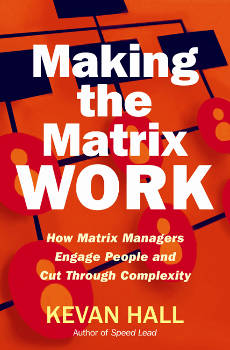
Welcome to the matrix, where multiple bosses, competing goals, influence without authority and accountability without control are the norm.
Today work is done in a ‘horizontal’ way and not in a vertical structure.
A matrix requires skills in leadership, co-operation and personal effectiveness.
The advantages and disadvantages of a matrix are fundamentally about people and the way they work together.
Skilled people can make any structure succeed, and even the most elegant structure will fail if the people within the structure do not have the skills.
Skilled people sometimes have an over-reliance on control and power. That doesn’t work in a matrix.
Traditional management prioritizes clarity, predictability and control. In a matrix, we need to balance ambiguity, manage change and decentralize control.
High levels of engagement increase discretionary effort. Leaders must push engagement in a matrix.
Employee engagement comes when individuals feel a sense of ownership of meaningful goals.
Matrix implementations are often followed by an increase in number of meetings, conference calls, emails and a slowdown in decision making.
There are four ways of co-operating in a matrix: networks, communities, teams and groups.
It leads to more escalations and nothing gets done.
In a matrix, we build engagement by demonstrating trust and enabling empowerment and we gain better, faster control.
The matrix is a deliberate choice to sacrifice some clarity for flexibility.
We need clarity in an organization to know who is doing what, we need flexibility to cope with change and ambiguity.
We set up a matrix to be good at different things that compete for our time, attention and money.
If the strategic goals are unclear, middle management tends to escalate a lot more.
Most of the debate and conflict on achieving goals happens in the middle management.
A recent survey found that 85% of middle management thought their roles were unclear; only 22% of senior management held this view.
Performance management in a matrix has to move up, it has to pay attention to people’s ability to juggle competing priorities and make decisions on trade-offs.
Research shows that role clarity is highly co-related with engagement, performance and retention.
In a matrix, you need to think of RACI—Responsible, Accountable, Consulted and Informed.
In a matrix, we rarely have full control over the things we are accountable for. We rely on a network of supporting functions and colleagues to deliver.
The trick is to get down to a sufficient level of detail where we can drive clarity on accountabilities.
The people who are responsible are the people who do the work.
Consult means you ask for and listen to someone’s opinions and inputs before you make a decision. It does not mean that they are the decision makers or that they have to agree.
In a matrix, everyone thinks that he should be consulted. That is not true.
When you inform people, they are not decision makers and they do not have a right to veto. You are not asking for approval or involvement when you inform.
“Why talk to someone with a job title, when you can talk to someone with an answer.”
That is one of the most common complaints in matrix working.
People tend to be pulled towards their local goals and old friendships and relationships as opposed to doing the right thing.
A level of “constructive tension” is good in a matrix.
As F Scott Fitzgerald said, “The test of a first-rate intelligence is the ability to hold two opposing ideas in mind at the same time and still retain the ability to function.”
The need for a trade-off implies constraint. We cannot have it all and participants in a trade-off need to have that maturity.
Be as fact-based as possible in trade-off discussions and don’t leak emotion all over the discussion room.
A compromise is where we agree to meet in the middle, and each of us gives up something in order to reach agreement. Many rigid managers fail in this meeting the middle ground philosophy.
Keep the issues objective rather than get emotional. Focus on the specific challenges to be resolved.
“Good judgement comes from experience and experience comes from bad judgement.” – Rita Mae Brown
Conflict happens when one party wants to impose their views on others without addressing the issue properly.
In a matrix you should always shoot for agreements and then monitor and hold people accountable to see that agreements have been met in good faith.
As we become more comfortable in a matrix, we need to cut the number of people involved in meetings and approvals—that is when the matrix will pick up speed.
We cannot afford low-quality meetings in a matrix.
Accountability means responsibility, answerability, blame worthiness, liability and account giving.
A good company is one where accountability routinely exceeds control over resources, that will stretch the manager to work collaboratively, to use others to deliver.
In a good company performance is monitored; in a poor company image is multiplied.
Coaching is a powerful way to build capability in a matrix. Leaders should ask the right questions rather than dictating answers.
The best coaching happens in an atmosphere of trust.
Trust is like the air we breathe. When it is present, nobody notices; when it is absent, everyone notices.
Trust is easier to destroy than to build.
Trust is about capability and character. Capability is about whether you are reliable; character is about whether your behaviour is predictable, consistent, open and fair.
The matrix victim waits for someone to bring clarity; the matrix manager relishes the flexibility, autonomy and breadth in a matrix.
By: Kevan Hall
Operating Partner | Advent International
Shivakumar is Operating Partner at Advent International. Before this, he was President (Corporate Strategy and Business Development) at Aditya Birla Group. Earlier assignments include: Chairman & CEO at Pepsico India and prior to that, Managing Director at Nokia India. Before joining Nokia, he worked with consumer electronics maker Philips and top consumer goods firm Hindustan Unilever. He is an engineer from IIT Chennai and an MBA from IIM Calcutta.
Shivakumar has written three books: Reflections - a collection of Shivs articles; The Right Choice - Resolving Ten Career Dilemmas; and The Art of Management. The latter two are business bestsellers.
FF Insights: Sharpen your edge, Monday–Friday.
FF Life: Culture, ideas and perspectives you won't find elsewhere — Saturday.

Founding Fuel is sustained by readers who value depth, context, and independent thinking.
If this essay helped you think more clearly, you may choose to support our work.

Founding Fuel is sustained by readers who value depth, context, and independent thinking.
If this essay helped you think more clearly, you may choose to support our work.

In his book ‘Managing in the Gray’, HBS ethics professor Joseph L Badaracco presents a framework to arrive at the best possible decisions in a hard situation

D Shivakumar
Operating Partner | Advent International
In his book ‘Managing in the Gray’, HBS ethics professor Joseph L Badaracco presents a framework to arrive at the best possible decisions in a hard situation
Operating Partner | Advent International
Dive into other themes from our network.