Guarding the Grain
Every new check on India’s ration system was meant to stop theft. None was designed to ask who gets turned away when it fails.
21 October 2026· 3 min read
TL;DR
India's ration system, despite abundant grain stocks, employs increasingly stringent digital "guards" like facial recognition to prevent theft. However, these checks frequently fail vulnerable beneficiaries, as exemplified by Preeti, a pregnant woman denied rations due to a mismatched Aadhaar photo. Anganwadi workers report widespread instances where old photographs or technical glitches exclude deserving individuals. While each security layer, from Aadhaar linking to biometrics, aims to secure commodities, the article argues none incorporate a "fail-safe" that prioritizes beneficiary access when technology inevitably falters. This approach safeguards grain over ensuring crucial support reaches those most in need, inadvertently punishing the very people it's designed to serve.
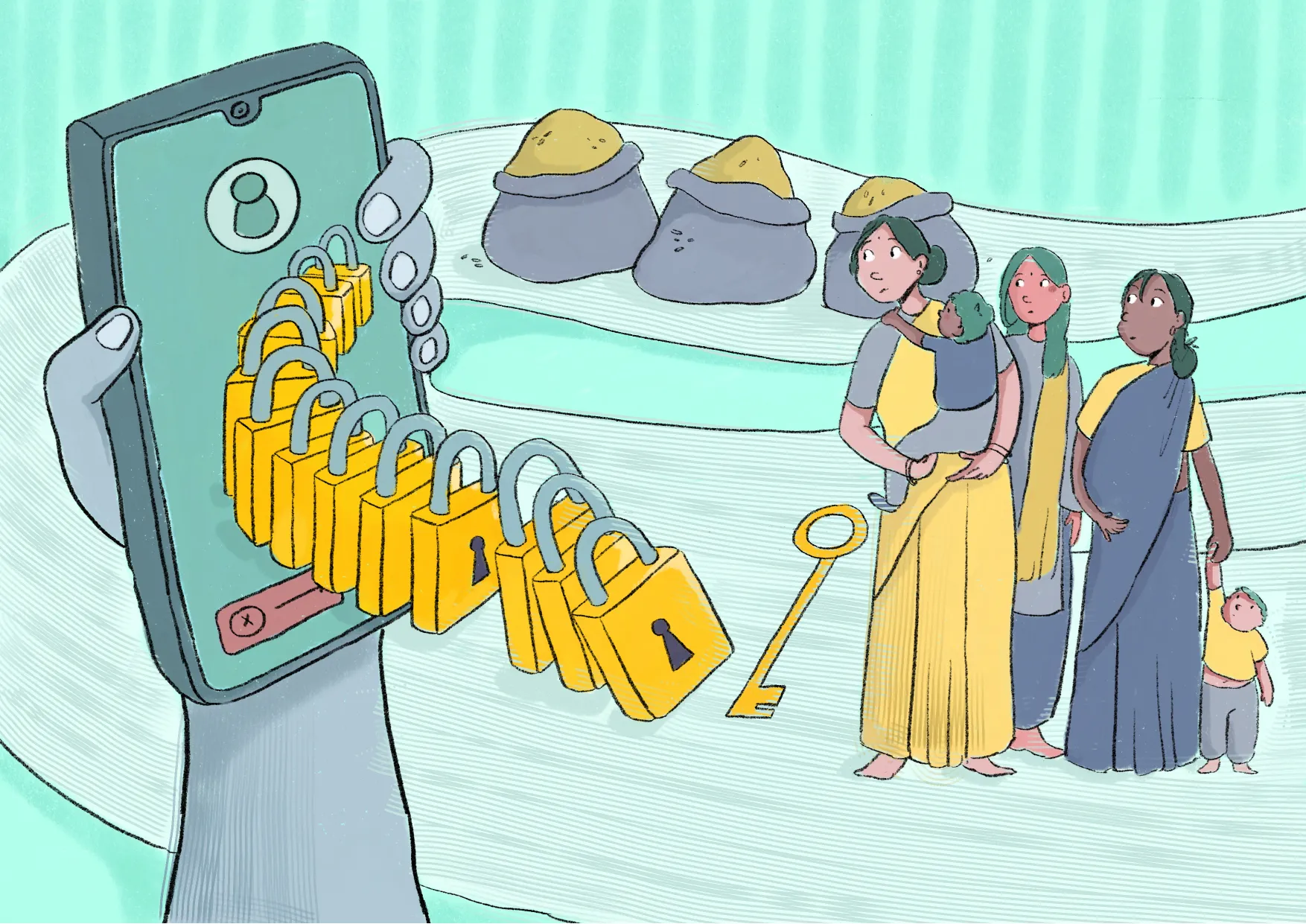
In November 2025, a reporter from Decode, an independent investigative publication, met Preeti (name changed), nine months pregnant and anaemic, in Karpi village, Bihar. She had gone four months without her ration.
Her ration comes from the anganwadi, run on the same logic as the ration card: check first, feed after. From July 2025, women collecting ration had to pass a facial recognition scan. The system could not match Preeti’s face to an Aadhaar photograph taken before her marriage. She travelled four kilometres to the block office to update it. Twice. Both times, the server was down. Preeti gave birth to a healthy baby in December and her husband, who works away from home, took extra shifts to send money for food. Preeti is still missing from the system.
Decode describes how the scan works at the anganwadi in Preeti’s village, where the worker is called Neelam. Women queue holding toddlers while she lifts a phone to each face. When the screen says “Face not matched,” she asks the women to take off their dupattas, to wipe the sweat from their foreheads and step closer to the light. Neelam says that she sometimes spends four hours a day trying to get the scans right. At her centre alone, she said that three pregnant women and five nursing mothers were dopped from the list because their faces no longer match their Aadhaar photographs.
Her case is not rare, but there is no data on how common it is. By December 2025, 2.79 crore of the 4.73 crore eligible beneficiaries had received their ration through face matching. The Ministry of Women and Child Development has not published how many of the rest went without and says rations can still be given without a scan, but reporting shows people have been struck off the list. One anganwadi worker in Jharkhand told Decode she has lost nearly ten women whose Aadhaar photos are many years old. Anganwadi workers have challenged the rule in the Karnataka High Court. In February, an app update let pregnant and nursing women upload other ID, such as a voter card, but reports say the scan still applies.
A card built for a war
The ration card was designed to manage scarcity. Rationing began in Bombay in 1939, as the Second World War started, and by 1946 more than 700 towns were covered. Grain was short, so it had to be counted, allocated and guarded. Independent India kept the system, widened it, and in 2013 made it a legal entitlement.
Today, about 81 crore people are covered by the Food Security Act. Grains have been free since 2023, and the scheme runs until December 2028. Currently, India holds rice stocks about three times its buffer norm. The godowns are full, and the system still behaves as if the grain is about to run out.
Guard on guard
Guarding a system is important and each time the system leaks, another guard is added. Researchers disagree on how much theft the guarding stops.
First, the Aadhaar was linked to the ration card to catch fake ones, and more than 99% of cards are now linked. Next, a biometric machine went into nearly every ration shop, so a thumbprint had to match. Studies in Jharkhand found that genuine beneficiaries lost their grain when fingerprints failed. Then One Nation One Ration Card was created to support migrant workers. The face scan for pregnant and nursing women came after that.
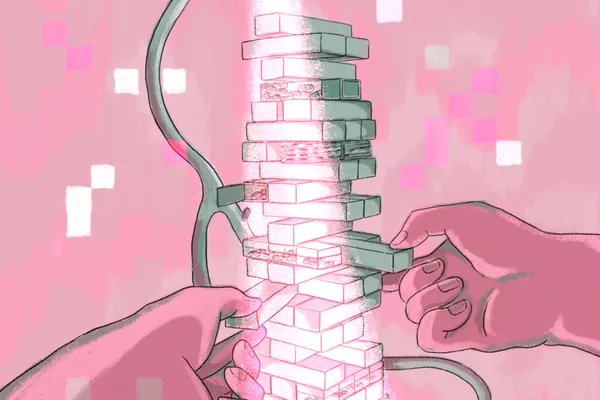
Each guard made sense on its own. Any one of them can fail: a worn fingerprint, an old photograph, a low signal, a dead server, a phone that left home with the husband. Every guard watches the grain but none has a brief to watch the person who was turned away.
What a fail-safe would look like
No system is error proof and a fail-safe system is designed to fail towards safety. A designer has to decide what should happen when it fails. We teach our students to evaluate which failure is worse and how to keep the weakest user safe.
A bank vault stays locked when the power fails. Many fire exits work the other way, when power fails, the electromagnetic locks release, so that the doors open. Both choices that were made. In the case of the ration system, when the scan fails, the access to ration shuts. A fail-safe ration system would be designed so that if the scan failed, the worker could hand over the ration, record the failure, and sort out the photograph afterwards.
Some workers already do this. “I can’t turn them away just because the app didn’t recognise their mother’s face,” one anganwadi worker in Jharkhand said. “I adjust whatever little allocation we get and feed them anyway.” The Food Security Act entitles every pregnant woman and nursing mother to a free meal through the anganwadi, until six months after childbirth. The worker is doing what the law asks.
A few kilos handed over to a lady costs the state very little. A ration withheld in the last month of a pregnancy costs a family much more. I would want the system to be designed to feed the wrong person before it starved the right one, wouldn’t you?
Why the ration card still answers
What the ration card set out to solve was getting scarce grain to wartime cities without hoarding. Today it serves about 81 crore people, and at the ration shop most transactions go through. Left out are the woman whose face has changed, the one whose phone is with her husband, and the one who lives four kilometres from a working server.
The original answer, guard the grain, was built for a shortage. Today we have no shortage, and the guard is still on duty.
India’s godowns are full. Preeti is still waiting on a server.
This is the fourth piece in the By Design series, which looks at the everyday systems around us, asking who built them, for whom, and who got left out.
About the illustrator
Purvi Ramtilak is a design student at BITS Design School, Mumbai, with an interest in telling stories through visual media. She is drawn to the way images can bring people together and make complex ideas feel more immediate.
Join the conversation
Nandita Abraham
Founding Dean | BITS Design School, Mumbai
Nandita Abraham is the Founding Dean of BITS Design School, Mumbai, under the aegis of BITS Pilani, an “Institution of Eminence”, where she leads efforts to revolutionise design education through collaboration, sustainability, and transdisciplinary learning.
With three decades in design education and institutional leadership, and global exposure spanning the US, Hong Kong, and India, she brings together expertise from the creative industries and academia. Her writing extends the same lens to systems beyond the classroom and leadership in higher education.
She has led the Tihar Jail Fashion Project, training over 300 inmates towards sustainable livelihoods, the Dastkar Ranthambore project, which rehabilitated people from three displaced villages, and Sewa Learning Centres, among other initiatives. The same instinct now shapes how she builds curriculum and leads institutions at BITS Design School: design judged by who it reaches, not by what it intended.
She serves on the FICCI National Higher Education Committee, holds Independent Director positions on corporate boards, and has held leadership roles at IFFTI and the CII National Design Committee. She has lectured at Northumbria University, the University of Delaware, and London College of Fashion, and presented at institutions and conferences across the US, the UK, Europe, Asia, and Australia.
Beyond the noise is the signal.
FF Insights: Sharpen your edge, Monday–Friday.
FF Life: Culture, ideas and perspectives you won't find elsewhere — Saturday.

Founding Fuel is sustained by readers who value depth, context, and independent thinking.
If this essay helped you think more clearly, you may choose to support our work.

Founding Fuel is sustained by readers who value depth, context, and independent thinking.
If this essay helped you think more clearly, you may choose to support our work.
Loading comments...
More by Nandita Abraham
Readers also liked

·Business & Strategy
What a Lasting Tata Settlement Must Resolve
Ahead of Tata Sons’ pending AGM, the fight over leadership and listing is widening. A lasting settlement must resolve who decides, how capital is used and whose interests count.
SP

Satish Pradhan
Independent Consultant
What a Lasting Tata Settlement Must Resolve
Ahead of Tata Sons’ pending AGM, the fight over leadership and listing is widening. A lasting settlement must resolve who decides, how capital is used and whose interests count.
Independent Consultant
·Economy, Policy & Society
Who Was the School Day Built For?
India’s school system was built to educate at scale. Its classrooms, exams and incentives reveal what that design rewards—and the individual child it struggles to see.
NA

Nandita Abraham
Founding Dean | BITS Design School, Mumbai
Who Was the School Day Built For?
India’s school system was built to educate at scale. Its classrooms, exams and incentives reveal what that design rewards—and the individual child it struggles to see.
Founding Dean | BITS Design School, Mumbai

·Leadership & Organisation
Who Owns the Fire?
A leader can light the spark. The harder question is what happens to the fire afterwards?
SP
Satish Pradhan
Independent Consultant
Who Owns the Fire?
A leader can light the spark. The harder question is what happens to the fire afterwards?
Independent Consultant
Explore more
Dive into other themes from our network.