The Brief for a Country
Three basic needs. Sixty years of policy choices. A country still living with the trade-offs. How India designed for food, livelihoods and shelter—and who those choices left out.
4 September 2026· 4 min read
TL;DR
This article examines India's foundational "design brief" for roti, kapada aur makaan (food, clothing, shelter), dissecting six decades of policy choices. It highlights how, while specific solutions like the Green Revolution achieved critical goals, they inherently involved significant trade-offs, often leaving populations or regions behind. For instance, prioritising irrigated areas for food security led to environmental issues, while protecting handloom livelihoods over mass production presented different dilemmas. The piece argues that India's development is a complex story of sequencing, where initial designs yield "harder sequels," illuminating the human impact of these historical choices.
Editor’s Note: By Design is a way of seeing the world. It looks at the choices hidden inside the systems that shape everyday life: what they set out to solve, whom they serve, who gets left out—and whether the original answers still hold.
Everything around you was designed. Yes, the apps and the products, but also the scheme that put money in a farmer’s account this morning. The loom that made the shawl on your shoulders. The alley your electrician’s shop sits in. Someone decided what each of these was for, and who it was built to serve.
This series asks two questions of the systems that shape everyday Indian life.
How was this designed?
And who has to live with what was decided?
The first question makes the system visible. The second makes it human. Most systems fail one test or the other. The failure is usually invisible until you go looking for the person it forgot.
Start with a brief that never called itself one.
In 1967, a phrase entered the language: roti, kapada aur makaan. Food, clothing, a roof. It stuck hard enough that a film borrowed it a few years later, and six decades on you can still trace its outline through nearly everything the country has built since.
It wasn't one design brief. It was three of them, folded into a phrase you could say in one breath. That's closer to how design problems actually arrive. Not one at a time. A country doesn't get to solve food, then clothing, then shelter, in order. It has to run all three at once, one priority pulling ahead, another finding its own workaround, a third still gathering momentum decades later. Watching how India answered isn’t a story of what went wrong. It’s a story of sequencing.
A country doesn't get to solve food, then clothing, then shelter, in order. It has to run all three at once. Watching how India answered isn’t a story of what went wrong. It’s a story of sequencing.
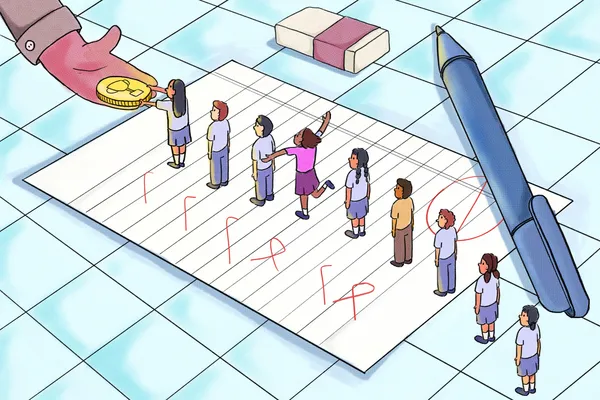
Take roti. The problem was specific and urgent: in 1965, India was three bad harvests from famine, importing wheat by the shipload. The system built to fix it was equally specific. A high-yield seed. A subsidy that made it affordable. A guaranteed price that removed the risk. All of it concentrated where irrigation already existed, which meant Punjab and Haryana. It worked. The country went from importing grain to feeding itself within twenty years.
But look past those two states and the frame runs out. A farmer in Bundelkhand, growing millet through a monsoon that shows up when it wants to, was never in it. Not a design failure. He was simply outside the brief. And in Punjab, the land itself has started sending its own bill: decades of the same rice-wheat cycle have pulled the water table down far enough that agricultural planners are now asking a question the original brief never needed to ask. A system that solves its stated problem this completely doesn't fail. It earns a harder sequel.
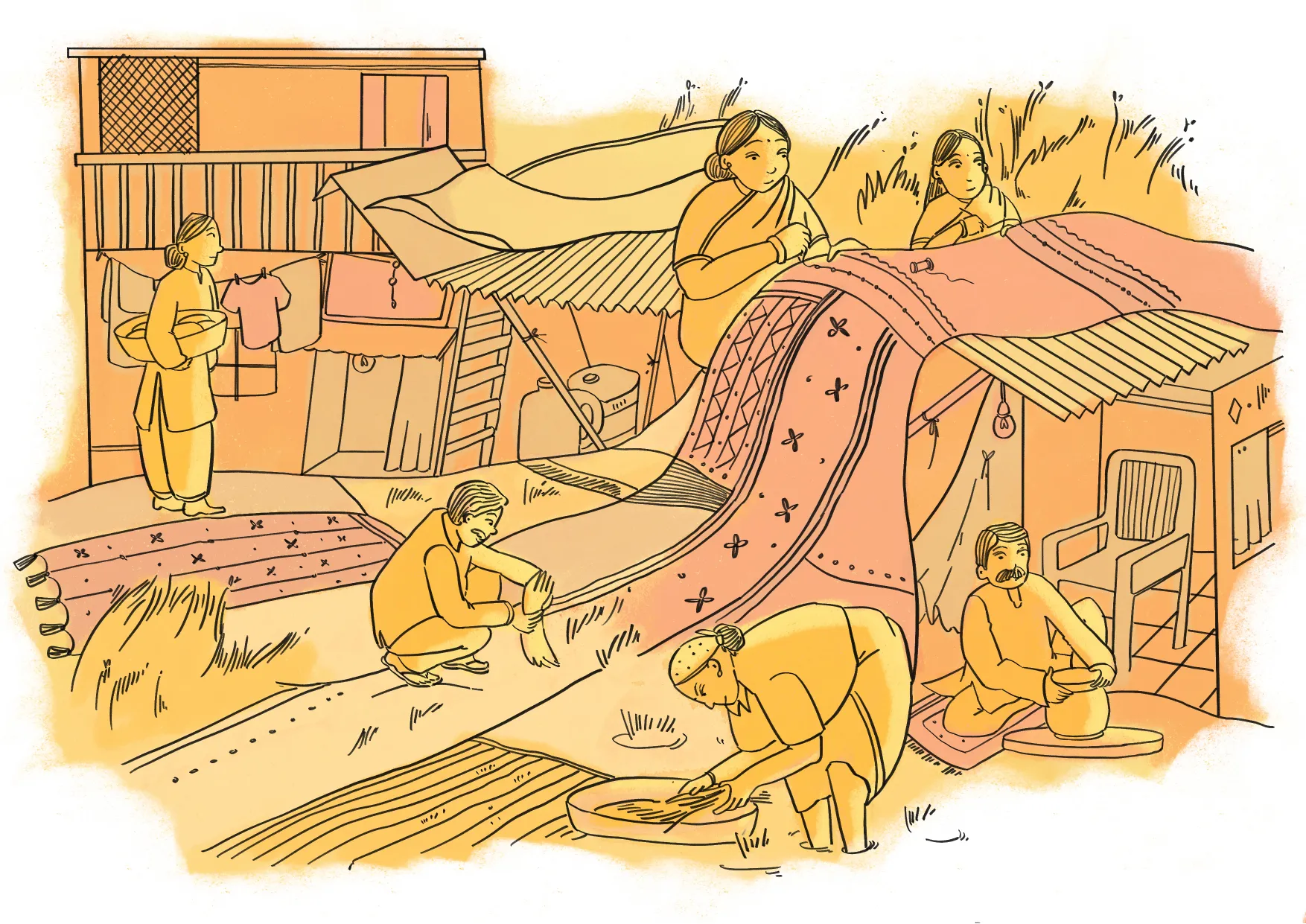
Kapada is quieter, because the choice embedded in it isn't obvious until you look at what got left out of the frame. After independence, the fastest way to clothe a young country would have been cheap mill cloth, coarse cotton churned out at scale by the big composite mills in Bombay and Ahmedabad. Instead, policy reserved whole categories of cloth production for the handloom and the small workshop, protecting them from being swallowed first by the mills, later by power looms.
So who was kapada actually designed for? Not the fastest, cheapest way to put cloth on a hundred crore backs. A weaver in Chanderi, working a loom that has stayed exactly her size for generations. Millions of livelihoods like hers, kept alive and independent rather than folded into bigger production. The trade-off shows up differently today: power-loom and mill cloth is cheaper and more consistent, and buyers increasingly follow the price, leaving many handloom clusters struggling even as heritage branding tries to keep demand alive. A decision that was entirely right for the weaver it protected is only now being asked whether it still is.
Makaan is where the state mostly declined to design anything, and where the most interesting design happened without it. Cities grew for decades under a legal ceiling called the Floor Space Index, which caps how much a building can hold relative to its plot. Low enough that Mumbai offered residents a fraction of the built space of a similarly sized Shanghai. A ceiling like that favours whoever already has a foothold in the city. It keeps existing neighbourhoods low, familiar, undisturbed.
Who was left holding the gap it created? The people who arrived after, who built their own answer instead. A mechanic setting up shop in a Dharavi lane the formal city's rulebook never made room for, part of a self-organised economy that now runs entire supply chains the city planners never designed. Impressive design, built without anyone’s permission. Cities are only now starting to ask whether a taller, more generous rulebook might have served everyone better than the gap did.
Look back across sixty years and one thing stands out: those three words rarely went quiet. Roti's descendant is a direct cash transfer into a farmer’s account, instead of a subsidy buried in fertiliser or power. Kapada’s descendant is a set of large, government-anchored textile parks, finally handing the small-scale-first choice the integrated supply chain it never aimed for. Makaan’s descendant is a national mission to build two crore houses, the first time a roof had a government department, a budget line, and a deadline attached to it. None of these are new priorities. They’re the same three words, redesigned for a country that has changed since 1967.
Who designed this? Who did they design it for? Who got left out? And the harder question, the one that keeps a design honest long after it has succeeded: is that still the right answer? This series will keep asking it, one system at a time.
About the illustrator
Purvi Ramtilak is a design student at BITS Design School, Mumbai, with an interest in telling stories through visual media. She is drawn to the way images can bring people together and make complex ideas feel more immediate.
About By Design
People think design means the visible, the object, the space, the interface. The choices that actually decide how something works are often buried in how a database is structured, who's copied on a decision, how a team is organised, what a policy assumes about the person it's meant for. None of that gets called design.
By Design is a way of seeing the world: what a system set out to solve, who it actually served, who got missed, and whether that answer still holds up. A constitution counts. So does a payments network, a supply chain, a pattern drawn in rice flour outside a door every morning. Different objects, same four questions.
Join the conversation
Nandita Abraham
Founding Dean | BITS Design School, Mumbai
Nandita Abraham is the Founding Dean of BITS Design School, Mumbai, under the aegis of BITS Pilani, an “Institution of Eminence”, where she leads efforts to revolutionise design education through collaboration, sustainability, and transdisciplinary learning.
With three decades in design education and institutional leadership, and global exposure spanning the US, Hong Kong, and India, she brings together expertise from the creative industries and academia. Her writing extends the same lens to systems beyond the classroom and leadership in higher education.
She has led the Tihar Jail Fashion Project, training over 300 inmates towards sustainable livelihoods, the Dastkar Ranthambore project, which rehabilitated people from three displaced villages, and Sewa Learning Centres, among other initiatives. The same instinct now shapes how she builds curriculum and leads institutions at BITS Design School: design judged by who it reaches, not by what it intended.
She serves on the FICCI National Higher Education Committee, holds Independent Director positions on corporate boards, and has held leadership roles at IFFTI and the CII National Design Committee. She has lectured at Northumbria University, the University of Delaware, and London College of Fashion, and presented at institutions and conferences across the US, the UK, Europe, Asia, and Australia.
Beyond the noise is the signal.
FF Insights: Sharpen your edge, Monday–Friday.
FF Life: Culture, ideas and perspectives you won't find elsewhere — Saturday.

Founding Fuel is sustained by readers who value depth, context, and independent thinking.
If this essay helped you think more clearly, you may choose to support our work.

Founding Fuel is sustained by readers who value depth, context, and independent thinking.
If this essay helped you think more clearly, you may choose to support our work.
Loading comments...
More by Nandita Abraham
Readers also liked

·Entrepreneurship, Startups & Innovation
The 33kV Wall
The energy transition is creating a brief opening in one of the hardest industrial sectors to crack. Can a new generation of Indian companies build lasting capabilities before the window closes?
BK

Bharti Krishnan
Founder | Finetrain
The 33kV Wall
The energy transition is creating a brief opening in one of the hardest industrial sectors to crack. Can a new generation of Indian companies build lasting capabilities before the window closes?
Founder | Finetrain

·FF Life
The Happiness We Keep Postponing
A reflection on joy, and why the ordinary day may be enough
HC

Haresh Chawla
Investor | Entrepreneur
The Happiness We Keep Postponing
A reflection on joy, and why the ordinary day may be enough
Investor | Entrepreneur

·Leadership & Organisation
The Blind Spots of India Inc
Disability inclusion, leadership imagination, and the limits of intent
SS

NJ
Subhashis Sinha & Nikunj Kumar Jain
The Blind Spots of India Inc
Disability inclusion, leadership imagination, and the limits of intent
Subhashis Sinha & Nikunj Kumar Jain
Explore more
Dive into other themes from our network.