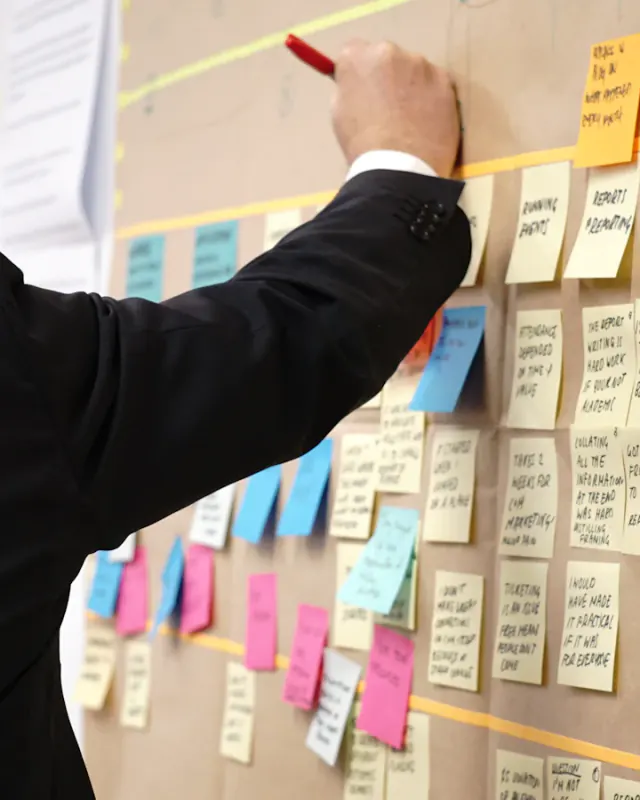
Detailed planning is passé. A do-learn-do approach works better
You can meet audacious goals through a willingness to constantly learn, being open to feedback, and flexibility to adapt to changes
11 May 2019· 2 min read
TL;DR
In today's dynamic business landscape, an agile "do-learn-do" approach supersedes detailed planning. Drawing insights from Nandan Nilekani's Aadhaar success, this article highlights that achieving audacious goals requires continuous learning, openness to diverse feedback, and adaptive flexibility, anchored by a clear long-term vision. This paradigm shift offers business leaders a potent framework for navigating uncertainty. Cultivate an organizational culture prioritizing rapid iteration and responsiveness over exhaustive upfront strategies. This enables nimble adaptation, transforming ambitious visions into tangible successes in complex, fast-changing environments, making it an indispensable strategy for modern leadership.

Dear friend,
When my colleague Charles Assisi and I were reporting on Aadhaar, we were not always on the side of the table that asked questions. Every so often, we had to field them too.
The most frequently asked question was on Nandan Nilekani. Our interlocutors—especially if they were executives trying the solve the hard problem of getting things done in a complex and dynamic environment—wanted to know if we picked anything on how Nilekani managed to pull the project off.
These days, many of us take it for granted that more than a billion people have a digital identity, as if it was meant to be so. But, the predominant mood during much of Nilekani’s time at the Unique Identification Authority of India (UIDAI) was one of scepticism. Many hoped for the best, but no one would have been surprised if he had failed, and had nothing to show after five years. He was an outsider in the government with all its pulls and pushes.
It is also a question we asked many who knew Nilekani well. Rohini Nilekani, co-founder of a number of non-profit organisations including Arghyam, Pratham Books and Ek Step, and Nandan’s wife, told us that he constantly gets feedback from a wide variety of sources, and adjusts his actions accordingly.
Shankar Maruwada, who runs Ek Step, and earlier, played a key role in UIDAI, also said something similar. There are doers, people who are action oriented, and there are thinkers, who spend their time on reflection. Nilekani follows a do-learn-do-learn cycle.
Our big takeaway was, while long-term vision is crucial, you can’t get things done by detailed planning. What you need is the willingness to constantly learn, be open to feedback from multiple sources, and flexibility to adapt to changes. All these while holding on to the long-term vision.
This is also a theme we discussed at length at Founding Fuel this past week. My colleague CS Swaminathan explained how the software development process has moved from waterfall method earlier to agile these days. The world is changing so fast that you can’t afford to leave too much time between your learning and doing. To see how companies are navigating the change, take a look at Spotify.
How are you managing change? Let us know.
NS Ramnath
FEATURED STORIES
The hyperlocal WhatsApp strategy, policy windows and AI food tasters

May 10, 2019: A roundup of news and perspectives on disruptive technology from around the world. Also in this issue: gene editing to prevent heart attack, and what North Korea's radio-tochkas show us about Big Tech's privacy violations (By NS Ramnath. Read Time: 6 mins)
Subscribe here
WHAT WE ARE READING & WATCHING
Spotify engineering culture
A look into how Spotify gets things done. (Play Time: 13 minutes)
ING’s agile transformation
Two senior ING executives, Peter Jacobs and Bart Schlatmann, share their experience transforming the bank in a conversation with McKinsey.
Offices can be hell for people whose brains work differently
Why workplaces should strive to make offices more accommodating for neurodivergent people.
FROM OUR ARCHIVES
The half-life of truth is 45 years
[The Agnew Clinic 1889 by Thomas Eakins. Public domain, via Wikimedia Commons.]
There is an old saying that goes, when the facts change, I change my mind. What will you do when you get obsolete? Or when everything changes, overnight? (By Charles Assisi)
7 Lessons about agility: How to succeed in turbulent worlds

[Photograph by Eckhard Pecher under Creative Commons]
How organisations and individuals can achieve success through agility. (By Baba Prasad)
You want an agile company. But is your HR agile?

[By Brussels Airport (CC BY-SA 2.0), via Wikimedia Commons]
How a design thinking approach to HR can make things simple and transform organisational culture. (By Hari Abburi)

Join the conversation
Founding Fuel aims to create the new playbook of entrepreneurship. Think of us as a hub for entrepreneurs- the go-to place for ideas, insights, practices and wisdom essential to build the enterprise of tomorrow. It is co-founded by veteran journalists Indrajit Gupta and Charles Assisi, along with CS Swaminathan, the former president of Pearson's online learning venture.
Beyond the noise is the signal.
FF Insights: Sharpen your edge, Monday–Friday.
FF Life: Culture, ideas and perspectives you won't find elsewhere — Saturday.

Founding Fuel is sustained by readers who value depth, context, and independent thinking.
If this essay helped you think more clearly, you may choose to support our work.

Founding Fuel is sustained by readers who value depth, context, and independent thinking.
If this essay helped you think more clearly, you may choose to support our work.
Loading comments...




Readers also liked

·Entrepreneurship, Startups & Innovation
Transformers: The DNA of an innovative company
How do you design and run an innovative company? In his book Deepak Loomba details his experiences in setting up De Core Science and Technologies as a scalable and flexible firm
RK

Rishikesha T Krishnan
Former Director, IIMB | Professor of Strategy
Transformers: The DNA of an innovative company
How do you design and run an innovative company? In his book Deepak Loomba details his experiences in setting up De Core Science and Technologies as a scalable and flexible firm
Former Director, IIMB | Professor of Strategy
Explore more
Dive into other themes from our network.