Listening is also debating
A college debate reveals how easily forceful speaking can be mistaken for a good argument—and how much we miss when we fail to listen.
30 October 2026· 5 min read
TL;DR
Judging a college debate, Charles Assisi finds his assessments at odds with those of his fellow judges. Where he rewards forceful delivery and incisive challenges, they also recognise attentive listening and questions that deepen understanding. The experience prompts a wider reflection on advocacy, journalism and family life. Listening, he discovers, does not necessarily mean compromising or agreeing. It means understanding another person’s position accurately enough to identify where the real disagreement lies—and allowing those closest to us to speak without anticipating what they need.
I was certain I knew who would make the final.
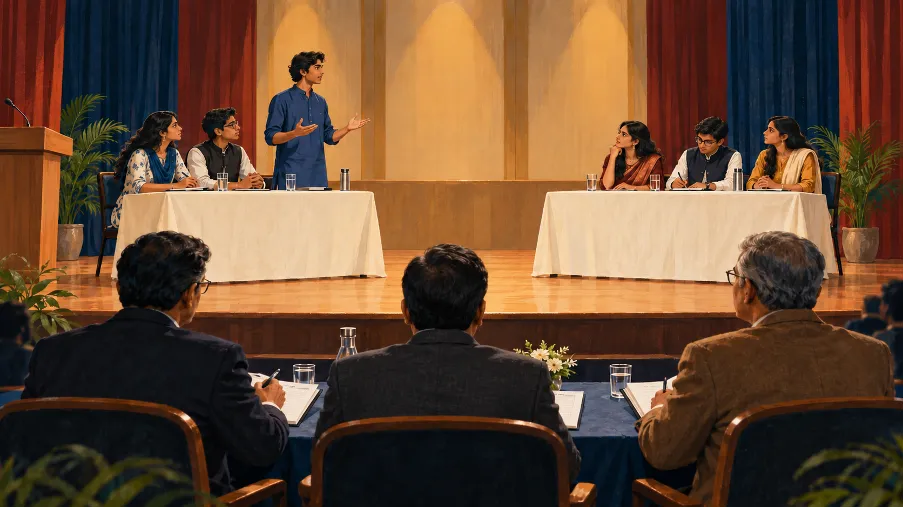
Last weekend, I judged the semi-finals and the final of an inter-college debate at the Sarla Modi School of Economics at NMIMS in Mumbai. It was part of Shastrarth ’26, a festival organised entirely by students, and the format was Oxford style. Two other judges sat with me: Rashim Bagga, CEO of the Association of Portfolio Managers in India (APMI), and Neil Borate, editor-in-chief of TheFynPrint, a personal finance weekly.
The rules were interesting. We did not know the names of the participants or the colleges they came from. The organisers had designed it that way to remove as much bias as possible. We knew the teams only by what they said.
Each of us was given scoring sheets. The teams and speakers had to be assessed on various parameters. The quality of their arguments; the substance in it; their delivery; how they engaged with the team pitted against them; and other such rules. The sheets looked intimidating initially. But as the teams for and against a motion started to speak, the merit in each sheet started to fall into place.
As the debates progressed, I thought I was being rational—a clinical judge, if you will. What I now know is that I wasn’t. I was listening for force. Which speaker could take an argument and make it land? Who had the sentence that made the room go still? I paid attention to the questions each team put to the other to draw blood—the ones that got my adrenaline going. Because in my head, a good question finds ways to look for cracks in an argument and then presses on until the crack bursts into a chasm. And I place an enormous premium on the closing comments. Anyone can be coherent to begin with. You can go around for a few rounds to question the other team. But you’ve got just a little window to leave a lasting impression.
When the semi-finals ended, I thought I had decided on who would make it to the finals. It was time to take a break; have a good masala chai and feel the quiet satisfaction of someone who had just gone about doing his job well.
Meanwhile, the volunteers were tallying the sheets. Imagine my surprise then when the teams I had scored the lowest were announced as the finalists. I looked at Borate and Bagga from the corner of my eyes. I tried to imagine what kind of people they may be. Surely, surely, they couldn’t be so very different from me. I was looking to see if they looked surprised. Did some error happen at the backend when the sheets got tallied?
It would turn out that the only thing in the room that had been compromised was my own listening.
What they were listening for
I did not understand it that day. It came in pieces, over the next few days, after the event ended.
Borate made some comments on stage about the significance of not interrupting when the other person is speaking.
I followed up with him to understand where he was coming from. “The standard debate format becomes about winning and losing. So incentives are directed towards aggression, tripping up your opponent or scoring a quick jab. This carries over to TV and Parliament. What is lost is listening, negotiation and finding a middle ground,” he said.
Bagga had said, almost in passing, on stage, that “listening carefully is also debating”. To me, he sounded polite. For some reason, the line stayed with me. I texted him later on WhatsApp and he explained what he meant:
A debate is not merely about speaking; it is about listening, understanding, and knowing when to remain silent.
Hearing is automatic.
Listening is a choice.
Silence is a response.
That is deep.
Put together, it explained my scoresheet. I had been scoring around how powerfully an argument was delivered. They had been scoring something else as well: the quality of the questions asked. It was not just about whether a question wounded the other side, but whether it drew something more of significance from the other team. They were questions of the kind that made the other side clarify, expand and reveal what it actually believes. This is a different kind of question from the one that tries to trap them. Both are questions. But only one kind is listening.
The teams I had written off as soft were soft in a way the other two judges had noticed and valued. They responded to what was actually said, not to the speech they had prepared. The judges scored for that. They scored for empathy, and I had not been looking for that.
By way of example, a point made clearly, forcefully, and passionately got a higher score. But Bagga and Borate did not have a problem with a clear point that was neither forceful nor passionate so long as it made sense, landed calmly, and did not sound intimidating. I liked the sound of a tough question that found holes. They liked questions that explored an idea that was articulated by their opposing team. It wasn’t obvious to me then that this deeper understanding of the other argument would go on to aid their closing remarks.
Where the disagreement begins
When I described all this to my colleague NS Ramnath, he sent me an extract from Nani A Palkhivala: A Life, by MV Kamath:
“M.R. Pai says that when Nani stood before the bench, the judges knew that while he was representing a client, he was fair to the other side as well. This often helped Nani in winning his case. He would say, ‘In this case, Your Lordship, there are twelve issues. Four are in favour of my client, three in favour of the other side. We need not argue on these if all agree. We shall argue on the remaining five.’”
Think about what that does. Before anyone raised a voice, he got everyone to acknowledge what the other side is right about. The fight gets smaller, and the part that remains is the part that matters.
Sometimes, listening reveals that the disagreement is narrower than either side imagined. Sometimes, it reveals that the disagreement is fundamental and cannot be resolved by splitting the difference.
Listening is often treated as a route to compromise: each side gives up something, and the parties meet somewhere in the middle. But that is only one possible outcome. Sometimes, listening reveals that the disagreement is narrower than either side imagined. Sometimes, it reveals that the disagreement is fundamental and cannot be resolved by splitting the difference.
Listening demands discipline: represent the other person's position accurately enough that they would recognise it as their own. Then identify precisely where you part company.
Palkhivala's example illustrates this discipline. By conceding the points that favoured the other side, he made it harder to dismiss him as a partisan who would say anything to win. More importantly, he reserved his effort for the questions that remained unresolved. His fairness did not weaken his advocacy. It gave his advocacy focus.
It is also the opposite of what I had been rewarding all afternoon—the sound of a case being won.
The thing I already knew
What is ironic here is that none of this is new to me. I have known for years that if I bite my tongue and don’t respond, the person at the other end keeps talking. They say more than they originally intended to. And a great deal of what is on their mind comes out only because I hold the line and stay quiet long enough to allow them to talk.
This is Journalism 101. I know this. I have built a working life on it. But when I sat in a judge’s chair, I rewarded the loudest argument in the room.
My mother is a case in point. I can be impatient with her, as most of us are with the people we have known longest. But when I let her finish, I hear her talk in a way I had stopped hearing. There is patience. There is the understanding that only someone who has known me from the time I was born can bring. Over all else, there is kindness.
At home, the same. When I don’t interrupt the people closest to me, I find that what they are trying to say is quite different from what I had assumed they were trying to tell me. I had been answering a question they had not asked.
My kid, for instance, has been trying to tell me for a few months now that she needs to talk—without being interrupted. But the dad in me is often unable to see that my baby is now an adult. Until now, I have heard her need to talk as a search for advice and pointers to solutions. I am now learning she doesn’t need that. She is a young woman who knows what to do. All she wants to do is talk to her dad. I am learning to shut up and listen more to her. It is tough. But it is an eye-opener as well into the world she lives in.
What the sheet measured
To go back to where we started from, I assumed a debate was a contest of who could speak best. The other judges understood it was also a contest of who could hear best. Eventually, the teams that heard best were the ones who earned their way to the final. And the team that continued to hear best, took home the trophy.
I don’t know whether I’ll remember this a few days from now. Habits slip, and a few days of not interrupting is not a transformation. I’ll think about those two teams I scored lowest.
Join the conversation
Charles Assisi
Co-founder and Director | Founding Fuel
Charles Assisi is an award-winning journalist with two decades of experience to back him. He is co-founder and director at Founding Fuel, and co-author of the book The Aadhaar Effect. He is a columnist for Hindustan Times, one of India's most influential English newspaper. He is vocal in his views on journalism and what shape it ought to take in India. He speaks on the theme at various forums and is often invited by various organizations to teach their teams how to write.
In his last assignment, he wore two hats: That of Managing Editor at Forbes India and Editor at ForbesLife India. As part of the leadership team, his mandate was to create a distinctive business title in a market many thought was saturated. When Forbes India was finally launched after much brainstorming and thinking through, it broke through the ranks and got to be recognized as the most influential business magazine in the country. He did much the same thing with ForbesLife India where he broke from convention and launched the title to critical acclaim.
Before that, he was National Technology Editor and National Business Editor at the Times of India, during the great newspaper wars of 2005. He was part of the team that ensured Times of India maintained top dog status in Mumbai on the face of assaults by DNA and Hindustan Times.
His first big gig came in his late twenties when German media house Vogel Burda marked its India debut with CHIP a wildly popular technology magazine. He was appointed Editor and given a free run to create what he wanted. During this stint, he worked and interacted with all of Vogel Burda's various newsrooms across Europe and Asia.
Charles holds a Masters in Economics from Mumbai Universtity and an MBA in Finance. Along the way he earned the Madhu Valluri Award for Excellence in Journalism and the Polestar Award for Excellence in Business Journalism.
In his spare time, he reads voraciously across the board, but is biased towards psychology and the social sciences. He dabbles in various things that catch his fancy at various points. But as fancies go, many evaporate as often as they fall on him.
Beyond the noise is the signal.
FF Insights: Sharpen your edge, Monday–Friday.
FF Life: Culture, ideas and perspectives you won't find elsewhere — Saturday.

Founding Fuel is sustained by readers who value depth, context, and independent thinking.
If this essay helped you think more clearly, you may choose to support our work.

Founding Fuel is sustained by readers who value depth, context, and independent thinking.
If this essay helped you think more clearly, you may choose to support our work.
Loading comments...



Readers also liked

·Business & Strategy
What a Lasting Tata Settlement Must Resolve
Ahead of Tata Sons’ pending AGM, the fight over leadership and listing is widening. A lasting settlement must resolve who decides, how capital is used and whose interests count.
SP

Satish Pradhan
Independent Consultant
What a Lasting Tata Settlement Must Resolve
Ahead of Tata Sons’ pending AGM, the fight over leadership and listing is widening. A lasting settlement must resolve who decides, how capital is used and whose interests count.
Independent Consultant

·Business & Strategy
The Real Question Behind a Tata Sons Listing
The debate is not simply about an IPO. It is about whether patient capital, stewardship and social purpose depend upon privacy, or can be protected through a different institutional architecture.
IG

Indrajit Gupta
Co-founder and Director | Founding Fuel
The Real Question Behind a Tata Sons Listing
The debate is not simply about an IPO. It is about whether patient capital, stewardship and social purpose depend upon privacy, or can be protected through a different institutional architecture.
Co-founder and Director | Founding Fuel

·Work, Careers & Personal Mastery
FF Daily #498: How to be a better listener
October 13, 2021: Deep Listening; The Great Supply Chain Disruption; Attrition or Attraction?; Cheap Talk
FF

Founding Fuel
FF Daily #498: How to be a better listener
October 13, 2021: Deep Listening; The Great Supply Chain Disruption; Attrition or Attraction?; Cheap Talk
Explore more
Dive into other themes from our network.