
The Night the Power Grid Voted
The backlash against data centres is forcing investors to reckon with the people who supply AI’s land, water and power. India should pay attention.
9 November 2026· 6 min read
Last Wednesday the market threw a party. On Thursday it realised it had the guest list wrong.
The morning after Democrats took both houses of the U.S. Congress, stocks had their best day in three months, and the President took to Truth Social to announce that Americans’ 401(k)s were “through the roof.” By Thursday’s close the S&P 500 had fallen 4.4%, its worst day since the tariff shock of April 2025, and the Nasdaq had lost 5.5% and slid into correction. Roughly $3 trillion of value evaporated from S&P 500 companies in a single session. By Friday, the President had discovered that the Democrats were to blame. Credit is his. Losses are yours.
Last month in these pages, I wrote that a conscience in a listed company is a disclosed risk factor, and that risk factors get priced. Neither I nor the world expected the American electorate to do the pricing quite so briskly.
The scale of it
Democrats flipped seven Senate seats and now hold 54 to the Republicans’ 44, with Alaska and Mississippi still counting. In the House they have passed 254 seats, their largest majority since 2008. Kansas has sent a Democrat to the Senate for the first time since 1932.
This was, first, a verdict on Donald Trump. But exit polls found 56% of voters called AI and data centres a crucial or major factor in their vote. More than half the electorate walked into the booth with server farms in their minds.
Data Centre Darline and other casualties
In Texas, Gina Hinojosa unseated Greg Abbott and became the first Democrat to win the Texas governorship since 1990. The last one, Ann Richards, lost in 1994 to a rising Republican called George W. Bush. And Hinojosa did it on a promise of a data centre moratorium. Abbott, who in November 2025 hailed Texas as “the epicentre of AI development,” discovered restraint in an election year and froze new approvals. Data centre donors had given him some $9 million since July 2025. Hinojosa called his freeze “a scam,” and voters agreed.
Elon Musk spent at least $474 million trying to keep Republicans in power, $224 million of it in Texas. Texas, his adopted home, now has a Democratic governor-elect, senator-elect and attorney general-elect. His reaction on Wednesday: “Data centres in space looking pretty appealing right now.”
In South Carolina, Annie Andrews spent the campaign calling her opponent “Data Centre Darline.” An AI-industry super PAC spent $4.8 million on Darline Graham. Darline lost. In Michigan, tech-funded PACs spent more against Will Lawrence than any other Democratic House candidate. He ran against data centres and won.
Voters in ten states decided 41 local questions on data centres. They sided against the industry in 40. All 21 in Ohio. Alhambra, California, banned them with 82% of the vote.
Pledges are cheap
The backlash reached well beyond the left. The electricity bill helped see to that. A single AI data centre can draw as much power as 100,000 homes, and by September, 61% of likely voters opposed building them.
In March the White House had the AI giants sign a Ratepayer Protection Pledge to cover their own energy costs: voluntary, non-binding and about as enforceable as a New Year’s resolution. In August the President advised Americans to stop opposing data centres unless they wished to be “backwards and poor.” OpenAI, sensing the mood, decided to stop calling its data centres data centres. They are now “compute campuses.” Voters were not persuaded that a substation becomes a university if you rename it.
Two days after the vote, OpenAI published a new community compact for future campuses it owns and operates. It promised to cover their electricity and infrastructure costs, publish site-level water and energy use, and limit non-disclosure agreements with public officials to narrowly defined sensitive information. These commitments build on work announced in January; they were not invented on election night. The compact also promises annual public reporting, giving communities something against which to judge delivery. It remains a company commitment, rather than a substitute for enforceable rules. But after Tuesday, the political cost of falling short is harder to miss.
Not just an American story
If Wall Street thinks this is an American peculiarity, it should look at Melbourne.
In September, residents of Melbourne’s inner west parked their cars and wheeled out their bins to stop the electricity distributor Jemena’s crews from putting up 15-metre poles for the high-voltage lines needed to feed NextDC’s M3 data centre. The council, which controls the roads, withheld consent while it consulted residents. Jemena suspended the work and does not expect to restart before February 2027. On 21 October NextDC cut its earnings guidance by more than a third, and its shares fell almost 42% in a single day. No legislature passed a law. A street did that.
Then the twist. On Thursday in Sydney, NextDC closed nearly 51% higher. Goodman Group and the US-listed Digital Realty had offered to buy almost a tenth of the company at a 45% premium. NextDC’s own board called the move opportunistic. Capital does not necessarily abandon an asset because a community has pushed back. Sometimes it waits for the price to fall, and then it buys.
Canberra is now consulting on minimum distances between data centres and homes and schools. In Ireland, data centres already use more electricity than every urban household combined.
Consent has a cost. Melbourne shows that its absence does too.
The question for India
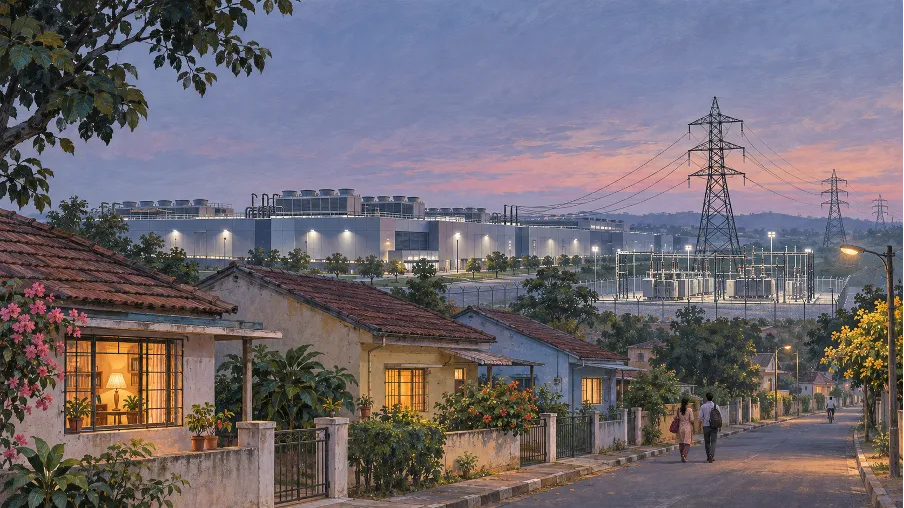
Which brings me to India, where the industry’s plans could not be more neighbourly. Equinix’s chief executive told The Economic Times this month that its Indian investments will land “around metros, close to people.” Melbourne has just shown what can happen when data centres get close to people. People push back.
The pushback is already here. In Balkum–Majiwada in Thane, residents have protested against Amazon’s proposed data centre, questioning its proximity to homes and its implications for noise, heat, water and electricity. Amazon says the facility will use no water for cooling, draw power through a dedicated high-voltage connection rather than the local distribution network, and incorporate noise controls. Those distinctions matter. So does residents’ ability to understand the plans and hold the company to its commitments.
In Visakhapatnam, Google’s planned hub with AdaniConneX has also faced opposition over water supplies and environmental impacts. Google says it will deploy advanced air cooling and sound mitigation, while the state says residential and rural water supplies will be protected. India needs the cloud infrastructure on which businesses and public services increasingly depend. The question is how to build it with credible safeguards and a meaningful say for its neighbours.
These concerns extend beyond individual sites. An investigation published by The Guardian linked rising data centre demand in Mumbai to diesel backup capacity and the continued operation of the ageing Tata coal plant at Trombay. Residents of nearby Mahul have long complained of respiratory illness. Amazon disputes responsibility for Mumbai’s emissions. The wider question is how cities assess the cumulative demands of a growing cluster of facilities, alongside those of households and other businesses.
And the regulator? In August the environment ministry told Parliament that AI data centres “do not, per se, require Environmental Clearance.” The qualification matters. Projects crossing specified building and area thresholds do require clearance, and water use and pollution remain subject to regulation. The question is whether this framework adequately captures the concentrated demands of data centres—and gives neighbouring communities enough information and influence over decisions that affect them. Several states compete on stamp-duty and electricity-duty waivers. The safeguards deserve at least as much attention as the incentives.
What the market has got wrong
None of this ends the AI boom. Democrats lack a filibuster-proof Senate, and on election night Trump posted an image of a red cap bearing a single word: VETO. Subtlety was not on the ballot. What is coming is scrutiny. Bernie Sanders wants a national moratorium. Committee chairs will have subpoenas; one senator is already listing his questions for Musk. Hinojosa has promised to keep the pause.
Restrictions on new capacity could make some existing data centres more valuable. They could also raise costs and delay expansion across the industry. The vote has not, by itself, settled how much compute the world will need. It has made the terms on which that capacity gets built harder for investors to take for granted.
There could be an upside for the industry too. Voluntary pledges, tax deals and quiet approvals have left companies exposed to opposition arriving late and at considerable cost. Clearer rules may make projects slower and dearer to develop. But a data centre planned with local participation, under rules everyone understands, should face fewer surprises once construction begins. Consent has a cost. Melbourne shows that its absence does too.
The family living next to a data centre may have no place in its contracts. Its ability to influence whether infrastructure gets built can still matter to the business.
The Anthropic test
In my Founding Fuel essay “A Conscience With a Ticker Symbol”, I argued that the future of AI is being shaped by three forces: capital, the state and liability. Last week brought another source of pressure into sharper focus: the communities on whose resources the industry depends.
For Anthropic, approaching its public-market debut, that pressure adds to the questions investors already face about fixed liabilities, uncertain future revenues and concentrated counterparties. The family living next to a data centre may have no place in its contracts. Its ability to influence whether infrastructure gets built can still matter to the business.
Anthropic’s willingness to argue for AI safeguards does not automatically mean it is better prepared to manage these local concerns. That will have to be demonstrated in how its computing infrastructure is developed, and on whose terms. The same test applies to its rivals. Investors weighing the AI boom need to ask not only how much capacity companies have secured, but how reliably that capacity can be delivered.
A correction, in the old sense
We have all seen markets misprice politics many times. They treat democracy as a risk factor, a volatility event to be hedged. Occasionally it is something else: a correction in the original sense of the word.
Asked what he would say to Democrats who are about to be courted by a suddenly friendly tech industry, Lawrence said beware, and called the tech titans “the Rockefellers and Carnegies of our day.” He meant it as a warning. Read with a little history, it is also a note of hope. The Rockefellers and Carnegies were eventually made to live within rules written by the public. America did not stop drilling for oil or making steel. It asserted the public’s right to decide the terms.
Tuesday’s results need not be read as a vote against the future. They were a warning against billing people for someone else’s version of it without asking them. That is not Luddism. It is exercising the rights and duties of citizenship. Any government, anywhere, that comes to treat the consent of the governed as optional would do well to study the results.
The machines are coming, and they will be extraordinary. The question is whether companies and governments will give the people living beside them a meaningful say—or look for places where opposition is easier to overcome. India should be asking that question now.
Building with consent can be slower and dearer. It also gives a technology this powerful a firmer foundation on which to last.
The grid voted back. Wall Street should listen.
Join the conversation
Anindya Dutta
Founder | Two Roads and author
Anindya Dutta is a former banker who spent three decades in Global Markets leadership roles across Mumbai, Hong Kong, Singapore, and London. He now runs Two Roads, a Singapore-based Leadership and Capital Markets Consulting firm. His alter ego is an award-winning author of several books reflecting his twin passions for sport and history.
Beyond the noise is the signal.
FF Insights: Sharpen your edge, Monday–Friday.
FF Life: Culture, ideas and perspectives you won't find elsewhere — Saturday.

Founding Fuel is sustained by readers who value depth, context, and independent thinking.
If this essay helped you think more clearly, you may choose to support our work.

Founding Fuel is sustained by readers who value depth, context, and independent thinking.
If this essay helped you think more clearly, you may choose to support our work.
Loading comments...




Readers also liked

·FF Life
The Happiness We Keep Postponing
A reflection on joy, and why the ordinary day may be enough
HC

Haresh Chawla
Investor | Entrepreneur
The Happiness We Keep Postponing
A reflection on joy, and why the ordinary day may be enough
Investor | Entrepreneur

·Leadership & Organisation
The Blind Spots of India Inc
Disability inclusion, leadership imagination, and the limits of intent
SS

NJ

Subhashis Sinha & Nikunj Kumar Jain
The Blind Spots of India Inc
Disability inclusion, leadership imagination, and the limits of intent
Subhashis Sinha & Nikunj Kumar Jain

·Artificial Intelligence
India’s AI Gambit: The Choices That Will Define Power
Speed is not strategy. The real battle is over sovereignty, science and state capacity
FF

Founding Fuel
India’s AI Gambit: The Choices That Will Define Power
Speed is not strategy. The real battle is over sovereignty, science and state capacity
Explore more
Dive into other themes from our network.