The Business of Wastewater Is Changing
The biggest competitive advantage in India's wastewater industry may no longer be better treatment technology. It may be the ability to finance, own and operate long-term water infrastructure.
5 August 2026· 4 min read
TL;DR
India's wastewater industry is undergoing a pivotal shift, moving beyond mere treatment technology to emphasize robust financing and long-term operational capabilities. The true competitive edge now lies in structuring durable infrastructure projects, as exemplified by Chandrapur's initiative transforming municipal wastewater into a dependable industrial resource. Here, the core product isn't a treatment plant, but a guaranteed, multi-decade water supply secured by innovative financial mechanisms like take-or-pay agreements. This strategic focus on long-term confidence and financial viability, rather than solely technological innovation, is crucial for unlocking India's substantial wastewater reuse potential and addressing water scarcity, reframing it as a significant climate opportunity.
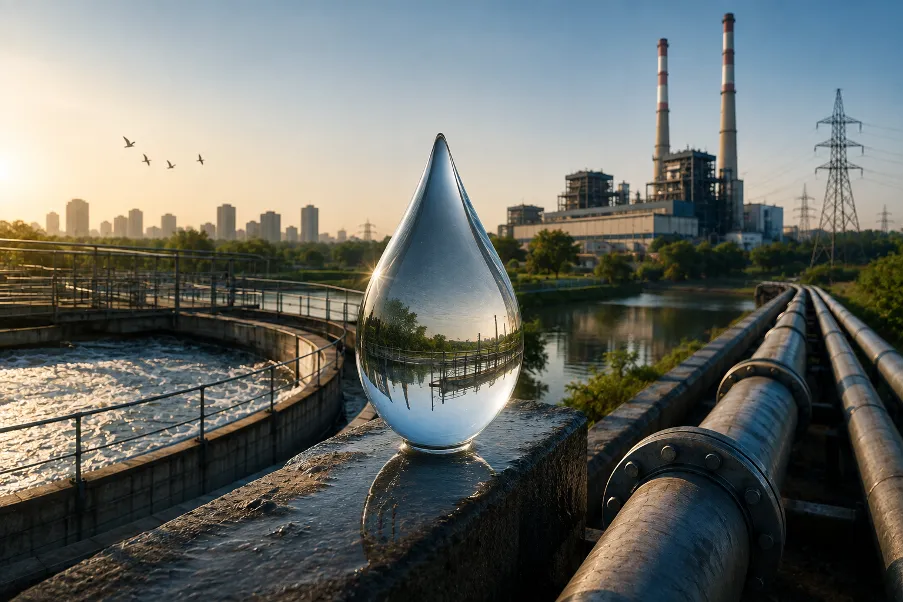
In February 2021, Chandrapur Municipal Corporation, in eastern Maharashtra, set out to turn wastewater into a dependable source of industrial water. With support under the Atal Mission for Rejuvenation and Urban Transformation (AMRUT), the city would rehabilitate its sewage treatment plants and supply treated water to the Chandrapur thermal power station operated by the Maharashtra State Power Generation Company (MAHAGENCO).
A similar wastewater reuse project in Nagpur had already demonstrated that municipal sewage could become a reliable industrial water source. Chandrapur adapted that model to create its own partnership between the city and the power plant.
Vishvaraj Environment Ltd was brought in to execute the project. It set up a special purpose vehicle to rehabilitate the treatment plants, lay the pipeline and supply treated water to MAHAGENCO—not as equipment, but as water, under a 25-year take-or-pay agreement.
The hard part wasn't the engineering. It was convincing lenders to finance a project that depended on a state utility making payments for the next 25 years. The financing was therefore structured to reduce risk—with reserve accounts, escrow arrangements and a repayment schedule designed to reassure lenders. Over the next two years, the project's credit rating was upgraded by ICRA from BBB (Positive) to A– (Stable), reflecting a proven payment track record, the strength of its long-term take-or-pay contract and financing structure. The plant hadn’t changed. Confidence had.
For years, India’s water entrepreneurs have told a compelling story. Water is becoming scarce. Industries are consuming more of it. Cities are running out of freshwater. Environmental regulations are tightening. Wastewater treatment, recycling and reuse, they argue, should therefore become one of India’s largest climate opportunities.
Most entrepreneurs remain focused on building better treatment technologies—from membranes and biological processes to AI-driven optimisation and smarter plant operations. These innovations matter. Without reliable treatment, there is no wastewater reuse industry.
Yet technology is no longer the industry’s primary bottleneck. The real bottleneck is financing.
As treated wastewater becomes an increasingly valuable resource, water—not treatment technology—becomes the product. Customers are no longer buying a treatment plant; they are buying the assurance of a reliable water supply for the next 15 or 20 years. Once that happens, the economics of the industry begin to resemble infrastructure rather than technology.
Customers are no longer buying a treatment plant; they are buying the assurance of a reliable water supply for the next 15 or 20 years.
Two Markets Hiding Inside One Industry
Most discussions treat wastewater as one large opportunity. In reality, it comprises two distinct businesses with very different customers, economics and financing models.
The first is municipal wastewater, where cities generate sewage that must be treated before discharge or reuse. The second is industrial wastewater, where factories must comply with discharge norms while ensuring reliable water supplies for their own operations.
Understanding that distinction explains why some business models are scaling while others continue to struggle.
Municipal Wastewater: The Contract Creates the Asset
Chandrapur isn’t exceptional in its structure. The same pattern is repeating across the country. In Nagpur, MAHAGENCO follows a similar model at other thermal power plants. In Chennai, manufacturing clusters in the State Industries Promotion Corporation of Tamil Nadu (SIPCOT) corridor buy reclaimed water instead of a power utility. Ghaziabad is building a version for more than a thousand industries at once. Different cities, different counterparties—but the same underlying discovery: sewage stopped being a disposal problem the moment someone downstream signed a contract long enough to make the project bankable.
Across these projects, the pattern is remarkably consistent. A municipality supplies wastewater, often supported by public funding for treatment infrastructure. An industrial customer commits to buying treated water over the long term. A private developer finances, builds and operates the project, while guaranteeing its performance.
The contract creates the asset—not the other way round.
That changes what lenders evaluate. They aren't asking whether the treatment technology works. By the time a project reaches this stage, everyone bidding has already crossed that technical threshold. Instead, lenders want to know whether the customer will still be buying water twenty years from now, whether the operator can maintain the plant over decades, and whether revenues will be predictable enough to service debt. Competitive advantage lies in bringing together customers, capital and long-term execution—not simply better engineering.
Technology solves engineering risk. Execution reduces operating risk. Long-term contracts reduce revenue risk. Confidence attracts capital.
The contract creates the asset—not the other way round.
Industrial Wastewater Is a Different Business—Today
Industrial wastewater operates under a different set of economics. Most industrial customers still buy equipment rather than water services because, for now, ownership remains the cheaper option.
Freshwater remains relatively inexpensive across much of India. Producing tertiary-treated recycled water often costs many times more than drawing freshwater from municipal supply or permitted groundwater. If an industrial customer can build and own a treatment plant economically enough to meet regulatory requirements, there is little incentive to spend more making wastewater reusable.
That is why much of India’s industrial wastewater market continues to behave like a capital expenditure business. Large players such as Thermax and Ion Exchange, along with hundreds of smaller enterprises, sell treatment systems. Industrial customers buy and own the assets, and the commercial relationship largely ends once the plant is commissioned. Here, technology still matters. The most reliable and cost-effective solution wins.
But it is also a bet that the status quo will hold—that freshwater will remain inexpensive and dependable enough for customers to keep buying equipment rather than water itself.
Why Industrial Water Will Likely Follow the Same Path
Municipal wastewater has already crossed the financing threshold that Chandrapur illustrates. Industrial wastewater largely hasn't. That is likely to change.
Water scarcity is unlikely to remain constant over the next decade. Groundwater restrictions are tightening in several regions, environmental compliance costs are rising, and climate variability is making water availability less predictable. As those pressures build, the comparison industrial customers make begins to shift—from relatively inexpensive freshwater versus more expensive recycled water, to uncertain freshwater versus guaranteed recycled water.
That is a fundamentally different decision.
It's already visible at the edges of the market. For sectors such as semiconductor fabrication and data centres, water isn’t a large line item to begin with—by some estimates, water infrastructure accounts for less than five percent of total capital expenditure—but the cost of a single unplanned outage or contamination event dwarfs anything spent on water itself.
As Swapnil Shrivastav, CEO of Uravu Labs, which develops technology to generate water from air, observes, customers like these are beginning to value reliability over the price of water. They are also becoming more open to alternative sources, including water generated from air. Other startups are taking different approaches. Boson Water, for instance, finances and operates tertiary treatment plants for sewage treatment plants (STPs) in apartment complexes, while customers simply buy the treated water rather than own the underlying infrastructure.
Industries rarely want to own infrastructure that isn’t central to their competitive advantage. Many already outsource logistics, compressed air, renewable power and other utility services to specialists who can deliver them more efficiently and reliably. Water may well follow the same trajectory.
The contracts may not run for 25 years. Depending on the customer and the sector, 10 or 15 years may be sufficient. But the underlying model begins to resemble municipal reuse. A specialist owns the asset—or guarantees the supply of water over the long term. The customer commits to demand. Competitive advantage gradually shifts from engineering alone towards financing, execution and long-term customer relationships.
Where Will Value Accumulate?
Technology remains the foundation. Without continued innovation in treatment processes, automation and monitoring, none of these business models would exist.
The more interesting question is where value accumulates once that foundation is in place.
As wastewater becomes an infrastructure business, founders may discover that enduring competitive advantage lies not only in better treatment technology, but in the ability to finance assets, build long-term customer relationships and deliver water as a service.
Where that value ultimately accumulates will shape the next generation of water companies.
Editor's Note: This is the first essay in a two-part series. In the second, Bharti Krishnan explores what this structural shift means for founders, investors and the next generation of water-tech companies.
Join the conversation
Bharti Krishnan
Founder | Finetrain
Bharti Krishnan, CFA, is the founder of Finetrain, where she works with climate startups on raising equity, debt, and grants. Her work sits at the intersection of finance and climate tech across energy, water, and materials. She spends most of her time meeting founders and helping them think through capital decisions.
Beyond the noise is the signal.
FF Insights: Sharpen your edge, Monday–Friday.
FF Life: Culture, ideas and perspectives you won't find elsewhere — Saturday.

Founding Fuel is sustained by readers who value depth, context, and independent thinking.
If this essay helped you think more clearly, you may choose to support our work.

Founding Fuel is sustained by readers who value depth, context, and independent thinking.
If this essay helped you think more clearly, you may choose to support our work.
Loading comments...
More by Bharti Krishnan

Readers also liked

·FF Life
My 10 Best Business Books of Summer 2026
The best books of the year so far—on disagreeing constructively, culture, strategic subtraction, genius, China's advantage, an India you think you know, creativity, establishment paralysis, imposter syndrome, and reimagining your career
DS

D Shivakumar
Operating Partner | Advent International
My 10 Best Business Books of Summer 2026
The best books of the year so far—on disagreeing constructively, culture, strategic subtraction, genius, China's advantage, an India you think you know, creativity, establishment paralysis, imposter syndrome, and reimagining your career
Operating Partner | Advent International

·Work, Careers & Personal Mastery
The Best Business Books of 2025
Ten essential reads on money, leadership, and navigating a changing world
DS
D Shivakumar
Operating Partner | Advent International
The Best Business Books of 2025
Ten essential reads on money, leadership, and navigating a changing world
Operating Partner | Advent International

·Economy, Policy & Society
Inside India’s Real-Money Gaming Ban: Design, Addiction, & the Business of Play
What India’s ban on real-money gaming reveals about design, addiction, and opinion
SV

Shrinath V
Founder, The Salient Advisory | Product & AI Strategy Advisor
Inside India’s Real-Money Gaming Ban: Design, Addiction, & the Business of Play
What India’s ban on real-money gaming reveals about design, addiction, and opinion
Founder, The Salient Advisory | Product & AI Strategy Advisor
Explore more
Dive into other themes from our network.