The One Before the Zeros
I went to a day-long conversation on AI and consciousness in Chennai with a phone, a laptop and a habit of hearing everything at double speed. The two moments I brought home were the two I did not record.
27 November 2026· 8 min read
TL;DR
At a Chennai event on AI and consciousness, NS Ramnath observes a significant evolution in public engagement. No longer just for techies or consultants, a diverse audience, from monks to families, now seeks AI's deeper meaning for humanity. Ramnath, a fervent technology user accustomed to accelerated consumption, questions how ancient philosophies like Vedanta can illuminate AI's implications for consciousness. Anticipation centers on Swami Sarvapriyananda, a revered speaker known for bridging timeless wisdom with modern dilemmas, whose insights into machine consciousness are eagerly awaited. The article subtly contrasts this profound inquiry with the author's hyper-efficient, tech-mediated approach to knowledge.
It is nine in the morning, an hour before anything begins, and I am in seat G11 of Kamarajar Arangam, an auditorium in Chennai, with my laptop open. I have some work to finish, and I don't want to waste the hour. So instead of going around the hall and taking in the atmosphere, I look at my notes. I am in my own virtual world.
On the big screen in front of me, a young Swami Vivekananda takes aim at eggshells bobbing on an American river. It is the old story, told for a century to show what concentration can do. But this Vivekananda has been made by AI. A moment later another version on the screen is counselling a roomful of youngsters. I take a photograph of the screen, then one of the empty stage, and go back to my laptop screen.
I have been to a good many AI events. In the early days they happened in small conference rooms in Bangalore offices. A handful of young men in jeans and T-shirts talked excitedly about what was happening under the hood, at a time when much of what was called AI in India was really glorified statistics. After ChatGPT, the events moved to bigger auditoriums, and there were more people in suits than in T-shirts. Consultants explained how AI had changed their business. Everyone was looking for the use case.
This crowd is different. By ten the hall has filled up, and I look up from the laptop. Schoolchildren. Women in silk saris. Grandparents. Monks of the Ramakrishna Order in saffron, some seated, some walking quietly down the aisles.
Watching them, I think about how the audience at AI events has changed. The people in T-shirts came to ask how it works. The people in suits came to ask what it is worth. This crowd, in silk saris and saffron robes, seems to have come to ask what it means for us.
That is my question too. The screen has just shown me AI retelling the stories of religion. I have come to find out the reverse: whether these old philosophies have anything to tell us about AI.
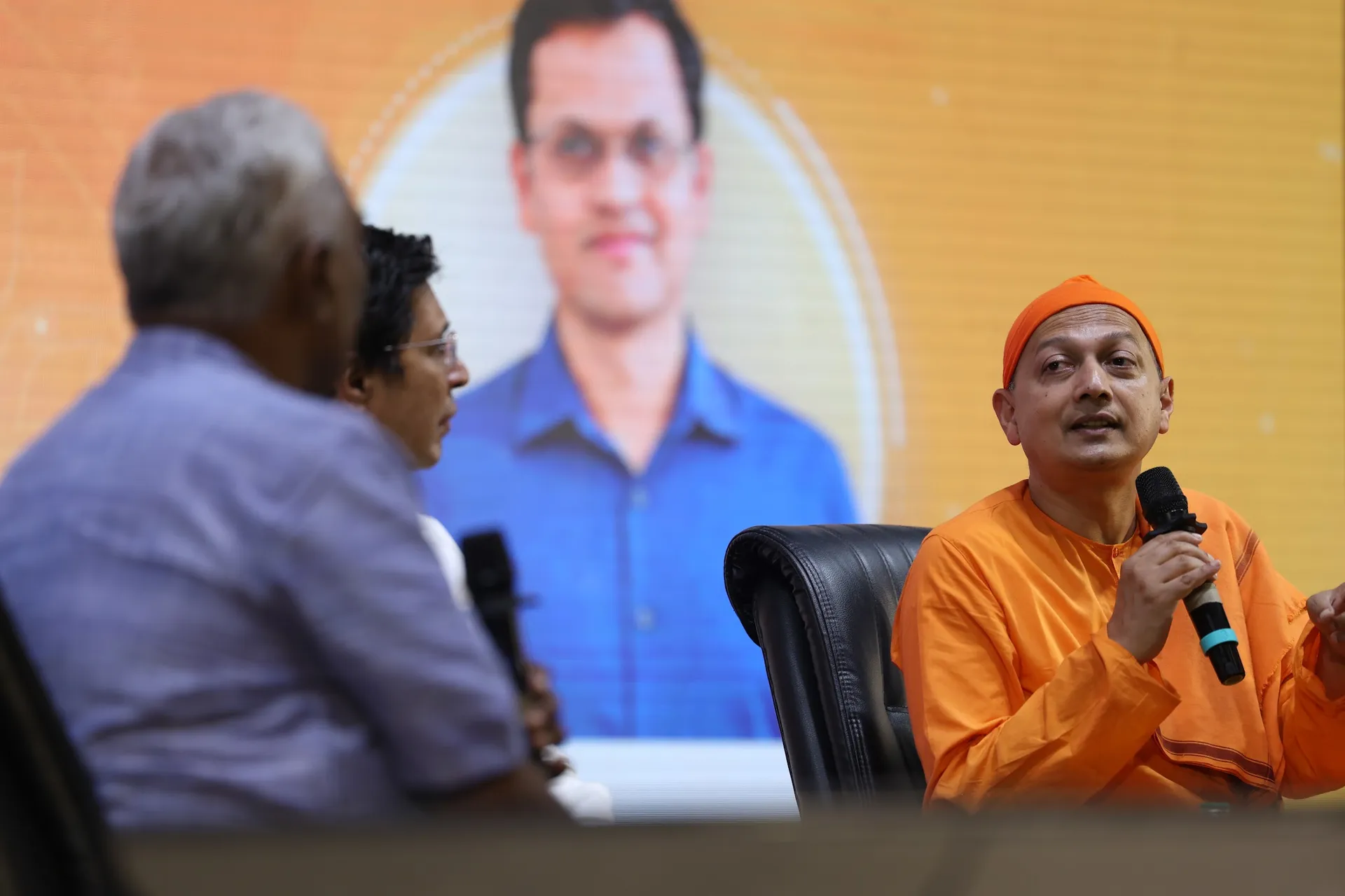
Three people have been asked to answer that. Pratyush Kumar is the co-founder of Sarvam AI, one of the few Indian companies building its own foundational models. Professor V. Kamakoti is the director of IIT Madras. And Swami Sarvapriyananda heads the Vedanta Society of New York. Most of the thousand people here, I suspect, have come for him. His talks on YouTube have travelled the world, for their clarity, for their humour, and for the way they bring ancient wisdom to bear on modern problems. As a monk, he spent some time at Harvard a couple of years ago. He sits with scientists and philosophers regularly. And he was recently invited by Anthropic to talk about whether machines can be conscious.
At double speed
I have followed him for years. But I have only ever seen him on a laptop screen, framed from the chest up. And I have rarely heard him at the speed at which he speaks.
I should explain. I love technology, mostly because it lets me go faster. I use apps to read faster. I listen to most lectures at twice their speed, his included. When AI arrived, I found I could go faster still. Now I often clip his YouTube talks into Obsidian, a note-taking app, feed them to an AI and read the summary. I have uploaded the transcripts of his talks to NotebookLM, and I talk to it. I go straight to the point I am interested in, instead of listening from start to finish. More and more, I take in ideas not in the order they were given, but in the order I want them. If that is the best way I learn, I have told myself, why not?
The first speaker is a monk of the Math. He too is showing how the institution uses digital technologies to preserve and spread knowledge. I didn't catch his name. I have been busy taking photographs and videos. The woman beside me keeps glancing at me. Her own phone is in her handbag, and the handbag is at her feet. I suspect my clicking is distracting her. I turn to her and ask who the speaker is. She doesn't know either. A few minutes later, the name surfaces from somewhere in her memory, and she turns to me. "Swami Paramashivananda." From then on, for some strange reason, she no longer looks at my phone with disapproval.
Not this, not this
Pratyush begins by telling Swami Sarvapriyananda that his family has watched his videos for more than a decade. Then he says something I don't expect from a man who builds AI. He is a software engineer, he tells us, and AI already writes better software than he does. He goes down his own list. I think I can write code. AI can do that. I think I can think about hard problems. AI can do that. I think I can plan what my company should do for the next two months. AI can do that too.
Vedanta, he reminds us, teaches neti, neti. Not this, not this. I am not my body, not my skills, not my work. I am the witness. He admits it is hard to practise. But if we think we are our skills, he says, we will fail the test, and AI is making us take it, urgently. He calls this an extraordinarily optimistic picture.
I use AI so that I can go faster. I have never stopped to ask how much of myself I hand over to it along the way.
I find myself running the same list. I read fast. AI reads faster. I can summarise a lecture. AI does it in seconds. I am not sure how I would do on the test. I use AI so that I can go faster. I have never stopped to ask how much of myself I hand over to it along the way.
Then he shows a demo. His team has built, overnight, a voice that answers questions in Swami Sarvapriyananda's manner, from his own lectures. Swami Sarvapriyananda is sitting in the front row. I can't see him directly, so I watch his face on the big screen as he listens to himself being explained. There is no smile. No curiosity. He listens the way you might listen to a stranger talking about you. Perhaps he doesn't like the AI version of his voice. Or perhaps it doesn't matter to him at all.
A few days earlier, he had led a half-day retreat at the Math, a guided meditation on exactly this. "Body and mind are objects," he had told the people there. "I am consciousness and only consciousness." I wasn't one of them. The fee was ₹150. My UPI payment failed, and by the time I tried again, the retreat was full. I spent those hours on a train.
If he is not his body, or his mind, then a copy of his voice is just one more object.
It strikes me that I am in the same room as him, and I am still watching him on a screen.
Kamakoti is known as a devout man, but he speaks as an engineer who wants technology to serve. Everyone in AI talks about exponential growth. He wants something else to grow exponentially. Each of us, he says, should persuade two families from our ancestral village to send a daughter to college, and each of them should persuade two more. Two to the power of fifty, he tells us, is the distance to the sun in millimetres.
No button to press
It is nearly lunchtime. The compère announces a lunch "not for the tummy, but for the brain," and calls Swami Sarvapriyananda to the stage.
The hall stands up. "Please sit," Swami Sarvapriyananda says. "Please sit." He is calmer and softer than he is on screen. And he walks fast. No video had ever shown me that.
He begins with the oldest of prayers. Asato ma sad gamaya. Lead us from the unreal to the real. From darkness to light. From death to immortality.
I had decided, before I came, that I would not film the prayer. My phone stays in my lap. And I close my eyes.
I have heard those words many times, through a small speaker, usually while doing something else. Here there is no button to press. The thousand people around me have gone completely still. The three lines come at their own pace, one after the other. And slowly, starting somewhere in my chest, a coolness spreads through my body, the way water soaks into dry earth.
When I open my eyes, I feel lighter than I have in a long time.
Then, almost at once, a small modern regret. I should have recorded it. Then I could feel this again, whenever I wanted.
His talk is built on an image from the Katha Upanishad. The body is a chariot. The senses are the horses. The mind is the reins, and the intellect is the driver. We are the passenger. Our attention, he says, is now the thing the richest companies in the world are mining from us. And the paper that began the whole AI revolution, he reminds us, was called "Attention Is All You Need."
Swami Sarvapriyananda explains the body-chariot analogy.
I look around. Nobody is looking at a phone. It is the eve of Deepavali, and there are no office calls either. The hall is completely silent.
A QR code on the screen invites us to send questions for the afternoon panel. More than 250 questions come in. I send mine: must one believe in consciousness in order to realise it? The moderator, a former principal research scientist at Infosys, promises to put our questions to the speakers.
As we walk out for lunch, a young man steps forward as Swami Sarvapriyananda passes, palms joined, head bowed. The monk's face lights up. "How are you?" he asks, the way you would greet an old friend. For a moment, the people streaming past fall away. He is listening to the young man as if they were the only two people in the building.
Outside, I meet a friend who has brought his son, a boy in Class 10. I ask the boy what he liked best. Pratyush, he says. Then, after a moment: Swami Sarvapriyananda too. Perhaps his generation will not have to choose between the T-shirt and the saffron robe.
Sitting near
In the afternoon the moderator reads out questions. As far as I can tell, they are the ones he had prepared. Mine never comes. Someone near me says, drily, that this is how functional specifications are written in Indian IT. Not what the client asked for, but what the vendor thinks he needs.
Then Kamakoti tells a story I keep coming back to. A woman's husband died cleaning a septic tank by hand. IIT Madras has built a robot to do that work. The first one went to her.
All day we have been asking what machines should never replace. Here is something they should. No human being should ever have to go down there again.
In an age of AI tutors and digital twins, what becomes of sitting at a teacher's feet?
Then the moderator asks about the guru. In an age of AI tutors and digital twins, what becomes of sitting at a teacher's feet? Swami Sarvapriyananda answers first with the word itself. Upanishad, he says, means to sit near. Near the teacher. A living one. Then he tells two stories. At Harvard, he says, most professors now put everything online. Warren Goldfarb, a philosopher, is one of the old-style ones. He tells his students to come to class. "Look at me when I'm speaking. Look at my expression. Listen to my voice. Watch my body language. You will understand." And a professor of electrical engineering at UT Austin once told him about a paper he thought he had understood, until he met its author over a cup of coffee and really got it.
The moderator asks whether technology could ever replicate that presence. Pratyush, the man who built the voice that morning, reaches for one of the oldest words we have. "Satsang," he says. The company of the good.
Swami Sarvapriyananda's tips to navigate the Age of AI.
At the very end, Swami Sarvapriyananda offers three takeaways. I raise my phone and film this part. Hold on to your spiritual nature. Train your senses, and guard your attention. And don't be afraid of AI; use it as your superpower. He explains the first with a parable of Sri Ramakrishna's. Put a one before a row of zeros, and each zero adds value: ten, a hundred, a thousand. Take away the one, and you can add as many zeros as you like. They add up to nothing.
At the car door
By the time it is over, the hall is emptying slowly. I go out along the side of the building.
Swami Sarvapriyananda comes out. A car is waiting. He gets into the front seat. The door is still open, and through the gap between the door and the car, he looks at me. His eyes are direct, and warm. He doesn't look like a man thinking about Advaita. For that moment, the people around the car fall away.
I can think of nothing to say. What does one say? Great speech? Loved it?
“I seek your blessings, Swamiji,” I manage.
He smiles, a small smile that says he has heard me. The door closes. The car pulls away.
I walk back with a quiet mind, and a happiness I could not have explained to anyone.
The way home
On my way home, after meeting some friends, I think again of the chant. Of how I had wished, that morning, that I had recorded it, so I could feel that peace again whenever I wanted.
Now I know it would not have worked.
I have the words. I have had them for years, on my laptop. They never did this to me. What did it was everything a recording would have left out. A thousand people sitting still. A phone left in a handbag. A voice coming at its own pace, with no way to hurry it. And if I had been holding up my phone, I would have been somewhere else, watching him on a screen, the way I watched him during the demo.
I will go on with my apps. I will still clip his talks, still hear them at 2x, still put my questions to a machine. It has taught me a great deal. But some things cannot be clipped or summarised, because they are not in the words. They are in the hours around them. In the waiting. In the silence. In strangers who came as seekers. And in a monk who, for a second at a car door, gave himself completely to whoever stood in front of him. That day, it was me.
Everything I recorded that day is on my phone, stored as zeros and ones. The two things that mattered most, the chant and the car, I did not record. I have nothing of them except the memory. They were what gave the rest its value. Ramakrishna would have called them the one before the zeros.
Join the conversation
N S Ramnath
Senior Editor | Founding Fuel
NS Ramnath is a member of the founding team & Lead - Newsroom Innovation at Founding Fuel, and co-author of the book, The Aadhaar Effect. His main interests lie in technology, business, society, and how they interact and influence each other. He writes a regular column on disruptive technologies, and takes regular stock of key news and perspectives from across the world.
Ram, as everybody calls him, experiments with newer story-telling formats, tailored for the smartphone and social media as well, the outcomes of which he shares with everybody on the team. It then becomes part of a knowledge repository at Founding Fuel and is continuously used to implement and experiment with content formats across all platforms.
He is also involved with data analysis and visualisation at a startup, How India Lives.
Prior to Founding Fuel, Ramnath was with Forbes India and Economic Times as a business journalist. He has also written for The Hindu, Quartz and Scroll. He has degrees in economics and financial management from Sri Sathya Sai Institute of Higher Learning.
He tweets at @rmnth and spends his spare time reading on philosophy.
Beyond the noise is the signal.
FF Insights: Sharpen your edge, Monday–Friday.
FF Life: Culture, ideas and perspectives you won't find elsewhere — Saturday.

Founding Fuel is sustained by readers who value depth, context, and independent thinking.
If this essay helped you think more clearly, you may choose to support our work.

Founding Fuel is sustained by readers who value depth, context, and independent thinking.
If this essay helped you think more clearly, you may choose to support our work.
Loading comments...


Readers also liked
·FF Life
One state, several images
The Indian state does not feel the same to everyone. Those everyday encounters shape trust—and reveal what national averages can hide.
AB

Arjo Basu
Systems thinker & technologist | Entrepreneur
One state, several images
The Indian state does not feel the same to everyone. Those everyday encounters shape trust—and reveal what national averages can hide.
Systems thinker & technologist | Entrepreneur
·FF Life
The Healing Kitchen
Many try to fix health with separate diets or willpower. A better way is to design the kitchen itself, so the easiest choice is also the healthy one—for everyone in the family.
HS

Hiteshi Dhami Shah
Clinical Nutritionist
The Healing Kitchen
Many try to fix health with separate diets or willpower. A better way is to design the kitchen itself, so the easiest choice is also the healthy one—for everyone in the family.
Clinical Nutritionist

·Entrepreneurship, Startups & Innovation
The 33kV Wall
The energy transition is creating a brief opening in one of the hardest industrial sectors to crack. Can a new generation of Indian companies build lasting capabilities before the window closes?
BK

Bharti Krishnan
Founder | Finetrain
The 33kV Wall
The energy transition is creating a brief opening in one of the hardest industrial sectors to crack. Can a new generation of Indian companies build lasting capabilities before the window closes?
Founder | Finetrain
Explore more
Dive into other themes from our network.